
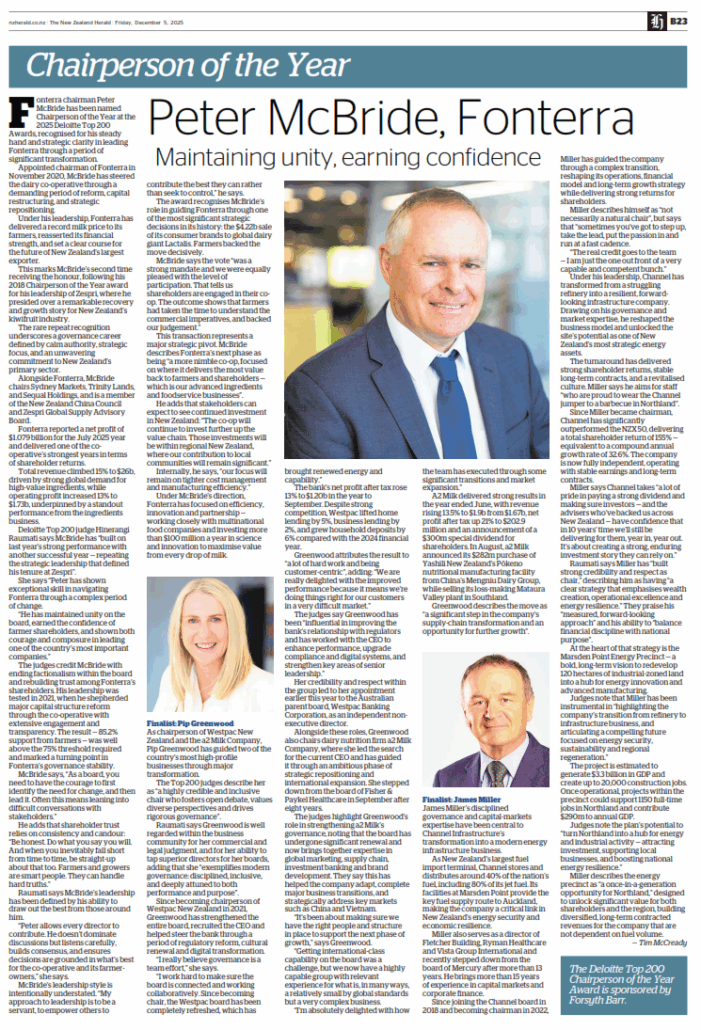
Deloitte Top 200: Fonterra’s Peter McBride wins 2025 chair of the year award
Fonterra chairman Peter McBride has been named Chairperson of the Year at the 2025 Deloitte Top 200 Awards, recognised for his steady hand and strategic clarity in leading Fonterra through a period of significant transformation.
Appointed chairman of Fonterra in November 2020, McBride has steered the dairy co-operative through a demanding period of reform, capital restructuring, and strategic repositioning.
Under his leadership, Fonterra has delivered a record milk price to its farmers, reasserted its financial strength, and set a clear course for the future of New Zealand’s largest exporter.
This marks McBride’s second time receiving the honour, following his 2018 Chairperson of the Year award for his leadership of Zespri, where he presided over a remarkable recovery and growth story for New Zealand’s kiwifruit industry.
The rare repeat recognition underscores a governance career defined by calm authority, strategic focus, and an unwavering commitment to New Zealand’s primary sector.
Alongside Fonterra, McBride chairs Sydney Markets, Trinity Lands, and Sequal Holdings, and is a member of the New Zealand China Council and Zespri Global Supply Advisory Board.
Fonterra reported a net profit of $1.079 billion for the July 2025 year, maintaining its milk price forecasts and delivering one of the co-operative’s strongest years in terms of shareholder returns.
Total revenue climbed 15% to $26b, driven by strong global demand for high-value ingredients, while operating profit increased 13% to $1.73b, underpinned by a standout performance from the ingredients business.
She says, “Peter has shown exceptional skill in navigating Fonterra through a complex period of change.
“He has maintained unity on the board, earned the confidence of farmer shareholders, and shown both courage and composure in leading one of the country’s most important companies.”
The judges credit McBride with ending factionalism within the board and rebuilding trust among Fonterra’s shareholders. His leadership was tested in 2021, when he shepherded major capital structure reform through the cooperative with extensive engagement and transparency. The result – 85.2% support from farmers – was well above the 75% threshold required and marked a turning point in Fonterra’s governance stability.
McBride says, “As a board, you need to have the courage to first identify the need for change, and then lead it. Often this means leaning into difficult conversations with stakeholders.”
He adds that shareholder trust relies on consistency and candour: “Be honest. Do what you say you will. And when you inevitably fall short from time to time, be straight-up about that too. Farmers and growers are smart people. They can handle hard truths.”
Raumati says McBride’s leadership has been defined by his ability to draw out the best from those around him. “Peter allows every director to contribute. He doesn’t dominate discussions
but listens carefully, builds consensus, and ensures decisions are grounded in what’s best for the co-operative and its farmer-owners,” she says.
McBride’s leadership style is intentionally understated. “My approach to leadership is to be a servant, to empower others to contribute the best they can rather than seek to control,” he says. “Surround yourself with the best talent you’ve got available, then encourage and value their contribution.”
The award recognises McBride’s role in guiding Fonterra through one of the most significant strategic decisions in its history: the $4.22b sale of its consumer brands to global dairy giant Lactalis.
Farmers backed the move decisively. McBride says the vote “was a strong mandate and we were equally pleased with the level of participation. That tells us shareholders are engaged in their co-op. The outcome shows that farmers had taken the time to understand the commercial imperatives, and backed our judgement.”
This transaction represents a major strategic pivot. McBride describes Fonterra’s next phase as being “a more nimble co-op, focused on where it delivers the most value back to farmers and shareholders – which is our advanced ingredients and foodservice businesses”.
He adds that stakeholders can expect to see continued investment in New Zealand: “The co-op will continue to invest further up the value chain. Those investments will be within regional New Zealand, where our contribution to local communities will remain significant.”
Internally, he says, “our focus will remain on tighter cost management and manufacturing efficiency.”
Under McBride’s direction, Fonterra has focused on efficiency, innovation and partnership – working closely with multinational food companies and investing more than $100 million a year in science and innovation to maximise value from every drop of milk.
With farmer confidence at its strongest in years and a record milk price underpinning the co-operative’s momentum, McBride’s leadership has positioned Fonterra, and the wider dairy sector, for a decisive next phase of growth.
Forsyth Barr is the sponsor of the Chairperson of the Year award.
Finalist: Pip Greenwood
As chairperson of Westpac New Zealand and the a2 Milk Company, Pip Greenwood has guided two of the country’s most high-profile businesses through major transformation.
The Top 200 judges describe her as “a highly credible and inclusive chair who fosters open debate, values diverse perspectives and drives rigorous governance”.
Raumati says Greenwood is well regarded within the business community for her commercial and legal judgment, and for her ability to tap superior directors for her boards, adding that she “exemplifies modern governance: disciplined, inclusive, and deeply attuned to both performance and purpose”.
Since becoming chairperson of Westpac New Zealand in 2021, Greenwood has strengthened the entire board, recruited the CEO and helped steer the bank through a period of regulatory reform, cultural renewal and digital transformation.
“I really believe governance is a team effort,” she says. “I work hard to make sure the board is connected and working collaboratively. Since becoming chair, the Westpac board has been completely refreshed, which has brought renewed energy and capability.”
The bank’s net profit after tax rose 13% to $1.20b in the year to September. Despite strong competition, Westpac lifted home lending by 5%, business lending by 2%, and grew household deposits by 6% compared with the 2024 financial year.
Greenwood attributes the result to “a lot of hard work and being customer-centric”, adding: “We are really delighted with the improved performance because it means we’re doing things right for our customers in a very difficult market.”
The judges say Greenwood has been “influential in improving the bank’s relationship with regulators and has worked with the CEO to enhance performance, upgrade compliance and digital systems, and strengthen key areas of senior leadership.”
Her credibility and respect within the group led to her appointment earlier this year to the Australian parent board, Westpac Banking Corporation, as an independent non-executive director.
Alongside these roles, Greenwood also chairs dairy nutrition firm a2 Milk Company, where she led the search for the current CEO and has guided it through an ambitious phase of strategic repositioning and international expansion. She stepped down from the board of Fisher & Paykel Healthcare in September after eight years.
The judges highlight Greenwood’s role in strengthening a2 Milk’s governance, noting that the board has undergone significant renewal and now brings together expertise in global marketing, supply chain, investment banking and brand development. They say this has helped the company adapt, complete major business transitions, and strategically address key markets such as China and Vietnam.
“It’s been about making sure we have the right people and structure in place to support the next phase of growth,” says Greenwood.
“Getting international-class capability on the board was a challenge, but we now have a highly capable group with relevant experience for what is, in many ways, a relatively small by global standards but a very complex business.
“I’m absolutely delighted with how the team has executed through some significant transitions and market expansion.”
A2 Milk delivered strong results in the year ended June, with revenue rising 13.5% to $1.9b from $1.67b, net profit after tax up 21% to $202.9 million and an announcement of a $300m special dividend for shareholders.
In August, a2 Milk announced its $282m purchase of Yashili New Zealand’s Pōkeno nutritional manufacturing facility from China’s Mengniu Dairy Group, while selling its loss-making Mataura Valley plant in Southland.
Greenwood describes the move as “a significant step in the company’s supply-chain transformation and an opportunity for further growth”.
She says the transactions form part of a broader strategy to accelerate access to China’s $23b infant formula market by securing valuable product registrations and world-class production capability, adding that “this capability positions a2 Milk well for its next phase of growth”.
Finalist: James Miller
James Miller’s disciplined governance and capital-markets expertise have been central to Channel Infrastructure’s transformation into a modern energy infrastructure business.
As New Zealand’s largest fuel import terminal, Channel stores and distributes around 40% of the nation’s fuel, including 80% of its jet fuel. Its facilities at Marsden Point provide the key fuel supply route to Auckland, making the company a critical link in New Zealand’s energy security and economic resilience.
Miller also serves as a director of Fletcher Building, Ryman Healthcare and Vista Group International and recently stepped down from the board of Mercury after more than 13 years. He brings more than 15 years of experience in capital markets and corporate finance.
Since joining the Channel board in 2018 and becoming chairman in 2022, Miller has guided the company through a complex transition, reshaping its operations, financial model and long-term growth strategy while delivering strong returns for shareholders.
Miller describes himself as “not necessarily a natural chair”, but says that “sometimes you’ve got to step up, take the lead, put the passion in and run at a fast cadence.
“The real credit goes to the team – I am just the one out front of a very capable and competent bunch.”
Under his leadership, Channel has transformed from a struggling refinery into a resilient, forward-looking infrastructure company. Drawing on his governance and market expertise, he reshaped the business model and unlocked the site’s potential as one of New Zealand’s most strategic energy assets. The turnaround has delivered strong shareholder returns, stable long-term contracts, and a revitalised culture – Miller says he aims for staff “who are proud to wear the Channel jumper to a barbecue in Northland”.
Since Miller became chairman, Channel has significantly outperformed the NZX 50, delivering a total shareholder return of 155% – equivalent to a compound annual growth rate of 32.6%. The company is now fully independent, operating with stable earnings and long-term contracts.
Miller says Channel takes “a lot of pride in paying a strong dividend and making sure investors – and the advisers who’ve backed us across New Zealand – have confidence that in 10 years’ time we’ll still be delivering for them, year in, year out. It’s about creating a strong, enduring investment story they can rely on.”
Raumati says Miller has “built strong credibility and respect as chair,” describing him as having “a clear strategy that emphasises wealth creation, operational excellence and energy resilience.” They praise his “measured, forward-looking approach” and his ability to “balance financial discipline with national purpose”.
At the heart of that strategy is the Marsden Point Energy Precinct – a bold, long-term vision to redevelop 120 hectares of industrial-zoned land into a hub for energy innovation and advanced manufacturing. Judges note that Miller has been instrumental in “highlighting the company’s transition from refinery to infrastructure business, and articulating a compelling future focused on energy security, sustainability and regional regeneration.”
The project is estimated to generate $3.3 billion in GDP and create up to 20,000 construction jobs. Once operational, projects within the precinct could support 1150 full-time jobs in Northland and contribute $290 million to annual GDP. Judges note the plan’s potential to “turn Northland into a hub for energy and industrial activity – attracting investment, supporting local businesses, and boosting national energy resilience.”
Miller describes the energy precinct as “a once-in-a-generation opportunity for Northland,” designed to unlock significant value for both shareholders and the region, building diversified, long-term contracted revenues for the company that are not dependent on fuel volume. He says it will be “the first attempt at large-scale re-industrialisation since Muldoon’s ‘think big’ – an ambitious moon shot for a company the size of Channel”.
Under his leadership, judges say Channel has become a model of transformation – commercially successful, strategically ambitious, and vital to New Zealand’s energy future.

