
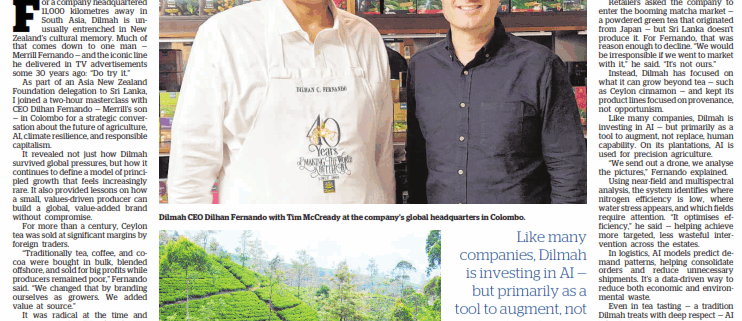
For a company headquartered 11,000 kilometres away in South Asia, Dilmah is unusually entrenched in New Zealand’s cultural memory. Much of that comes down to one man – Merrill Fernando – and the iconic line he delivered in TV advertisements some 30 years ago: “Do try it.”
As part of an Asia New Zealand Foundation delegation to Sri Lanka, I joined a two-hour masterclass with CEO Dilhan Fernando – Merrill’s son – in Colombo for a strategic conversation about the future of agriculture, AI, climate resilience, and responsible capitalism.
It was a session that revealed not just how Dilmah survived global pressures, but how it continues to define a model of principled growth that feels increasingly rare. It also provided lessons for New Zealand on how a small, values-driven producer can build a global, value-added brand without compromise.
For more than a century, Ceylon tea was sold at significant margins by foreign traders.
That simple act was radical at the time and remains central to Dilmah’s identity. It’s a mindset he says New Zealanders instinctively understand.
“New Zealanders understand the connection between nature and taste,” said Fernando. “While the importance of ingredients is shared by your wine and dairy industries, around the world I see that respect for artisanship and for ingredients disappearing, sacrificed to discounts and so on.”
Many organisations have been softening or retreating from environmental, social, and governance (ESG) commitments recently, driven by regulatory uncertainty, political pushback, and rising scepticism about real-world impact and costs. Yet Dilmah has held firm – even when it costs.
“Of course, we took the logical step and walked away”.
The decision significantly dropped Dilmah’s market share overnight, but for Fernando, the company’s purpose was non-negotiable.
“Most CEOs have a three-month timeframe. But we think in generations. We are responsible for an ecosystem that includes people and nature.”
Last year was Dilmah’s worst on record for profit – yet it was its greatest for impact.
More than one billion Sri Lankan rupees were invested through its foundation in education, healthcare, disability services, climate science, food programmes, and Sri Lanka’s post-conflict rehabilitation.
“Success is important,” said Fernando. “But significance is success expressed in the lives of others.”
The commitment extends beyond Sri Lanka. “We work in New Zealand with hospice, with the homeless through different organisations,” he said. “In Australia as well, through the Salvation Army, with people struggling with substance abuse and with the homeless.”
Together, these efforts shape a view of business that goes beyond profit. “You realise the purpose of business,” Fernando said. “And you understand what really motivates a business to do more.”
But he was also frank about the pressure ethical businesses face. “The challenge businesses have in doing the right thing today is something exceptional.”
He outlined the realities of sustainable farming: “Looking after the soil, using biochar, biological control for pest management, agroforestry methods. Unfortunately, when you do the right thing, you generally pay a high price for it.”
And yet, that struggle is central to Dilmah’s identity. “It motivates us,” he said simply. “It makes us leaner, fitter.”
Dilmah’s approach to product development also reflects a refusal to compromise.
Retailers asked the company to enter the booming matcha market – a powdered green tea that originated from Japan – but Sri Lanka doesn’t produce it. For Fernando, that was reason enough to decline.
“We would be irresponsible if we went to market with it,” he said. “It’s not ours.”
Instead, Dilmah has focused on what it can grow beyond tea – such as Ceylon cinnamon – and kept its product lines focused on provenance, not opportunism.
Like many companies, Dilmah is investing in AI – but primarily as a tool to augment, not replace, human capability.
On its plantations, AI is used for precision agriculture. “We send out a drone, we analyse the pictures,” Fernando explained. Using near-field and multispectral analysis, the system identifies where nitrogen efficiency is low, where water stress appears, and which fields require attention. “It optimises efficiency,” he said – helping achieve more targeted, less wasteful intervention across the estates.
In logistics, AI models predict demand patterns, helping consolidate orders and reduce unnecessary shipments. It’s a data-driven way to reduce both economic and environmental waste.
Even in tea tasting – a tradition Dilmah treats with deep respect – AI is beginning to play a supporting role. Dilmah’s team tastes around 12,000 teas each week, selecting only the best for its range.
“We use AI to augment that,” Fernando said. Liquor from each batch is run through hyperspectral analysis, creating detailed flavour profiles. The goal is to “create a flavour map” of the many terroirs across the island. “It’s not a replacement for tasters, but another element to support them in their evaluation.”
In a global market where it’s becoming easier to dilute principles than hold them, Dilmah has built a business by refusing to compromise.
Thirty years after Merrill Fernando first invited New Zealanders to “Do try it”, the line still resonates – not only as a tagline for tea, but as a challenge to the business world.
Tim McCready joined the Asia New Zealand Foundation’s delegation to Sri Lanka.

Tourism and international education were among the hardest-hit sectors during the pandemic. While global travel has largely rebounded, New Zealand’s recovery in the China market continues to lag behind.
What’s holding us back, and how do we turn it around?
In this session, Lisa Li MNZM (China Travel Service), Professor Dawn Freshwater (Vice Chancellor, University of Auckland), Carrie Hurihanganui (Chief Executive, Auckland Airport) and Jessica Miao (United Media Solution) share insights on how the landscape has shifted, explore strategies to reignite growth, and discuss what a sustainable rebound to pre-pandemic levels looks like.
Moderator: Tim McCready, Summit MC
—
The 2025 China Business Summit was held on 18 July 2025 at Cordis, Auckland.
Brought to you by NZ INC. and Auckland Business Chamber.

I enjoyed joining Anna Thomas on RNZ’s Summer Times show this morning to chat about my recent visit to Hong Kong for the Asian Financial Forum (AFF). Our discussion covered:
📈Cautious optimism in the financial sector: Despite the uncertainty looming over markets caused by the Trump administration, there’s a prevailing sense of confidence in global markets.
🌏Markets to watch: Southeast Asia and the Middle East stood out at the Forum as hotspots for growth and investment opportunities.
🤖AI’s impact on finance: Artificial intelligence is transforming the financial sector, from predicting trends and outperforming humans, to making financial services more accessible to everyday investors.
🛍️Changing shopping trends: Many Hong Kong locals now head to mainland China for shopping, dining and even dental work – thanks to the convenience of high-speed trains and the allure of lower prices and wider options across the border.
🦢The (non-work) highlight: Of course: food! Including a comparison of budget vs. high-end roast goose. (Spoiler: the budget spot came out on top!)

Over the past five years, New Zealand’s economic ties with Asean (the Association of Southeast Asian Nations) have undergone significant growth, from $17.15 billion in 2017 to $27.42b in 2022.
With 10 member states, the union is New Zealand’s third-largest trading partner — we now trade more in a week with Asean than we did in an entire year in the early 1970s.
The National-led Government has set an ambitious trade goal to double the value of our exports within a decade. Despite the region navigating the same economic challenges that echo worldwide, it is clear Asean will be an important component in New Zealand reaching its lofty ambitions.
The NZ Asean Business Alliance Conference in Kuala Lumpur last month saw more than 250 attendees gather from across the region and New Zealand to explore the tremendous opportunities inherent in mutual collaboration. There is a keen interest to do more and a desire from Asean to deepen its ties with New Zealand.
An economic anchor
New Zealand’s top trade official, Vangelis Vitalis, told the conference the region has a role as an “economic anchor”, particularly during the past two years where global markets have seen the highest increase in non-tariff and other forms of direct protectionism.
Highlighting the strength of New Zealand’s trade ties with Asean, Vitalis underscored the significance of the rules-based trading system all member nations honour. There hasn’t been a case brought against a member within the Asean Australia New Zealand Free Trade Agreement (AANZFTA) or the Regional Comprehensive Economic Partnership (RCEP). These agreements have led to the near-complete elimination of trade tariffs for New Zealand in the region.
Vitalis gave an example of how the rules matter and they make a difference to business: “In 2021, we estimated across the Apec region that it was taking up to eight days for products to cross the border. That does not apply between Asean members and New Zealand.
“We have a commitment to move products within 48 hours across our customs borders, and the recent upgrade of the AANZFTA has delivered a commitment of six hours for chilled and high-quality fresh produce. That is a significant advantage that we enjoy in each other’s markets over and above our competitors.”
Next generation of trade
Professorial chair in business in Asia and Director of the Southeast Asia Centre of Asia-Pacific Excellence, Professor Siah Hwee Ang, stressed the pivotal role of Asean in shaping the future of New Zealand’s trade, pointing to the age of its population as an important indicator.
“Two of the largest countries in Asean — the Philippines and Vietnam — have a median age less than 30, and most other nations are not much older,” he said.
“That demographic profile gives access to a substantial number of current and future customers, providing markets that offer 10-20 years of growth potential.”
The digital economy is a particularly prominent area of opportunity for New Zealand, fuelled by Asean’s young population and the rapid adoption of smartphones among the expanding middle class. Also notable is the health and wellness sector, which has emerged as a fast-growing area in the aftermath of the pandemic.
Deputy Minister of Investment, Trade and Industry for Malaysia, Liew Chin Tong, emphasised the pro-active moves global businesses are making to mitigate against ongoing geopolitical uncertainties by adopting “friend-shoring”. This strategic shift involves relocating manufacturing operations to countries viewed as political and economic allies, with India and Asean gaining in prominence.
“Southeast Asia is geopolitically a middle ground,” he said.
“By building a strong middle class in the years to come, it will not just be a production site, but it will be a major market for global businesses.”
Malaysia — a gateway
With a population of almost 34 million and one of Asean’s fastest-growing countries, Malaysia is a large, dynamic market, that is easily accessible to business.
Its blend of Malay, Chinese, Indian, and European cultures is unique. Impressive shopping centres and towering skyscrapers, including the Petronas twin towers, dot the landscape, interspersed with colonial buildings.
The Commonwealth member has a political structure and legal framework largely based on British systems. Its cost-effectiveness, central location and the prevalence of English used in business makes it a great launchpad for expansion into the region.
While many attendees at the conference had not yet visited New Zealand, they had an admiration for and interest in our country and a keen desire to engage in business with us.
Some of this can be traced back to the Colombo Plan, which brought Malaysians to New Zealand for education. Today, many of them hold senior positions in business and government, bringing a valuable network that encourages bilateral collaboration and favourability towards New Zealand that has not been taken advantage of.
Emerging sustainability
What surprised me in Malaysia was the pervasive use of plastic bags. They are prolific at grocery stores, food stalls and markets. Even drinks are served container less in bags.
Despite this cultural norm, the Malaysian Government has committed to phase out plastic bags by 2025. This reflects the increasing environmental awareness in the region and a heightened focus on climate change.
Some of Asean’s largest cities — Jakarta, Bangkok, Manila and Ho Chi Minh City — are at severe risk of permanent flooding if ocean levels continue to rise.
Nine out of 10 countries in the region have committed to achieving net-zero by 2060 or sooner.
During the conference, delegates expressed interest in technologies and services New Zealand could provide in terms of renewable energy and carbon reduction technologies — yet another promising area to help New Zealand meet its ambitious new trade goals!
· The Association of Southeast Asian Nations (Asean) is a union of 10 sovereign states in Southeast Asia: Brunei, Cambodia, Indonesia, Laos, Malaysia, Myanmar, the Philippines, Singapore, Thailand, and Vietnam.
· Tim McCready was a guest of the Southeast Asia Centre of Asia-Pacific Excellence and the Malaysia NZ Chamber of Commerce.

New Zealand’s thriving tourism and export education links with China were heavily impacted during the pandemic years, enduring significant challenges and setbacks. The reopening of borders has seen a remarkable revitalisation of these connections. The return of foreign tourists has been a prominent bright spot for New Zealand’s economy, and there has been a notable increase in study visa approvals, particularly for universities. This panel will share perspectives on the changed landscape, including new strategies adopted to rebuild business, and the inspiring wins and war stories that have emerged along the way, showcasing the resilience and adaptability of the sectors.


Without viewing at full resolution it is difficult to make out the names of the 53 volcanoes. They are, in order:


http://bit.ly/2mkaDme