Eden Park boss urges Auckland to think bigger

Eden Park boss urges Auckland to think bigger
Tim McCready

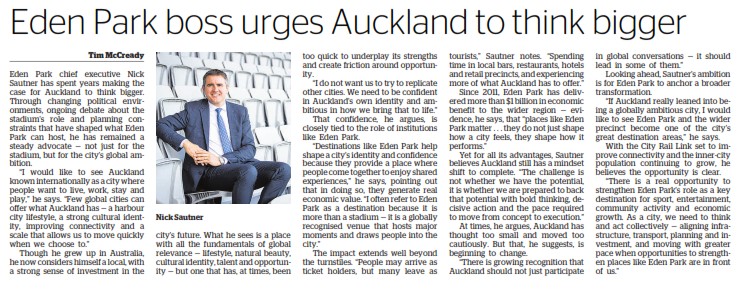
Eden Park chief executive Nick Sautner has spent years making the case for Auckland to think bigger. Through changing political environments, ongoing debate about the stadium’s role and planning constraints that have shaped what Eden Park can host, he has remained a steady advocate — not just for the stadium, but for the city’s global ambition.

“I would like to see Auckland known internationally as a city where people want to live, work, stay and play,” he says. “Few global cities can offer what Auckland has — a harbour city lifestyle, a strong cultural identity, improving connectivity and a scale that allows us to move quickly when we choose to.”

Though he grew up in Australia, he now considers himself a local, with a strong sense of investment in the city’s future. What he sees is a place with all the fundamentals of global relevance — lifestyle, natural beauty, cultural identity, talent and opportunity — but one that has, at times, been too quick to underplay its strengths and create friction around opportunity.

“I do not want us to try to replicate other cities. We need to be confident in Auckland’s own identity and ambitious in how we bring that to life.”

That confidence, he argues, is closely tied to the role of institutions like Eden Park.

“Destinations like Eden Park help shape a city’s identity and confidence because they provide a place where people come together to enjoy shared experiences,” he says, pointing out that in doing so, they generate real economic value. “I often refer to Eden Park as a destination because it is more than a stadium — it is a globally recognised venue that hosts major moments and draws people into the city.”

The impact extends well beyond the turnstiles. “People may arrive as ticket holders, but many leave as

tourists,” Sautner notes. “Spending time in local bars, restaurants, hotels and retail precincts, and experiencing more of what Auckland has to offer.”

Since 2011, Eden Park has delivered more than $1 billion in economic benefit to the wider region — evidence, he says, that “places like Eden Park matter . . . they do not just shape how a city feels, they shape how it performs.”

Yet for all its advantages, Sautner believes Auckland still has a mindset shift to complete. “The challenge is not whether we have the potential, it is whether we are prepared to back that potential with bold thinking, decisive action and the pace required to move from concept to execution.”

At times, he argues, Auckland has thought too small and moved too cautiously. But that, he suggests, is beginning to change.

“There is growing recognition that Auckland should not just participate in global conversations — it should lead in some of them.”

Looking ahead, Sautner’s ambition is for Eden Park to anchor a broader transformation.

“If Auckland really leaned into being a globally ambitious city, I would like to see Eden Park and the wider precinct become one of the city’s great destination areas,” he says.

With the City Rail Link set to improve connectivity and the inner-city population continuing to grow, he believes the opportunity is clear.

“There is a real opportunity to strengthen Eden Park’s role as a key destination for sport, entertainment, community activity and economic growth. As a city, we need to think and act collectively — aligning infrastructure, transport, planning and investment, and moving with greater pace when opportunities to strengthen places like Eden Park are in front of us.”
The battle to build a better city

The battle to build a better city
Richard Hills explains his vision for a housing density plan to Tim McCready

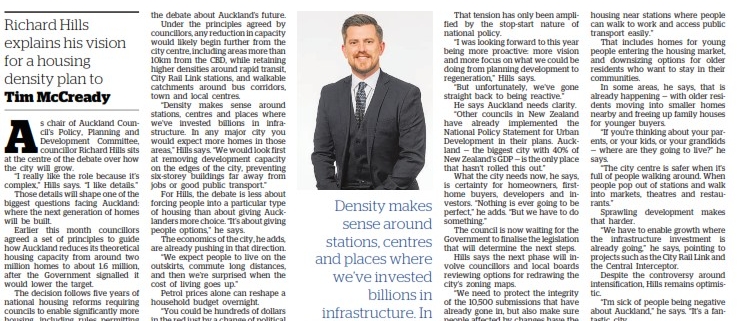
As chair of Auckland Council’s Policy, Planning and Development Committee, councillor Richard Hills sits at the centre of the debate over how the city will grow.

“I really like the role because it’s complex,” Hills says. “I like details.”

Those details will shape one of the biggest questions facing Auckland: where the next generation of homes will be built.

Earlier this month councillors agreed a set of principles to guide how Auckland reduces its theoretical housing capacity from around two million homes to about 1.6 million, after the Government signalled it would lower the target.

The decision follows five years of national housing reforms requiring councils to enable significantly more housing, including rules permitting up to three homes of three storeys on most residential sites.

In Auckland, that meant the city’s planning rules had to demonstrate enough zoning capacity for roughly two million homes.

The figure was never a construction target. It simply represented the number of homes Auckland’s zoning rules could theoretically allow if every eligible site was developed. But it quickly became a lightning rod in the debate about Auckland’s future.

Under the principles agreed by councillors, any reduction in capacity would likely begin further from the city centre, including areas more than 10km from the CBD, while retaining higher densities around rapid transit, City Rail Link stations, and walkable catchments around bus corridors, town and local centres.

“Density makes sense around stations, centres and places where we’ve invested billions in infrastructure. In any major city you would expect more homes in those areas,” Hills says. “We would look first at removing development capacity on the edges of the city, preventing six-storey buildings far away from jobs or good public transport.”

For Hills, the debate is less about forcing people into a particular type of housing than about giving Aucklanders more choice. “It’s about giving people options,” he says.

The economics of the city, he adds, are already pushing in that direction.

“We expect people to live on the outskirts, commute long distances, and then we’re surprised when the cost of living goes up.”

Petrol prices alone can reshape a household budget overnight.

“You could be hundreds of dollars in the red just by a change of political conflict overseas.”

Protections for historic neighbourhoods also remain. “We are still allowed to use qualifying matters, including special character.”

For Hills, one of the hardest parts of the job is navigating the politics.

“It’s not easy because everyone expects you to help their one issue,” he says. “You’re constantly balancing the area you were elected to represent with the whole city.”

That tension has only been amplified by the stop-start nature of national policy.

“I was looking forward to this year being more proactive: more vision and more focus on what we could be doing from planning development to regeneration,” Hills says.

“But unfortunately, we’ve gone straight back to being reactive.”

He says Auckland needs clarity.

“Other councils in New Zealand have already implemented the National Policy Statement for Urban Development in their plans. Auckland — the biggest city with 40% of New Zealand’s GDP — is the only place that hasn’t rolled this out.”

What the city needs now, he says, is certainty for homeowners, firsthome buyers, developers and investors. “Nothing is ever going to be perfect,” he adds. “But we have to do something.”

The council is now waiting for the Government to finalise the legislation that will determine the next steps.

Hills says the next phase will involve councillors and local boards reviewing options for redrawing the city’s zoning maps.

“We need to protect the integrity of the 10,500 submissions that have already gone in, but also make sure people affected by changes have the ability to have their say.”

After that, the independent hearings panel will examine the detail.

“They’ll be measuring it against access to trains, the city centre, jobs, parks and amenity,” Hills says.

Beyond the policy mechanics, he says the debate ultimately comes down to the kind of city Auckland wants to be.

“My vision is a city centre that is full of people, with higher-density housing near stations where people can walk to work and access public transport easily.”

That includes homes for young people entering the housing market, and downsizing options for older residents who want to stay in their communities.

In some areas, he says, that is already happening — with older residents moving into smaller homes nearby and freeing up family houses for younger buyers.

“If you’re thinking about your parents, or your kids, or your grandkids — where are they going to live?” he says.

“The city centre is safer when it’s full of people walking around. When people pop out of stations and walk into markets, theatres and restaurants.”

Sprawling development makes that harder.

“We have to enable growth where the infrastructure investment is already going,” he says, pointing to projects such as the City Rail Link and the Central Interceptor.

Despite the controversy around intensification, Hills remains optimistic.

“I’m sick of people being negative about Auckland,” he says. “It’s a fantastic city.

“Year after year people come here and want to live here. The natural environment — our beaches and our forests — are second to none.”

Ultimately, he says, the challenge is not just building more homes, but building a better city. “We haven’t done infrastructure well for generations,” he says.

“But we’re getting on top of it. We just need to make sure we bring everyone along with us.”

The right mix for success

Tim McCready

Diversity is a productive asset for a globally competitive city, says growth expert

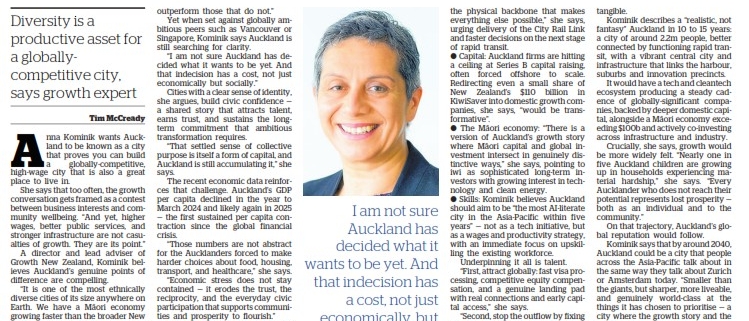
Anna Kominik wants Auckland to be known as a city that proves you can build a globally-competitive, high-wage city that is also a great place to live in.

She says that too often, the growth conversation gets framed as a contest between business interests and community wellbeing. “And yet, higher wages, better public services, and stronger infrastructure are not casualties of growth. They are its point.”

A director and lead adviser of Growth New Zealand, Kominik believes Auckland’s genuine points of difference are compelling.

“It is one of the most ethnically diverse cities of its size anywhere on Earth. We have a Māori economy growing faster than the broader New Zealand economy, representing a distinctive model of indigenous capitalism that the world is increasingly admiring. And we have a disproportionate track record of producing world-class companies.”

Kominik says that connecting all this is Auckland’s diversity, which she says is a productive asset, not just a social virtue. “Cities that unlock the full creative and economic potential of all their people consistently outperform those that do not.”

Yet when set against globally ambitious peers such as Vancouver or Singapore, Kominik says Auckland is still searching for clarity. “I am not sure Auckland has decided what it wants to be yet. And that indecision has a cost, not just economically but socially.”

Cities with a clear sense of identity, she argues, build civic confidence — a shared story that attracts talent, earns trust, and sustains the longterm commitment that ambitious transformation requires.

“That settled sense of collective purpose is itself a form of capital, and Auckland is still accumulating it,” she says.

The recent economic data reinforces that challenge. Auckland’s GDP per capita declined in the year to March 2024 and likely again in 2025 — the first sustained per capita contraction since the global financial crisis.

“Those numbers are not abstract for the Aucklanders forced to make harder choices about food, housing, transport, and healthcare,” she says.

“Economic stress does not stay contained — it erodes the trust, the reciprocity, and the everyday civic participation that supports communities and prosperity to flourish.”

Infrastructure gaps compound the issue. Kominik points to delays in rapid transit, long-running uncertainty over the port, and a shortage of growth-stage capital that pushes successful companies offshore.

Against that backdrop, she argues Auckland needs to treat growth as a system rather than a set of isolated fixes.

“You cannot fix capital markets without fixing talent. You cannot retain talent without fixing housing. You cannot attract globally ambitious founders without the infrastructure that makes a city worth living in.”

She points to several priorities:

  • Infrastructure: “Productive cities are built around public transport as the physical backbone that makes everything else possible,” she says, urging delivery of the City Rail Link and faster decisions on the next stage of rapid transit.
  • Capital: Auckland firms are hitting a ceiling at Series B capital raising, often forced offshore to scale. Redirecting even a small share of New Zealand’s $110 billion in KiwiSaver into domestic growth companies, she says, “would be transformative”.
  • The Māori economy: “There is a version of Auckland’s growth story where Ma ¯ ori capital and global investment intersect in genuinely distinctive ways,” she says, pointing to iwi as sophisticated long-term investors with growing interest in technology and clean energy.
  • Skills: Kominik believes Auckland should aim to be “the most AI-literate city in the Asia-Pacific within five years” — not as a tech initiative, but as a wages and productivity strategy, with an immediate focus on upskilling the existing workforce.

Underpinning it all is talent.

“First, attract globally: fast visa processing, competitive equity compensation, and a genuine landing pad with real connections and early capital access,” she says.

“Second, stop the outflow by fixing structural settings around tax, housing and services, that deter people from staying; and third, unlock the talent that already exists across our city and in the Auckland diaspora.”

New Zealand’s large offshore population, she says, should be treated as an economic network rather than a loss. “At the end of the day, we want New Zealand to be a place that our children want to stay in.” If those settings shift, the upside is tangible.

Kominik describes a “realistic, not fantasy” Auckland in 10 to 15 years: a city of around 2.2m people, better connected by functioning rapid transit, with a vibrant central city and infrastructure that links the harbour, suburbs and innovation precincts.

It would have a tech and cleantech ecosystem producing a steady cadence of globally-significant companies, backed by deeper domestic capital, alongside a Māori economy exceeding $100b and actively co-investing across infrastructure and industry.

Crucially, she says, growth would be more widely felt. “Nearly one in five Auckland children are growing up in households experiencing material hardship,” she says. “Every Aucklander who does not reach their potential represents lost prosperity — both as an individual and to the community.”

On that trajectory, Auckland’s global reputation would follow.

Kominik says that by around 2040, Auckland could be a city that people across the Asia-Pacific talk about in the same way they talk about Zurich or Amsterdam today. “Smaller than the giants, but sharper, more liveable, and genuinely world-class at the things it has chosen to prioritise — a city where the growth story and the wellbeing story are the same.”

Anna Kominik is an independent director, investor, adviser and innovator who recently made Auckland home. She is part of Growth New Zealand, a non-partisan group of passionate and experienced New Zealanders promoting a future where growth means lasting economic, social and environmental wellbeing, shared across the whole community.