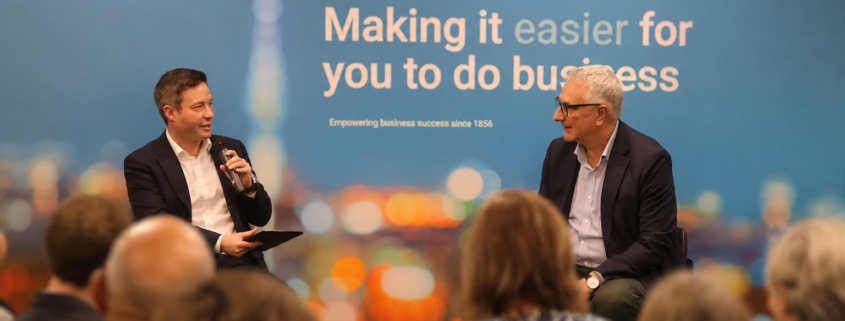

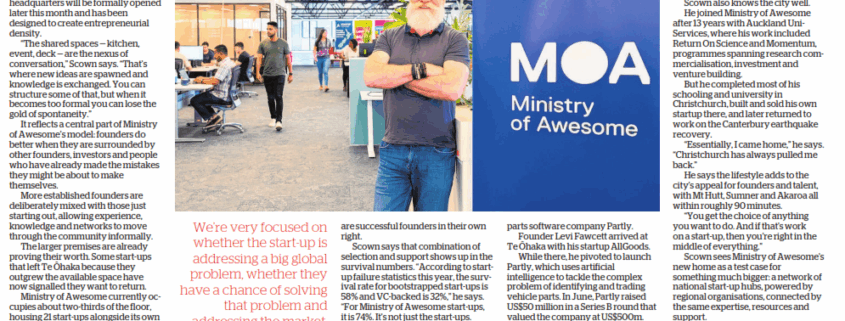
Ministry of Awesome has tripled its Christchurch footprint. Chief executive Graham Scown tells Tim McCready he sees it as economic infrastructure needed by New Zealand’s start-ups.
There are deliberately few walls in Ministry of Awesome’s new Christchurch home.
The start-up organisation has moved from the 400sq m Te Ōhaka space it shared with Ara Institute of Canterbury into an 1100sq m floor on Colombo St in the centre of Christchurch.
For Graham Scown, who took over as Ministry of Awesome chief executive last year, the threefold increase is about much more than fitting in more desks. The new headquarters will be formally opened later this month and has been designed to create entrepreneurial density.
“The shared spaces – kitchen, event, deck – are the nexus of conversation,” Scown says. “That’s where new ideas are spawned and knowledge is exchanged. You can structure some of that, but when it becomes too formal you can lose the gold of spontaneity.”
It reflects a central part of Ministry of Awesome’s model: founders do better when they are surrounded by other founders, investors and people who have already made the mistakes they might be about to make themselves.
More established founders are deliberately mixed with those just starting out, allowing experience, knowledge and networks to move through the community informally.
The larger premises are already proving their worth. Some start-ups that left Te Ōhaka because they outgrew the available space have now signalled they want to return.
Ministry of Awesome currently occupies about two-thirds of the floor, housing 21 start-ups alongside its own team – around 60 people in total. Once the remaining space is opened, Scown says capacity will grow to more than 100.
Ministry of Awesome was founded in 2012, when post-earthquake Christchurch was searching for ways to rebuild differently. Scown says its purpose has not changed so much as become more focused.
“In 2012, Ministry of Awesome was founded specifically to provide a mechanism for Christchurch people to address ways they could see the city being rebuilt with innovation at the forefront.”
Today he describes it as New Zealand’s biggest start-up organisation: headquartered in Christchurch, but increasingly national in reach.
“We’re very focused on whether the start-up is addressing a big global problem, whether they have a chance of solving that problem and addressing the market, and whether the company can scale internationally.”
The programmes it offers are sector-agnostic. What matters is whether a business has the potential to solve a sizeable problem and grow well beyond the New Zealand market.
Its flagship programme, Founder Catalyst, works intensively with around 40 to 60 scalable start-ups a year. Startup Aotearoa, delivered in partnership with Wellington’s Creative HQ, provides early-stage founder coaching around the country.
Ministry of Awesome is particular about who makes it into Founder Catalyst. Its entrepreneurs-in-residence, who act as honorary co-founders to start-ups in the programme, are successful founders in their own right.
Scown says that combination of selection and support shows up in the survival numbers. “According to start-up failure statistics this year, the survival rate for bootstrapped start-ups is 58% and VC-backed is 32%,” he says. “For Ministry of Awesome start-ups, it is 74%.”
“It’s not just the start-ups. There’s something special about the support and the expertise that we bring in,” he says.
Ministry of Awesome has supported more than 330 start-ups, which have collectively raised more than $345 million in private capital and $31m in non-dilutive funding, generated more than $93m in annual revenue and created more than 1080 jobs.
Its support base spans local and central government and the private sector. ChristchurchNZ is a key local partner, the Ministry of Business, Innovation and Employment supports its national programmes, and Ministry of Awesome also works with Auckland Council through GridAKL and has a major corporate partnership with Kiwibank.
Events form another strand of its work, ranging from Coffee & Jam meet-ups to Electrify Aotearoa, its growing national event focused on women founders and investors.
One of Ministry of Awesome’s most successful alumni is automotive parts software company Partly.
Founder Levi Fawcett arrived at Te Ōhaka with his startup AllGoods. While there, he pivoted to launch Partly, which uses artificial intelligence to tackle the complex problem of identifying and trading vehicle parts. In June, Partly raised US$50 million in a Series B round that valued the company at US$500m.
Fawcett is now on the Ministry of Awesome board of trustees. For Scown, stories such as Partly’s demonstrate the value of putting ambitious founders around each other.
Scown says New Zealand’s geography makes start-up density harder to achieve naturally than in many of the international innovation models.
“Governments of various flavours over the years have been really interested in overseas models: the Helsinki model, the Danish model, the Singapore model, the Israeli model and, lately, the Waterloo model.
“But New Zealand is uniquely different. We take a similar-sized population and geographically distribute it over a very long country, in places that are annoying to get to.”
His answer is to deliberately create some of the density New Zealand lacks.
Christchurch provides a particularly good testing ground. Its relatively compact central city allows founders, businesses, co-working spaces and start-up support organisations to congregate within a much tighter footprint than is possible in somewhere like Auckland.
Scown also knows the city well. He joined Ministry of Awesome after 13 years with Auckland UniServices, where his work included Return On Science and Momentum, programmes spanning research commercialisation, investment and venture building.
But he completed most of his schooling and university in Christchurch, built and sold his own startup there, and later returned to work on the Canterbury earthquake recovery.
“Essentially, I came home,” he says. “Christchurch has always pulled me back.”
He says the lifestyle adds to the city’s appeal for founders and talent, with Mt Hutt, Sumner and Akaroa all within roughly 90 minutes.
“You get the choice of anything you want to do. And if that’s work on a start-up, then you’re right in the middle of everything.”
Scown sees Ministry of Awesome’s new home as a test case for something much bigger: a network of national start-up hubs, powered by regional organisations, connected by the same expertise, resources and support.
He describes such spaces as “economic infrastructure” – shared assets and networks that successive generations of companies can draw on rather than having to recreate them around every individual start-up.
“The hypothesis is that a significant floor space, with all the right founders and all of the right support mechanisms in place, becomes a really critical piece of economic infrastructure for New Zealand.”
His ambition is for Christchurch to become the first example of a model that could be adapted around the country with other ecosystem partners.
“That’s when I think you’ll start to see a New Zealand model emerge that is of real interest to central government, rather than looking at yet another overseas model to try and copy.”
For an organisation born from Christchurch’s need to rebuild, the next experiment is whether the city can provide a blueprint for building something much bigger.
Tim McCready
New Zealand’s food and fibre sector could disappear tomorrow and global markets would barely notice.
That was the provocation from one industry leader during this year’s KPMG Agribusiness Agenda roundtable discussions on international markets.
They qualified it: while New Zealand is a relatively small cog in an enormous system, it would absolutely be missed.
Customers do not choose New Zealand because we are the cheapest producer. They choose New Zealand for attributes that are harder to replicate, including its stability, world-class biosecurity, sustainable production systems, adherence to international trade rules, high food safety standards and reputation as an ethical and transparent partner.
Those attributes have earned New Zealand a place in global value chains. The challenge now, as the Agribusiness Agenda outlines, is for the food and fibre sector to build on these strengths while continuously evolving to meet the changing needs of our customers.
New Zealand will never compete by being the biggest producer. New Zealand is a small producer in global terms and geographically distant from almost every customer.
There is consensus among contributors that the peak of globalisation has passed. Governments, rather than markets, are setting the rules for global trade, and geopolitical shifts have become one of the most significant risks exporters now face.
Against that backdrop, several argue that New Zealand’s stability, biosecurity status and reputation for playing by the rules matter as much to buyers as anything coming off the farm.
That conversation sits behind the entire 2026 Agribusiness Agenda.
KPMG challenged contributors with a broad question: whether existing settings remain fit for purpose, or whether more fundamental shifts are required to secure long-term success.
Around three-quarters of contributors favour change over the status quo, noting that current settings and processes may constrain the sector’s potential as it responds to disruption such as climate change and geopolitical shifts.
This doesn’t mean abandoning New Zealand’s strengths. Rather, contributors repeatedly argue for continuous evolution – ensuring products, production systems and business models evolve alongside customer demand instead of relying on historical competitive advantages.
The report identifies 24 “global future shapers” that will reshape food systems over the next quarter century.
They range from geopolitical fragmentation, cyber risk and changing demographics, to AI, water scarcity, climate change and the growing convergence of food and pharmaceuticals.
Others point to the integration of nature into business models – including the rise of the circular bioeconomy – and increasing pressure on ageing infrastructure.
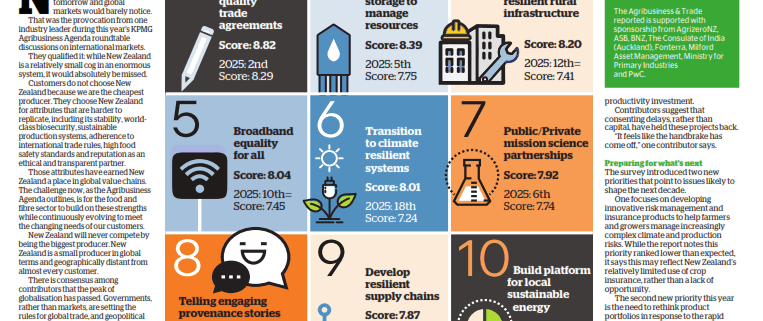
Each year, KPMG asks contributors to score a set of priorities for the organisations they represent in the food and fibre sector. This year, 105 leaders worked through 39 priorities on a scale of 1 to 10, with 10 indicating that the issue is considered a critical priority.
For the 16th consecutive year, world-class biosecurity remains the sector’s highest priority. This year’s score (9.40 out of 10) is the highest score reported for any priority since 2018 – the year Mycoplasma bovis and Myrtle Rust pushed biosecurity to an all-time survey record of 9.62, demonstrating the enormous economic cost of a single biosecurity failure.
The concern now is that future incursions become harder to prevent. Increasing international connectivity and evolving production systems create new pathways for pests and diseases to enter New Zealand.
Contributors point out that many of the country’s most important export sectors are built on monocultures, making a single breach a bigger risk to economic resilience than is often acknowledged – and one that alignment between industry and government is critical to managing.
Signing high-quality trade agreements again ranked second in the survey. Contributors also say that existing agreements need to be actively managed and evolve to remain fit for purpose, and investment is required in regulatory systems and infrastructure to ensure organisations can fully utilise the market access already secured.
Several priorities recorded significant movements in this year’s survey, reflecting how leaders see the sector adapting to a more uncertain future.
Resilient rural infrastructure jumped from 12th-equal last year to fourth place.
Contributors link it directly to operational efficiency – and to the sector’s ability to attract the best talent.
Transition to climate-resilient farming systems rose from 18th last year to sixth, a sharp turnaround for a priority that was ranked lowest of all in 2024.
Building a platform for local sustainable energy climbed into the Top 10 for the first time this year, from 27th in its debut year in 2024, to 12th equal last year, to 10th now.
The rise in water storage as a priority reflects a similar shift. It reached third place – its highest ranking since 2013. Contributors frame water infrastructure as a strategic capability that underpins productivity, social licence and diversification, rather than simply a productivity investment.
Contributors suggest that consenting delays, rather than capital, have held these projects back.
“It feels like the handbrake has come off,” one contributor says.
The survey introduced two new priorities that point to issues likely to shape the next decade.
One focuses on developing innovative risk management and insurance products to help farmers and growers manage increasingly complex climate and production risks. While the report notes this priority ranked lower than expected, it says this may reflect New Zealand’s relatively limited use of crop insurance, rather than a lack of opportunity.
The second new priority this year is the need to rethink product portfolios in response to the rapid uptake of GLP-1 weight-loss medicines.
This priority ranked 37th with a score of 6.25 – near the bottom of the survey. The report suggests the ranking may understate the significance of the issue.
Around the world, food companies are already reshaping product portfolios as consumer preferences evolve. For New Zealand, the shift may prove more opportunity than threat. Protein sectors broadly are seen as well placed to benefit, with red meat among those already seeing early demand and pricing effects offshore.
Technology, particularly artificial intelligence, sits beneath many of this year’s priorities.
AI is rapidly changing how global consumer packaged goods companies understand consumers, develop products and forecast demand, contributors say. It is no longer a source of competitive advantage in itself. The report describes it as a “ticket to play” – a capability that organisations must have to remain relevant.
That is the thread running through the entire Agribusiness Agenda.
If New Zealand disappeared tomorrow, the world would continue eating. Global commodity markets would adjust. But customers who value trusted supply, ethical production and dependable partners would notice.
The challenge is ensuring they still notice 25 years from now.
Tim McCready
When conflict in the Middle East threatened to disrupt New Zealand’s fuel supplies, the organisations critical to the country’s trade and international connectivity were forced to confront just how exposed they were.
Fuel tankers continued to arrive, aircraft kept flying and export products remained on the move. But prices surged, shipping routes came under pressure and officials began calculating how long supplies would last, which industries would be prioritised if shortages hit, and how disruption to petrochemicals might spread through the wider economy.
Those questions framed the opening panel at last month’s China Business Summit, where leaders from Fonterra, Air New Zealand, Auckland Airport and the Ministry for Primary Industries described how repeated shocks have changed the way they manage supply chains, markets and China.
Ray Smith, director-general of the Ministry for Primary Industries (MPI), said about 30% of New Zealand’s refined fuel comes from Singapore and 60% from South Korea.
Tankers leave for New Zealand almost every other day, a regular flow that received little attention until it came under threat. “We have talked a lot about transition in our fuel supplies and what we do as we move into a greener world, but all of a sudden fossil fuels were disappearing on us quickly,” Smith said.
“There was huge concern about how we would power up the economy.”
Diesel underpins freight, food production and manufacturing. Jet fuel carries passengers, but it also keeps high-value exports moving as cargo.
The exposure extends beyond fuel.
New Zealand produces about a third of its fertiliser and imports the rest, much of it from the Middle East. Plastics, agrochemicals and pharmaceuticals are also vulnerable to disruption in the petrochemical supply chain.
The Government decided against subsidising fuel prices. Smith, who was seconded from MPI for six weeks to take over operational leadership of the Government’s fuel crisis response, said allowing prices to reflect the shortage encouraged businesses and consumers to consider how much they used.
“If you have a shortage, you want people to think about their consumption levels, which they do not do if the price does not change.”
His greatest concern was for vulnerable domestic producers, including vegetable growers, arable farmers and inshore fishers, who might stop planting or operating if fuel costs climbed too far.
For the aviation sector, the disruption ultimately proved to be a price shock rather than a shortage.
Air New Zealand chief executive Nikhil Ravishankar had just returned from the International Air Transport Association’s (IATA) annual gathering, where airlines were counting an estimated US$100 billion increase in fuel costs and a fall in industry net profit from about US$45b to US$22b.
Despite that hit, he said the mood at IATA was buoyant.
“Everyone realised the fuel supply lines were more robust than anyone had imagined,” Ravishankar said. “This wasn’t a supply crisis as much as a commercial crisis.”
Air New Zealand had recovered between 25% and 40% of its additional fuel costs, but Ravishankar said the airline could not simply pass the full increase on to passengers. “If we kept putting prices up, we would fly empty planes.”
The airline also faces a timing mismatch: tickets can be sold a year before travel, while the fuel is bought when the aircraft flies. Ravishankar said fares could therefore remain elevated for a period as airlines recovered losses and rebuilt their balance sheets for the next disruption.
Auckland Airport chief executive Carrie Hurihanganui said minimum stockholding obligations introduced in recent years have proved their value. These require 24 days of jet fuel to be held within New Zealand, with 10 days close to Auckland Airport.
The requirements provided a buffer, although Hurihanganui said they needed to be kept under review as risks change.
“Volatility is the new norm and we need to adapt.”
That adaptation is becoming embedded in the way major companies operate.
The experience showed how crisis management has become a permanent organisational capability.
Fonterra chief executive Richard Allen said the co-operative had been in a “pseudo-crisis” since Covid first disrupted global trade.
“For the last five years, there has been something to deal with every day: ships running aground, bridges getting hit, wars.”
When the fuel crisis emerged, Fonterra had product on the water heading to the Middle East, including markets where local food production is constrained.
It worked with logistics partners to keep those shipments moving. The cost was significant, but maintaining supply to customers took priority.
Air New Zealand has adopted a similar discipline. Ravishankar described the airline leadership approach as “panic slowly”.
The objective is to contain the problem, make clear who is responsible for managing it, and allow the rest of the airline to continue operating its roughly 500 daily flights.
Engine problems, the flooding of Auckland Airport and the upheaval of Covid have helped build those reflexes.
“Resiliency is the new reliability,” Ravishankar said.
The same capacity to adapt is shaping how the organisations approach China.
The market remains critical to New Zealand, but the competitive environment has changed markedly.
Allen said the Chinese dairy industry has invested in advanced factories and lifted its ability to produce high-quality products locally. Fonterra cannot assume the strategy that worked over the past quarter-century will carry it through the next.
“What worked for the last 20 to 25 years is unlikely to work for the next 25 without modifications,” he said.
Fonterra’s strategy is focused on ingredients and food service, retaining control of the Anchor brand in China, localising its route to market and concentrating on areas where New Zealand can command a premium.
It also sees further growth beyond China’s tier-one and tier-two cities as urbanisation spreads, although Allen stresses that additional volume must deliver sustainable returns.
“If you focus just on volume without understanding long-term economics in a market like China, it can kill you,” he said. “We must find our differentiation point.”
Smith said New Zealand’s regulatory relationship with China has also matured.
MPI this year marks 20 years of formal engagement with China, supported by relationships across its customs, agriculture, market regulation and forestry agencies.
The relationship is built on “trust, confidence and respect”, Smith said, and gave New Zealand access many competing countries did not enjoy.
That trust carries direct commercial value. New Zealand officials are permitted to audit infant formula producers on China’s behalf, helping protect an export trade worth about $2 billion.
China’s food production and safety systems have also advanced. Where a Western label once carried an automatic advantage, Smith said products made in China increasingly enjoy the same standing with consumers.
New Zealand exporters now have to compete more sharply on brand, provenance and health attributes.
Diversification provides another layer of resilience.
Primary sector exports to China peaked at about 35% in 2023 and have since eased to around 30%.
Smith identified forestry as the clearest concentration risk, with 54% of its export revenue tied to China and demand exposed to the country’s subdued residential construction market.
Weakness in Chinese construction was already being felt through plant closures in New Zealand, he said.
The India trade agreement provides another avenue for growth. Air New Zealand has signed a memorandum of understanding with Air India, established code-sharing arrangements and applied for joint venture authorisation as it plans for direct services.
But diversification does not mean stepping back from China.
Air New Zealand has consolidated its capacity there and, alongside alliance partners, connects into about 30 Chinese cities. It is also exploring links with ferry companies and high-speed rail operators, particularly in the Greater Bay Area.
Closer to home, Air New Zealand and Auckland Airport see an opportunity to deepen Auckland’s role as a connecting hub.
Hurihanganui said six airlines now link Auckland with seven Chinese destinations. The airport has expanded its transit footprint by 80% and handles about 700,000 transit passengers.
“We are not going to be another Singapore, but Auckland can be the best-positioned secondary hub for the Australasian area,” she said.
China Eastern’s Shanghai-Auckland-Buenos Aires service demonstrates the potential. Since the route was introduced, direct Shanghai-Auckland passenger numbers have increased by 25% and cargo tonnage to South America has risen by more than 120%.
For Ravishankar, New Zealand’s distance can become an advantage while aircraft remain unable to fly non-stop from China or Southeast Asia to South America. Auckland provides a practical connection between the two regions.
The wider opportunity lies in moving faster and being more precise about where New Zealand can add value. Hurihanganui said New Zealand needs to match the speed at which China moves, while Ravishankar sees potential for companies from both countries to co-develop and co-innovate. Smith pointed to advanced nutrition and
China’s green transition, and Allen stressed the need to identify areas where New Zealand can maintain a genuine advantage.
The fuel shock exposed how narrow the margins keeping New Zealand’s economy moving can be. Greater resilience into the future will come from stronger relationships, more routes to market and a clearer understanding of where New Zealand can still command a premium.
For Allen, uncertainty now sits at the centre of the strategy rather than at its edges.
“We are building a strategy that expects uncertainty and volatility,” he said, “and figuring out how to turn that into opportunity.”

A first-hand account of the Chartered Member Assessment, with practical tips on expectations and how to approach it.
I’ve lost count of how many people have asked me about the Institute of Directors Company Directors’ Course (CDC) since I completed it – and even more have asked what’s actually involved in the optional Chartered Member Assessment (CMA) that follows.
What surprised me was how many people completed the CDC but had not gone on to do the assessment. Most weren’t sure what to expect, so it was easy to put it off. I found myself in the same position, reaching out to understand how the process worked.
If you’re looking for the same, here it is.
The CDC is the best professional development I have done. It is five and a half intensive days covering governance, strategy, finance, law and culture, brought to life through boardroom simulations that feel surprisingly real.
The days are long. Mock board meetings run into the evenings and board packs that need to be read before the next morning arrive overnight. You need to dedicate the full week to it. The facilitators are excellent, so it is not as daunting as it sounds.
What also makes it worthwhile is the cohort. The CDC brings together a diverse group: experienced directors alongside those just starting out, from the private sector, public sector and elected office. You build strong connections over the week.
For those who complete the CDC, the next step is the CMA, which leads to the ‘CMInstD’ designation. If you begin the process within six months of completing the CDC, it is included in the course fee.
With Christmas approaching, I made the mistake of deferring the exam until the final week of the six-month window. If you have not sat a formal exam since university, it can feel like a nerve-wracking prospect.
The exam is held at an official examination centre. When I arrived on a Saturday afternoon, there were about a dozen people sitting exams – most completing electrician qualifications. One other person from my CDC cohort was there too, which was reassuring.
The exam is open book. You are given a clean copy of the Four Pillars of Governance Best Practice and the relevant sections of the Companies Act. What you don’t have is time to rely on them. Sixty multiple-choice questions in 75 minutes gives enough time to think, but not enough to search.
The questions cover four areas: corporate governance (12 questions), finance (21 questions), law and compliance (20 questions), and risk governance (seven questions).
The system is straightforward. It shows your remaining time, which questions you have answered, which you have bookmarked and which are still blank. That visibility is helpful when you are under pressure.
A few things I have been telling others preparing to sit it:
Do a first pass at pace. Bookmark the questions you are uncertain about and come back to them.
Know the index of the Four Pillars. On your second sweep, use the pen and paper provided to note relevant page numbers from the book’s index. Some questions required me to cross-reference more than one section and writing the page numbers down avoided constant flipping back to the index.
Brush up on your financials. Finance accounts for more than a third of the exam and most questions cannot be answered from the Four Pillars. The questions didn’t require calculations, but you need to be comfortable with financial statements and what they are telling you about the business.
I had initially assumed I’d finish with time to spare. In reality, I used almost every minute.
Results arrive by 5pm the same day. Mine came through at 4:57pm. Scoring 92% – well above the 70% pass mark – was a relief.
The assignment
Passing the exam triggers an email from the IoD asking when you would like to receive the assignment. From the date you nominate, you have exactly three weeks to submit.
The assignment is based on a fictitious board pack. You step into the role of a director preparing for a board meeting and respond to five questions across core governance areas.
The word allocation reflects weighting: strategy is 750 words (25%), finance and legal is 600 words (20%), board effectiveness and dynamics is 750 words (25%), and risk and ethics are 450 words each (15% each).
I found it engaging. The more time I spent away from the material, the more I noticed on subsequent reads. The materials are deliberately imperfect. Part of the task is identifying where governance has drifted.
It tests judgement: identifying whether strategy is grounded in reality, whether capital decisions stack up, whether risks have been accounted for, and where board dynamics do not align with good governance practice.
The hardest part for me was the word limit. Three thousand words across five questions, with 10% leeway. It seems generous at first, until you realise every question feels like it deserves more space.
You are asked to think like a director, not write like a novelist. Bullet points are encouraged, but I spent more time editing my responses than writing them – tightening language, prioritising key points and keeping everything focused on governance.
You do not receive a grade. You either pass or you don’t. The marker’s feedback on my assignment noted that I had demonstrated the “depth and breadth of critical thinking in the competencies required of a Chartered Member” and provided “insightful responses at an appropriate governance level in all areas”.
You cannot use the Chartered designation until you hold a qualifying board role, but the assessment does not expire. You can upgrade to Chartered Member when the right opportunity comes along.
For anyone building a governance career, that external validation carries weight. Experienced Chartered Members often say the designation signals that you have done the work, understand the material and can demonstrate it.
The IoD estimates around 30 hours of preparation for the exam and another 15 to 30 hours for the assignment. That feels about right, although I spent longer on the assignment.
If you do the assessment right away while the content is fresh, it is much easier. My advice if you have completed the CDC and have not yet started the assessment: do it sooner rather than later.
If you are weighing up the CDC, the assessment or have questions about either, feel free to get in touch.
Tim McCready MInstD is Director of Business & Entrepreneurship at the Asia New Zealand Foundation. He is also director of CrammedCity Consulting, advising boards, executives and government agencies on strategy, trade and investment. Tim is a columnist for the New Zealand Herald, writing on trade, geopolitics, capital markets and innovation, and is convenor of judges for the 2degrees Auckland Business Awards. He is a Member of the Institute of Directors.
India FTA throws the door wide open for agribusiness opportunities
Trade agreements open doors. The New Zealand-India free trade agreement has thrown one wide open – but people still need to walk through it.
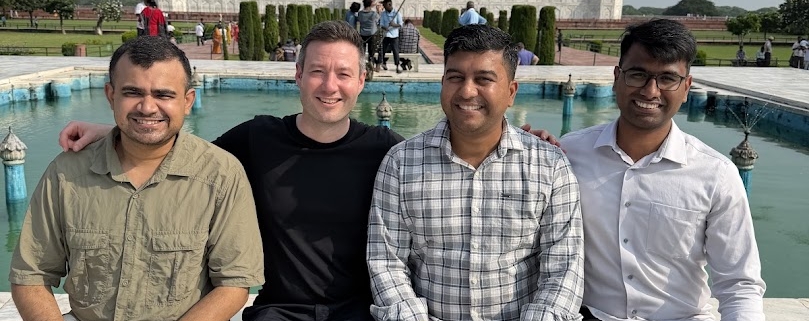
I saw that first-hand last month, accompanying 10 of India’s brightest agribusiness entrepreneurs and business leaders during a week-long visit to New Zealand.
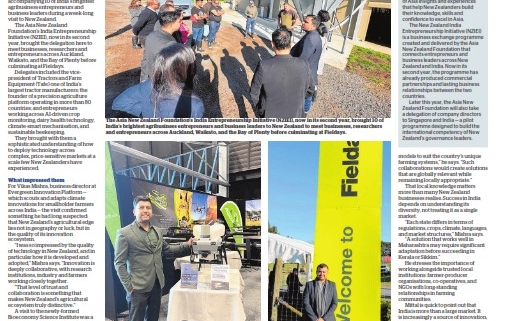
The Asia New Zealand Foundation’s India Entrepreneurship Initiative (NZIEI), now in its second year, brought the delegation here to meet businesses, researchers and entrepreneurs across Auckland, Waikato, and the Bay of Plenty before culminating at Fieldays.
Delegates included the vice-president of Tractors and Farm Equipment (Tafe) one of India’s largest tractor manufacturers; the founder of a precision agriculture platform operating in more than 80 countries; and entrepreneurs working across AI-driven crop monitoring, dairy health technology, climate-smart mechanisation, and sustainable beekeeping.
They brought with them a sophisticated understanding of how to deploy technology across complex, price-sensitive markets at a scale few New Zealanders have experienced.
For Vikas Mishra, business director at Evergreen Innovation Platform – which scouts and adapts climate innovations for smallholder farmers across India – the visit confirmed something he had long suspected: that New Zealand’s agricultural edge lies not in geography or luck, but in the quality of its innovation ecosystem.
“I was so impressed by the quality of technology in New Zealand, and in particular how it is developed and adopted,” Mishra says. “Innovation is deeply collaborative, with research institutions, industry and farmers working closely together.
“That level of trust and collaboration is something that makes New Zealand’s agricultural ecosystem truly distinctive.”
Mishra was impressed that producers are involved in developing new technologies from the outset, testing and refining innovations before they reach the market.
“Rather than being passive end-users, they actively participate in validating innovations, making the final products far more relevant and practical,” he says.
For Pulkit Mittal, vice-president at Tafe, it was the commercial model that stood out.
“New Zealand consistently creates value beyond the farm gate,” he says, citing Zespri and Comvita as examples of how the country turns agricultural science into globally competitive businesses.
“Innovation here is not technology for technology’s sake, but instead it is designed to solve real problems for growers and producers.”
Fieldays made a strong impression too.
Swapnil Jadhav, founder and CEO of Map My Crop, has attended agricultural trade shows in more than 25 countries. He called Fieldays one of the best he has seen – for the technology on display, but also for the setting, the culture, and the willingness of New Zealand farmers to engage with new ideas.
Several memoranda of understanding were signed during the visit, with further partnerships already under negotiation.
Rohan Ursal, who joined last year’s inaugural delegation, has since introduced the New Zealand apple variety Rouge to India, where an entire container sold out in a single day.
He is now importing Royal Gala through his company and is receiving inbound interest from New Zealand growers seeking Indian buyers.
“This year, we have people connecting with us – new suppliers and small growers from New Zealand trying to seek new markets and new buyers like us in India,” Ursal says.
He credits both the FTA and Rouge’s commercial success for the growing interest from New Zealand suppliers.
“In the next five years, I think we will see very good growth in this sector.”
But New Zealand would be making a mistake if it viewed India simply as an export destination. Both Mishra and Mittal were clear that the value runs both ways.
“The opportunities are significant because our strengths are highly complementary,” Mittal says.
“New Zealand brings world-class expertise in dairy, horticulture, sustainability and agricultural science, while India offers scale, manufacturing capability, digital innovation and a rapidly growing agritech ecosystem.”
Mishra sees horticulture innovation as particularly promising.
He suggests technologies developed for New Zealand apple orchards could be adapted for apple growers in Shimla and Kashmir, or for orange farmers in Maharashtra.
“The opportunity lies in developing technologies together and then adapting deployment models to suit the country’s unique farming systems,” he says. “Such collaborations would create solutions that are globally relevant while remaining locally appropriate.”
That local knowledge matters more than many New Zealand businesses realise. Success in India depends on understanding its diversity, not treating it as a single market.
“Each state differs in terms of regulations, crops, climate, languages, and market structures,” Mishra says.
“A solution that works well in Maharashtra may require significant adaptation before succeeding in Kerala or Sikkim.”
He stresses the importance of working alongside trusted local institutions: farmer-producer organisations, co-operatives, and NGOs with long-standing relationships in farming communities.
Mittal is quick to point out that India is more than a large market. It is increasingly a source of innovation, engineering talent and technology solutions.
“The greatest opportunities will come from partnerships and co-development rather than simply exporting products,” he says.
The NZIEI programme is designed to build those relationships. Next year, the Foundation will take a reciprocal delegation of New Zealand businesses to India.
When they go, Mishra has some advice:
“I encourage New Zealand businesses not to underestimate Indian farmers,” he says. “They are remarkably knowledgeable, entrepreneurial, and practical. They quickly recognise technologies that genuinely solve problems – and are equally quick to reject those that do not.”
The free trade agreement has created the opportunity. Whether New Zealand captures it will depend on relationships, trust, and a willingness to see India as a long-term partner rather than just another export market.
The door is open. Now it’s time to walk through it.
The Asia New Zealand Foundation is New Zealand’s leading provider of Asia insights and experiences that help New Zealanders build their knowledge, skills and confidence to excel in Asia.
The New Zealand India Entrepreneurship Initiative (NZIEI) is a business exchange programme created and delivered by the Asia New Zealand Foundation that connects entrepreneurs and business leaders across New Zealand and India. Now in its second year, the programme has already produced commercial partnerships and lasting business relationships between the two countries.
Later this year, the Foundation will also take a delegation of company directors to Singapore and India – a pilot programme designed to build the international competency of New Zealand’s governance leaders.
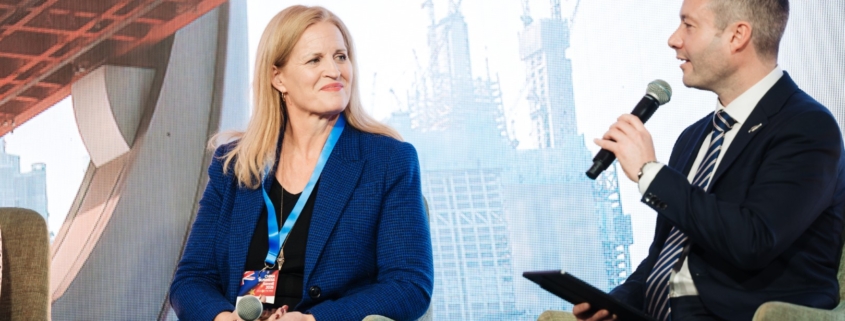
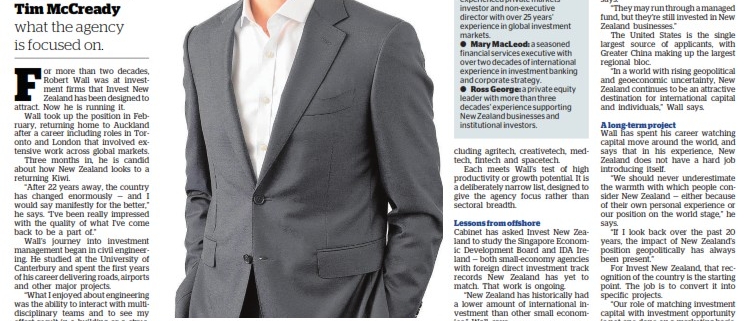
Robert Wall has returned home to lead Invest New Zealand. Three months in as the inaugural chief executive, he tells Tim McCready what the agency is focused on.
For more than two decades, Robert Wall was at investment firms that Invest New Zealand has been designed to attract. Now he is running it.
Wall took up the position in February, returning home to Auckland after a career that included roles in Toronto and London and involved extensive work across global markets.
Three months in, Wall is candid about how New Zealand looks to a returning Kiwi.
“After 22 years away, the country has changed enormously – and I would say manifestly for the better,” he says.
“I’ve been really impressed with the quality of what I’ve come back to be a part of.”
Wall’s journey into investment management began in civil engineering. He studied at the University of Canterbury and spent the first years of his career delivering roads, airports and other major projects.
“What I enjoyed about engineering was the ability to interact with multi-disciplinary teams and to see my effort result in a building or a structure or something that we could look back on,” he says.
“But I realised that is just a small piece of the puzzle. I thought, wouldn’t it be great to be involved in that whole lifecycle? Who had the idea? How did they get the money to build it?”
That curiosity took him into private infrastructure investing. Wall was a founding member of the infrastructure investments team at the Canada Pension Plan Investment Board, then a partner at United States-headquartered Federated Hermes.
He joined Lazard Asset Management in 2021 as head of sustainable private infrastructure and was most recently managing director and co-head of the firm’s quantitative and alternative investment management committee.
Through those roles he ran investment strategies for sovereign wealth funds, pension giants and insurance companies – the same pools of capital he is now tasked with attracting into New Zealand.
A two-way mandate
Wall is clear about Invest New Zealand’s mandate.
“We are the single co-ordinating entity for engaging with international capital on behalf of New Zealand,” he says. “Our focus is on working with international investors to find ways in which to improve and invest in the future productivity and growth in New Zealand businesses.”
That involves two-way engagement. The agency spends a lot of time with international capital providers, to understand where they want to invest, and where they are running into constraints.
“We are in a unique position in that we can take what the world is telling us, work with the Government to change constraints or create incentives for that capital to flow.
“We need to listen to where the large pools of capital want to invest. We have high quality businesses that have very attractive characteristics for investors in today’s world. We should use that position, this opportunity, go out and communicate that.”
When asked what international investors find difficult about doing business in New Zealand, Wall is candid that he is too early in the role to be definitive. But an opportunity he sees for further investment into New Zealand is that of scale.
“We have lots of high-quality businesses that are small in a global context. We want to be able to use capital and expertise that’s internationally available to unlock that growth potential.”
New Zealand’s distance to the investors Invest New Zealand is trying to attract does not concern him.
“Distance is less of an issue when you’re working in easy-to-move knowledge, telecommunications, and people skills – rather than commodities,” Wall says.
“The challenge as an international investor is in finding countries you can really trust and work with for the long term.”
Stable politics, attractive demographics and rule of law, he says, will always outweigh distance.
Priority sector focus
Wall is explicit that the agency cannot succeed without long-term clarity of focus.
“Not every dollar of capital has the same impact on an economy,” he says.
“A dollar of capital invested in a company or sector that has high productivity or high growth potential will allow us to address the economic challenges in the future.”
That has shaped a set of five priority sectors for the agency: private infrastructure; renewable energy; data centres and AI infrastructure; advanced manufacturing and processing facilities; and technologies including agritech, creativetech, medtech, fintech and spacetech.
Each meets Wall’s test of high productivity or growth potential. It is a deliberately narrow list, designed to give the agency focus rather than sectoral breadth.
Lessons from offshore
Cabinet has asked Invest New Zealand to study the Singapore Economic Development Board and IDA Ireland – both small-economy agencies with FDI track records New Zealand has yet to match. That work is ongoing.
“New Zealand has historically had a lower amount of international investment than other small economies,” Wall says. “We should look at comparable countries and how they’ve succeeded.” He cites Singapore, Denmark, Sweden and, to a degree, Greece and Italy.
Wall acknowledges the limits of direct replication but says there are opportunities for New Zealand to learn from other countries.
“New Zealand has an incredible diaspora. We are part of the Indo-Pacific. While we may not have the same scale of incentives, we can look to replicate some tools that similar-sized countries have used successfully.”
Attracting human and financial capital
The Active Investor Plus (AIP) visa is intended to attract investors who take an active role in helping companies access global knowledge networks, capital and markets. It is designed to generate higher business productivity and job growth.
Settings were refreshed in April last year, introducing two investment categories: Growth (higher-risk investments with a minimum $5 million investment over three years) and Balanced (mixed investments with a minimum of $10 million over five).
Uptake has been substantial. As of May, Immigration New Zealand had received 730 applications under the new settings, representing a potential total minimum investment of $4.26 billion.
Resident visas have been approved and granted to 288 applicants, with $1.69 billion of capital committed into the New Zealand economy.
For Wall, the visa is doing what it was designed to do – bringing into New Zealand both capital and the people behind it.
“The Active Investor Plus is an important part of what we do where it connects the human capital and financial capital that individuals can bring,” he says. “We have a really interesting group of people who have elected to commit their capital and time and want to be a part of New Zealand.”
The majority of AIP capital has so far flowed through Invest New Zealand-approved managed funds and bonds.
“Investments into managed funds are an active contributor to the New Zealand economy and growth,” Wall says. “They may run through a managed fund, but they’re still invested in New Zealand businesses.”
The United States is the single largest source of applicants, with Greater China making up the largest regional bloc.
“In a world with rising geopolitical and geoeconomic uncertainty, New Zealand continues to be an attractive destination for international capital and individuals,” Wall says.
A long-term project
Wall has spent his career watching capital move around the world, and says that in his experience, New Zealand does not have a hard job introducing itself.
“We should never underestimate the warmth with which people consider New Zealand – either because of their own personal experience or our position in the world stage,” he says. “If I look back over the past 20 years, the impact of New Zealand’s position geopolitically has always been present.”
For Invest New Zealand, that recognition of the country is the starting point. The job is to convert it into specific projects.
“Our role of matching investment capital with investment opportunity is not one done on a marketing basis. It’s done on a project-specific basis,” Wall says.
“We’re not an organisation that presents New Zealand at a high level, but one where we go and understand what the international investor is looking for.”
Invest New Zealand was stood up last July, with a board chaired by Rob Morrison confirmed late last year. Wall arrived in February. Visible results – by his own admission – are months and years away.
The challenge ahead is substantial. At the announcement of the Invest New Zealand board last December, Trade and Investment Minister Todd McClay was blunt about the gap.
New Zealand’s stock of foreign direct investment, he said, sat at 37% of GDP against an OECD average of 53%, placing the country 27th of 38 OECD economies on stock and 31st on inflows.
“Chronically low levels of overseas investment have starved this country of capital for infrastructure and business,” McClay said. “Quite simply, we need more capital.”
Closing that gap is the challenge Wall and his team have been handed.
“We have to view this as a long-term project,” Wall says.
“I’m confident we are already seeing the benefit for New Zealand. I see that in some of the projects we’re working on and the impact we’re having with international investors.
“But there is a lot more to do. We’re still in the early innings of this game.”
Who’s on the Invest New Zealand board
Rob Morrison: chairman, an investment banker and corporate leader with a distinguished international career in finance, governance, and sustainability.
Carmel Fisher: deputy chairperson, who is a seasoned investment professional with more than 30 years’ experience in New Zealand’s investment industry.
David Tapsell: a respected legal and governance professional with a career spanning law, Māori economic development, and corporate leadership.
Richard Hedley: an experienced private markets investor and non-executive director with over 25 years’ experience in global investment markets.
Mary MacLeod: a seasoned financial services executive with over two decades of international experience in investment banking and corporate strategy.
Ross George: a private equity leader with more than three decades’ experience supporting New Zealand businesses and institutional investors.