


Rocket Lab, Sky TV CEO Sophie Moloney and financial services pioneer Carmel Fisher headlined this year’s Deloitte Top 200 Awards, one of the most anticipated events in New Zealand’s corporate calendar.
With the theme “Celebrating those who move Aotearoa forward”, the black-tie gala at Auckland’s Viaduct Events Centre brought together more than 800 business leaders, politicians and media. Hosted by Jack Tame and Stacey Morrison, the evening recognised outstanding performance, decisive leadership and the organisations driving New Zealand’s economic future.
Rocket Lab was the night’s standout, winning Company of the Year for a performance that has redefined what is possible for a New Zealand business on the global stage.
Its Nasdaq-listed share price doubled over the past year, giving the company a recent market capitalisation of US$21 billion, and its order book has swelled beyond US$500m as demand grows for both its Electron and next-generation Neutron rockets.
Strategic acquisitions in the United States and Europe have expanded Rocket Lab’s capabilities into areas such as missile tracking and laser communications, broadening its footprint and vertical integration across the space industry.
This year also saw a milestone interplanetary mission send two Rocket Lab spacecraft to Mars. The mission will help scientists better understand how the Red Planet lost its atmosphere.
The panel of high-profile judges, convened by NZME’s Fran O’Sullivan, praised Rocket Lab for securing a rare global leadership position for a New Zealand company, saying its success is “inspiring our next generation of young engineering and science talent”.
Sky chief executive Sophie Moloney is this year’s Chief Executive of the Year, recognised for reshaping the company through a people-first strategy and her ability to act decisively during a string of transformative deals.
After early-year turbulence from satellite issues, Sky delivered major strategic wins – including the $1 acquisition of Three and ThreeNow from Warner Bros, a five-year rugby rights deal, and Olympic broadcasting rights through to 2032. Judges say Moloney’s leadership helped propel Sky’s share price to five-year highs and restore investor confidence.
The only award that is given without finalists — the Visionary Leader — went to Carmel Fisher, honoured for her pioneering work in the financial services industry.
Fisher began investing in the early 1980s and quickly earned a strong reputation through a series of roles.
In 1998, she and her husband Hugh launched Fisher Funds from home with $17m in seed capital from Sovereign, making investing accessible through low minimums and nationwide town hall roadshows. The firm grew from a single managed fund to more than $25b in assets under management and 500,000 clients.
Judges describe Fisher as a trailblazer, and Fisher Funds chief executive Simon Power says her influence remains “present and enduring”, even after she stepped back from day-to-day leadership in 2017 following nearly two decades at the helm.
A2 Milk’s David Muscat, named Chief Financial Officer of the Year, was recognised for steering the dual-listed milk and infant formula company through a complex series of transactions.
Muscat oversaw the acquisition of Yashili’s Pōkeno plant, the sale of Mataura Valley Milk and the establishment of a long-term supply agreement with Fonterra. Operating across multiple markets and with significant exposure to the renminbi, he has built a finance function that supports disciplined decision-making and transparent investor communication.
Judges praise his humility, competence and “extraordinary impact for a CFO”, noting his role in restoring confidence after the company’s 2020-21 earnings slump and helping deliver a 49% total shareholder return over the year to September.
Fonterra chairman Peter McBride was named Chairperson of the Year, recognising his calm and unifying governance during a period of significant strategic change for New Zealand’s largest exporter. This is a rare repeat win in this category, with McBride also taking out the award in 2018 during his time chairing Zespri – underscoring a governance career defined by clarity, stability and deep commitment to New Zealand’s primary sector.
Since taking the role in 2020, McBride has guided the co-op through capital structure reform, strong performance, and the landmark $4.22b sale of its consumer brands to Lactalis. Fonterra delivered a $1.079b net profit this year, with strong performance from its high-value ingredients business.
Judges say McBride has rebuilt shareholder trust and ended factionalism on the board, highlighting the significant farmer support for the 2021 capital reform vote as a turning point.
Fisher & Paykel Healthcare won Best Growth Strategy for its long-term, organic approach that has seen the company double revenue every five to six years without relying on acquisitions.
It posted $2.021b in revenue and $377m in net profit this year, driven by its respiratory care products and sleep apnoea technology. With more than 1000 R&D staff and $226.9m invested in R&D, the company maintains a tight strategic focus.
Judges praise its clarity, discipline and willingness to plan decades ahead as it expands manufacturing in Auckland and overseas, calling it a model of innovation-led, patient, long-horizon growth.
Tower won Most Improved Performance for its transformation that delivered on both digital execution and financial growth.
The major transformation replaced legacy technology systems with a single modern, cloud-based digital platform across New Zealand and its Pacific markets, streamlining operations and enabling sophisticated risk-based pricing.
Air New Zealand’s Kate Boyer, named Young Executive of the Year, impressed judges with her energy, drive, and rapid impact as GM Airports, a role she stepped into at age 30.
She inherited a complex operation still recovering from the pandemic, with more than half the workforce newly hired and considerable leadership instability. Three weeks into the job, a spike in serious near-miss airport incidents required immediate action.
Boyer led a safety reset that reduced serious incidents by 60% and launched an Airport Champions Network to bridge the gap between agile product development and day-to-day operations. She also implemented productivity improvements that saved more than $10m while improving engagement.
Judges say her leadership maturity, people-first approach, and execution at scale place her firmly on a trajectory towards senior executive roles.
Precinct Properties took home the Sustainability Leadership award for a commercially grounded approach that has begun to shift practices across the construction sector.
Judges highlight its influence over contractors and suppliers, as well as its long-standing partnership with Ngāti Whātua Ōrākei.
Energy group Clarus received the Diversity & Inclusion Leadership award for its Building Belonging programme, launched in 2022 to create a workplace where everyone feels connected, supported and empowered.
The initiative strengthened foundations through online training, campaigns on topics like neurodiversity, and team values workshops. D&I was also added to every manager’s performance plan.
It introduced targeted workstreams for women, Māori and older workers, with gender-neutral recruitment, improved parental leave and early-career pathways. It has also more than halved the gender pay gap and lifted female hiring from 29% to 43%.
Judges praise the programme’s maturity, authenticity and strong executive sponsorship.
O’Sullivan is stepping down this year after 12 years as a judge and as convenor of the judging panel, a tenure defined by her rigorousness, independence and commitment to celebrating the best of New Zealand business excellence.
The Deloitte Top 200 Index consists of New Zealand’s largest entities ranked by revenue. These include publicly listed companies, large unlisted entities, New Zealand subsidiaries and branches of overseas companies and the commercial operations of Māori entities; also producer boards, co-operatives, local authority trading enterprises and state-owned enterprises.
An overview of the Top 200 Index – along with New Zealand’s Top 30 finance companies – is provided at the end of this report, including detailed analysis of revenue, profitability, efficiency and other key performance metrics. Together, these figures offer a clear snapshot of how New
Zealand’s largest organisations are performing, supported by commentary from the Herald’s business reporting team.
The high-level view of the Top 200 this year shows steady but subdued growth. Total revenues rose 2.1%, a slower pace than the previous two years, while underlying earnings (Ebitda) increased 5.1%. Profit after tax rebounded strongly, rising 23.7% and reversing last year’s 57.2% decrease.
ANZ remains the largest bank by a wide margin, with $199b in assets — more than $63b ahead of second-placed Westpac. ANZ also continues to lead the sector in both profitability and equity.

Precinct has won the Deloitte Top 200 Sustainability Leadership award for 2025, recognising its ambitious, commercially grounded and sector-shaping approach to sustainability in the built environment.
A finalist last year, Precinct impressed judges with the breadth of its activity and the way it continues to evolve its sustainability efforts.
They highlight Precinct’s climate adaptation and operational resilience plans, and its commitment to working collaboratively to tackle challenges that no single organisation can address alone. Judges also note the recent expansion of Precinct’s sustainability team as further evidence of its commitment to long-term impact.
“Precinct’s sustainability initiatives are underpinned by a strong business case for why such actions add value to the company,” says Deloitte Top 200 sustainability judge Katie Beith. “It has also made good headway in influencing contractors and suppliers to source locally and sustainably – and is incentivising them to reduce emissions if they want to be eligible for future contracts.”
Precinct’s head of sustainability, Lisa Hinde, says sustainability is a core element of Precinct’s strategy, taking a long-term view that delivers enduring value for clients, investors and the wider community.
“It isn’t just the right thing to do, our track record shows it goes hand in hand with commercial success, ensuring our portfolio retains its value for future generations,” she says. This commercially grounded approach was highlighted by the judges as a standout feature of Precinct’s performance this year.
Recognising that a significant contributor to emissions in property development occurs during construction, Precinct has prioritised understanding and measuring embodied carbon.
It publishes upfront data for assessed development projects, ensuring visibility and accountability on its journey to net zero. Its most advanced project in this space, the Deloitte Centre development, achieved a 67% reduction in embodied carbon. The judges praise Precinct’s innovative methods for understanding and reducing embodied carbon – an area where it is helping set the pace.
“Precinct is proud to lead on addressing upfront embodied carbon in our development projects, which makes up more than 50% of annual emissions,” says Hinde.
“The biggest challenge is influencing emissions across our value chain, where we don’t have such direct control, but it’s also where we can create the greatest impact through procurement.”
Precinct is also progressing a broader initiative to decarbonise key construction materials, including steel, concrete and aluminium – with 10-year annual step-down targets planned from FY26.
In 2025, Precinct improved its score in the Global Real Estate Sustainability Benchmark to 91 out of 100, retaining its position for the second year running in the top 20% of more than 2000 participating funds and entities.
Earlier this year, Precinct development Beca House – New Zealand’s largest urban regeneration project – achieved a 6-star “World Leadership” Green Star Design rating. The building hosts Precinct’s largest rooftop solar array, part of a total 309kW of rooftop solar across Auckland’s Wynyard Quarter. The Deloitte Centre, Te Kaha, also received a 6-star certification – the first mixed-use office and hotel development in New Zealand to do so. These projects demonstrate how adaptive reuse (Deloitte Centre) and high-performance design can deliver strong commercial and sustainability outcomes.
Precinct also delivered New Zealand’s first NABERSNZ water ratings, achieving 4.5 to 5 stars across four commercial office buildings.
In FY25, Precinct introduced a national waste management strategy across its full portfolio to support a transition to circular economy principles. Through its quarterly ESG reporting programme, it shares energy, water and waste data with clients and runs workshops to support tenants in estimating their first NABERSNZ tenancy ratings – reflecting its commitment to sector-wide capability building.
Judges also recognise Precinct’s long-standing partnership with mana whenua, demonstrating its approach to partnership grounded in Te Tiriti o Waitangi and mana whenua engagement. It has formed a joint venture with Ngāti Whātua Ōrākei, alongside global investor PAG, to invest in the regeneration of the Te Tōangaroa precinct in Auckland’s city centre.
“Our partnerships with mana whenua are fundamental to our purpose and performance,” says Hinde. “They uphold cultural integrity, foster inclusive design, and strengthen our supply chain to deliver social and environmental outcomes that matter to the communities we serve.”
She says it is rewarding to see the mutually beneficial outcomes these relationships bring, from joint venture ownership to cultural advisory roles, service provision, and enduring connections that enrich both the built environment and society.
The judges commend Precinct’s focused and commercial approach to sustainability: “Precinct is focused on where it can achieve impact within its own value chain, how this adds value to the business and how it can drive progress across the broader sector.”
Its work continues to set benchmarks in sustainable property development – by reducing carbon as well as reshaping how commercial buildings are designed, delivered, and operated in New Zealand.
The Sustainability Leadership award is sponsored by Credibl.
Bank of New Zealand (BNZ) has been named a finalist for Sustainability Leadership, recognised for the depth and breadth of its approach, and its strong commitment to long-term resilience.
At the heart of BNZ’s strategy is Te Pae Tawhiti, a name that reflects a distant horizon and inter-generational mindset. Launched in 2020, it has two core pillars: Kaitiakitanga, focused on accelerating a just transition to a net-zero emissions economy that supports building back nature, and Manaakitanga, aimed at enhancing the long-term well-being of New Zealanders.
The judges note that BNZ is impressive for the comprehensiveness of its approach: “It is commendable to see it holding firm on commitments when other international banks are walking away.”
BNZ chief sustainability officer, Rebekah Cain, says the bank set ambitious targets when it committed to supporting customers to build a regenerative, resilient, and inclusive future.
“Climate impacts are real and are impacting our business and our customers now; they are crystallising faster than anticipated. It makes commercial sense to continue to support our customers and communities to adapt to those impacts and to stay relevant to international markets.”
Judges also highlight that “ensuring a healthy, growing and thriving business into the future is a core motivator,” noting BNZ’s focus on long-term resilience.
BNZ has set 2030 decarbonisation targets across high-emitting sectors including energy, residential real estate and agriculture, and is on track to meet its commitment to exit all lending to thermal coal mining by the end of 2025 – and all remaining coal mining-related lending by 2030.
“We recognise the important role that guidance, frameworks, and local laws have played in helping us build capability, plan, and set emissions targets,” says Cain. “These measures have set us on a pathway to help New Zealand reach net zero by 2050.”
In FY24, operational emissions were down 49% from 2019, with 96% of the bank’s purchased electricity needs sourced from renewables.
BNZ is also supporting customers in transition-exposed industries. Judges note the bank “is engaging to support customers in transition‑exposed industries, including acute challenges like energy resilience, with ESG fully integrated into the credit process.”
It has delivered $8.8 billion in sustainable finance since 2020 and aims to reach $10b this year. An additional $93m in green consumer lending in FY24 has helped over 2300 households to electrify transport or improve home resilience and efficiency.
“We’re confident we’ll surpass our $10b sustainable finance target in 2025,” says Cain. “Over the past five years, this lending has supported our customers, who represent a variety of sectors, to build models of resilience, and invest in things like energy efficiency, sustainable product innovation, water infrastructure and irrigation, preventing pollution, protecting and restoring biodiversity, social housing, and diversification of land.”
BNZ is also demonstrating leadership in nature regeneration. The BNZ Foundation supports biodiversity efforts such as depositing green-lipped mussels in the Hauraki Gulf as part of the “Revive Our Gulf” restoration project, and is a leading partner of the Aotearoa Circle, advancing sustainability through cross-sector collaboration.
The bank continues to invest in financial well-being and inclusion, having delivered $42.4 million in no- or low-interest loans to disrupt predatory lending and assisting over 350,000 New Zealanders to become scam-savvy through targeted education and tools.
BNZ’s integrated strategy positions it as a leader among New Zealand’s financial institutions, focused on creating long-term value for customers, communities and the environment.
Goodman Property Trust (GMT) has been recognised as a finalist for its bold and forward-looking approach to sustainability leadership and its decision to press ahead with new emissions targets despite growing uncertainty in global markets.
As a long-term property investor, GMT’s decision-making is guided by a business strategy that aims to deliver positive outcomes for all its stakeholders. It includes targets for a lower-carbon and more resilient portfolio.
Judges say GMT’s leadership was clear in its actions. “The key development in 2025 was setting science-based emissions reduction targets, including for embodied carbon, which reflects the vast majority of the company’s footprint. While this may not seem special on its own, it was done at a time when other companies were pulling back from net-zero aspirations.”
GMT’s CFO, Andy Eakin, who also has overall responsibility for the organisation’s sustainability efforts, says that confidence came from the depth of analysis behind the targets.
“A significant amount of work has been undertaken to align our 2030 carbon reduction pathway with science-based targets. Expert advice, supported by an independent review from Toitū, has provided confidence that while our targets are ambitious, they remain both credible and achievable.”
GMT’s updated emissions reduction targets include a 43% reduction in corporate emissions and a 30% reduction in embodied carbon intensity by 2030.
To help meet these goals, GMT launched an Embodied Carbon Innovation Fund (ECIF), using an internal carbon price to replace the purchase of offsets. This fund is directed toward lower-emission materials and construction techniques across future projects. The judges found this to be a key differentiator for the company in an emissions-intensive sector.
Eakin says the ECIF is already shifting the way GMT approaches construction.
“The fund allows us to think more broadly about development, looking at all aspects of the process and the specifics of individual projects. We have already invested in a new initiative to critically assess the materials efficiency of our current building design, which aims to reduce the amount of building materials required to deliver to our designs, reducing materials, cost and embodied carbon.”
GMT’s commitment to sustainable development includes targeting a minimum 5 Green Star Built rating for all new projects. Its FY25 development programme has seen three project completions, with a reduction in upfront embodied carbon of 27%. Its sustainability initiatives have included the installation of electrical submetering, customer and public EV chargers, LED lighting upgrades, rooftop solar energy systems, and water-saving technologies.
“Committing to a minimum 5 Green Star Built rating since 2021 reflects a base building standard that is both highly sustainable and operationally efficient,” says Eakin. “We’ve developed over $750 million of properties that have achieved 5 Star or World Leadership 6 Green Star Built ratings.” He adds that partnering closely with customers has been key to reducing emissions across both new developments and existing buildings.
Governance is central to GMT’s sustainability strategy. Progress is reviewed quarterly at board level, underpinned by a Sustainable Finance Framework that has enabled over $600m in green bonds and loans to date.
The judges also recognise GMT’s growing social and environmental efforts.
Employee retention is high at nearly 99%, with an engagement score of 87%. GMT maintains inclusive workplace policies and achieved 33% female representation across its board and executive team.
Biodiversity initiatives include native planting and urban regeneration, and features such as beehives across larger estates to enhance and protect the natural environment.
GMT’s approach balances ambition with delivery, showing that climate leadership is possible even amid economic headwinds. Judges say this “embodies courageous leadership, and a board willing to take bold decisions on sustainability.”

Fonterra chairman Peter McBride has been named Chairperson of the Year at the 2025 Deloitte Top 200 Awards, recognised for his steady hand and strategic clarity in leading Fonterra through a period of significant transformation.
Appointed chairman of Fonterra in November 2020, McBride has steered the dairy co-operative through a demanding period of reform, capital restructuring, and strategic repositioning.
Under his leadership, Fonterra has delivered a record milk price to its farmers, reasserted its financial strength, and set a clear course for the future of New Zealand’s largest exporter.
This marks McBride’s second time receiving the honour, following his 2018 Chairperson of the Year award for his leadership of Zespri, where he presided over a remarkable recovery and growth story for New Zealand’s kiwifruit industry.
The rare repeat recognition underscores a governance career defined by calm authority, strategic focus, and an unwavering commitment to New Zealand’s primary sector.
Alongside Fonterra, McBride chairs Sydney Markets, Trinity Lands, and Sequal Holdings, and is a member of the New Zealand China Council and Zespri Global Supply Advisory Board.
Fonterra reported a net profit of $1.079 billion for the July 2025 year, maintaining its milk price forecasts and delivering one of the co-operative’s strongest years in terms of shareholder returns.
Total revenue climbed 15% to $26b, driven by strong global demand for high-value ingredients, while operating profit increased 13% to $1.73b, underpinned by a standout performance from the ingredients business.
She says, “Peter has shown exceptional skill in navigating Fonterra through a complex period of change.
“He has maintained unity on the board, earned the confidence of farmer shareholders, and shown both courage and composure in leading one of the country’s most important companies.”
The judges credit McBride with ending factionalism within the board and rebuilding trust among Fonterra’s shareholders. His leadership was tested in 2021, when he shepherded major capital structure reform through the cooperative with extensive engagement and transparency. The result – 85.2% support from farmers – was well above the 75% threshold required and marked a turning point in Fonterra’s governance stability.
McBride says, “As a board, you need to have the courage to first identify the need for change, and then lead it. Often this means leaning into difficult conversations with stakeholders.”
He adds that shareholder trust relies on consistency and candour: “Be honest. Do what you say you will. And when you inevitably fall short from time to time, be straight-up about that too. Farmers and growers are smart people. They can handle hard truths.”
Raumati says McBride’s leadership has been defined by his ability to draw out the best from those around him. “Peter allows every director to contribute. He doesn’t dominate discussions
but listens carefully, builds consensus, and ensures decisions are grounded in what’s best for the co-operative and its farmer-owners,” she says.
McBride’s leadership style is intentionally understated. “My approach to leadership is to be a servant, to empower others to contribute the best they can rather than seek to control,” he says. “Surround yourself with the best talent you’ve got available, then encourage and value their contribution.”
The award recognises McBride’s role in guiding Fonterra through one of the most significant strategic decisions in its history: the $4.22b sale of its consumer brands to global dairy giant Lactalis.
Farmers backed the move decisively. McBride says the vote “was a strong mandate and we were equally pleased with the level of participation. That tells us shareholders are engaged in their co-op. The outcome shows that farmers had taken the time to understand the commercial imperatives, and backed our judgement.”
This transaction represents a major strategic pivot. McBride describes Fonterra’s next phase as being “a more nimble co-op, focused on where it delivers the most value back to farmers and shareholders – which is our advanced ingredients and foodservice businesses”.
He adds that stakeholders can expect to see continued investment in New Zealand: “The co-op will continue to invest further up the value chain. Those investments will be within regional New Zealand, where our contribution to local communities will remain significant.”
Internally, he says, “our focus will remain on tighter cost management and manufacturing efficiency.”
Under McBride’s direction, Fonterra has focused on efficiency, innovation and partnership – working closely with multinational food companies and investing more than $100 million a year in science and innovation to maximise value from every drop of milk.
With farmer confidence at its strongest in years and a record milk price underpinning the co-operative’s momentum, McBride’s leadership has positioned Fonterra, and the wider dairy sector, for a decisive next phase of growth.
Forsyth Barr is the sponsor of the Chairperson of the Year award.
As chairperson of Westpac New Zealand and the a2 Milk Company, Pip Greenwood has guided two of the country’s most high-profile businesses through major transformation.
The Top 200 judges describe her as “a highly credible and inclusive chair who fosters open debate, values diverse perspectives and drives rigorous governance”.
Raumati says Greenwood is well regarded within the business community for her commercial and legal judgment, and for her ability to tap superior directors for her boards, adding that she “exemplifies modern governance: disciplined, inclusive, and deeply attuned to both performance and purpose”.
Since becoming chairperson of Westpac New Zealand in 2021, Greenwood has strengthened the entire board, recruited the CEO and helped steer the bank through a period of regulatory reform, cultural renewal and digital transformation.
“I really believe governance is a team effort,” she says. “I work hard to make sure the board is connected and working collaboratively. Since becoming chair, the Westpac board has been completely refreshed, which has brought renewed energy and capability.”
The bank’s net profit after tax rose 13% to $1.20b in the year to September. Despite strong competition, Westpac lifted home lending by 5%, business lending by 2%, and grew household deposits by 6% compared with the 2024 financial year.
Greenwood attributes the result to “a lot of hard work and being customer-centric”, adding: “We are really delighted with the improved performance because it means we’re doing things right for our customers in a very difficult market.”
The judges say Greenwood has been “influential in improving the bank’s relationship with regulators and has worked with the CEO to enhance performance, upgrade compliance and digital systems, and strengthen key areas of senior leadership.”
Her credibility and respect within the group led to her appointment earlier this year to the Australian parent board, Westpac Banking Corporation, as an independent non-executive director.
Alongside these roles, Greenwood also chairs dairy nutrition firm a2 Milk Company, where she led the search for the current CEO and has guided it through an ambitious phase of strategic repositioning and international expansion. She stepped down from the board of Fisher & Paykel Healthcare in September after eight years.
The judges highlight Greenwood’s role in strengthening a2 Milk’s governance, noting that the board has undergone significant renewal and now brings together expertise in global marketing, supply chain, investment banking and brand development. They say this has helped the company adapt, complete major business transitions, and strategically address key markets such as China and Vietnam.
“It’s been about making sure we have the right people and structure in place to support the next phase of growth,” says Greenwood.
“Getting international-class capability on the board was a challenge, but we now have a highly capable group with relevant experience for what is, in many ways, a relatively small by global standards but a very complex business.
“I’m absolutely delighted with how the team has executed through some significant transitions and market expansion.”
A2 Milk delivered strong results in the year ended June, with revenue rising 13.5% to $1.9b from $1.67b, net profit after tax up 21% to $202.9 million and an announcement of a $300m special dividend for shareholders.
In August, a2 Milk announced its $282m purchase of Yashili New Zealand’s Pōkeno nutritional manufacturing facility from China’s Mengniu Dairy Group, while selling its loss-making Mataura Valley plant in Southland.
Greenwood describes the move as “a significant step in the company’s supply-chain transformation and an opportunity for further growth”.
She says the transactions form part of a broader strategy to accelerate access to China’s $23b infant formula market by securing valuable product registrations and world-class production capability, adding that “this capability positions a2 Milk well for its next phase of growth”.
James Miller’s disciplined governance and capital-markets expertise have been central to Channel Infrastructure’s transformation into a modern energy infrastructure business.
As New Zealand’s largest fuel import terminal, Channel stores and distributes around 40% of the nation’s fuel, including 80% of its jet fuel. Its facilities at Marsden Point provide the key fuel supply route to Auckland, making the company a critical link in New Zealand’s energy security and economic resilience.
Miller also serves as a director of Fletcher Building, Ryman Healthcare and Vista Group International and recently stepped down from the board of Mercury after more than 13 years. He brings more than 15 years of experience in capital markets and corporate finance.
Since joining the Channel board in 2018 and becoming chairman in 2022, Miller has guided the company through a complex transition, reshaping its operations, financial model and long-term growth strategy while delivering strong returns for shareholders.
Miller describes himself as “not necessarily a natural chair”, but says that “sometimes you’ve got to step up, take the lead, put the passion in and run at a fast cadence.
“The real credit goes to the team – I am just the one out front of a very capable and competent bunch.”
Under his leadership, Channel has transformed from a struggling refinery into a resilient, forward-looking infrastructure company. Drawing on his governance and market expertise, he reshaped the business model and unlocked the site’s potential as one of New Zealand’s most strategic energy assets. The turnaround has delivered strong shareholder returns, stable long-term contracts, and a revitalised culture – Miller says he aims for staff “who are proud to wear the Channel jumper to a barbecue in Northland”.
Since Miller became chairman, Channel has significantly outperformed the NZX 50, delivering a total shareholder return of 155% – equivalent to a compound annual growth rate of 32.6%. The company is now fully independent, operating with stable earnings and long-term contracts.
Miller says Channel takes “a lot of pride in paying a strong dividend and making sure investors – and the advisers who’ve backed us across New Zealand – have confidence that in 10 years’ time we’ll still be delivering for them, year in, year out. It’s about creating a strong, enduring investment story they can rely on.”
Raumati says Miller has “built strong credibility and respect as chair,” describing him as having “a clear strategy that emphasises wealth creation, operational excellence and energy resilience.” They praise his “measured, forward-looking approach” and his ability to “balance financial discipline with national purpose”.
At the heart of that strategy is the Marsden Point Energy Precinct – a bold, long-term vision to redevelop 120 hectares of industrial-zoned land into a hub for energy innovation and advanced manufacturing. Judges note that Miller has been instrumental in “highlighting the company’s transition from refinery to infrastructure business, and articulating a compelling future focused on energy security, sustainability and regional regeneration.”
The project is estimated to generate $3.3 billion in GDP and create up to 20,000 construction jobs. Once operational, projects within the precinct could support 1150 full-time jobs in Northland and contribute $290 million to annual GDP. Judges note the plan’s potential to “turn Northland into a hub for energy and industrial activity – attracting investment, supporting local businesses, and boosting national energy resilience.”
Miller describes the energy precinct as “a once-in-a-generation opportunity for Northland,” designed to unlock significant value for both shareholders and the region, building diversified, long-term contracted revenues for the company that are not dependent on fuel volume. He says it will be “the first attempt at large-scale re-industrialisation since Muldoon’s ‘think big’ – an ambitious moon shot for a company the size of Channel”.
Under his leadership, judges say Channel has become a model of transformation – commercially successful, strategically ambitious, and vital to New Zealand’s energy future.
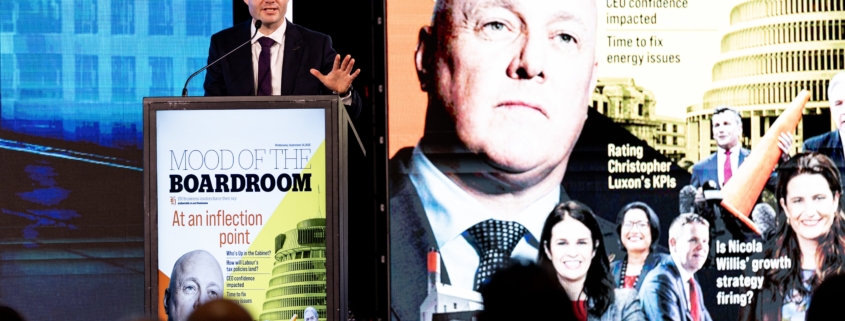
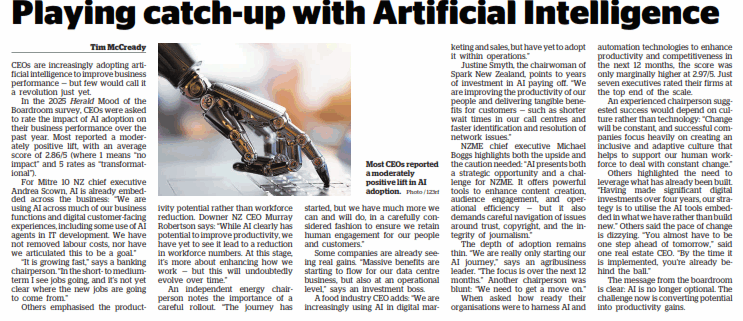
Mood of the Boardroom: Playing catch-up with Artificial Intelligence (NZ Herald)
CEOs are increasingly adopting artificial intelligence to improve business performance — but few would call it a revolution just yet.
In the 2025 Herald Mood of the Boardroom survey, CEOs were asked to rate the impact of AI adoption on their business performance over the past year. Most reported a moderately positive lift, with an average score of 2.86/5 (where 1 means “no impact” and 5 rates as “transformational”).
For Mitre 10 NZ chief executive Andrea Scown, AI is already embedded across the business: “We are using AI across much of our business functions and digital customer-facing experiences, including some use of AI agents in IT development. We have not removed labour costs, nor have we articulated this to be a goal.”
“It is growing fast,” says a banking chairperson. “In the short- to medium-term I see jobs going, and it’s not yet clear where the new jobs are going to come from.”
Others emphasised the productivity potential rather than workforce reduction. Downer NZ CEO Murray Robertson says: “While AI clearly has potential to improve productivity, we have yet to see it lead to a reduction in workforce numbers. At this stage, it’s more about enhancing how we work — but this will undoubtedly evolve over time.”
An independent energy chairperson notes the importance of a careful rollout. “The journey has started, but we have much more we can and will do, in a carefully considered fashion to ensure we retain human engagement for our people and customers.”
Some companies are already seeing real gains. “Massive benefits are starting to flow for our data centre business, but also at an operational level,” says an investment boss.
A food industry CEO adds: “We are increasingly using AI in digital marketing and sales, but have yet to adopt it within operations.”
Justine Smyth, the chairwoman of Spark New Zealand, points to years of investment in AI paying off. “We are improving the productivity of our people and delivering tangible benefits for customers — such as shorter wait times in our call centres and faster identification and resolution of network issues.”
NZME chief executive Michael Boggs highlights both the upside and the caution needed: “AI presents both a strategic opportunity and a challenge for NZME. It offers powerful tools to enhance content creation, audience engagement, and operational efficiency — but it also demands careful navigation of issues around trust, copyright, and the integrity of journalism.”
The depth of adoption remains thin. “We are really only starting our AI journey,” says an agribusiness leader. “The focus is over the next 12 months.” Another chairperson was blunt: “We need to get a move on.”
When asked how ready their organisations were to harness AI and automation technologies to enhance productivity and competitiveness in the next 12 months, the score was only marginally higher at 2.97/5. Just seven executives rated their firms at the top end of the scale.
An experienced chairperson suggested success would depend on culture rather than technology: “Change will be constant, and successful companies focus heavily on creating an inclusive and adaptive culture that helps to support our human workforce to deal with constant change.”
Others highlighted the need to leverage what has already been built. “Having made significant digital investments over four years, our strategy is to utilise the AI tools embedded in what we have rather than build new.” Others said the pace of change is dizzying. “You almost have to be one step ahead of tomorrow,” said one real estate CEO. “By the time it is implemented, you’re already behind the ball.”
The message from the boardroom is clear: AI is no longer optional. The challenge now is converting potential into productivity gains.
Mood of the Boardroom: Executives divided on defence spending plan (NZ Herald)
Business leaders are split on whether the Government’s commitment to raise defence spending to 2% of GDP is enough to keep New Zealand secure in an increasingly volatile world.
Just under a third (32%) of respondents to the Herald’s 2025 Mood of the Boardroom survey believe the target is sufficient, while 43% say it falls short. The remainder (25%) are unsure.
The debate comes as the Government commits $12 billion over the next four years — $9b of it new money — to modernise the New Zealand Defence Force. Spending is expected to climb above 2% of GDP within eight years.
For many executives, the challenge is scale. “A percentage of our small GDP will never be enough,” says Mainfreight CEO Don Braid. “Strong security relationships with other nations remain our only options.”
Jason Paris, chief executive of One NZ, is direct: “We will never be able to invest enough to protect ourselves without our partners.”
Forsyth Barr managing director Neil Paviour-Smith warns, “New Zealand is only truly ‘protected’ if we are part of a credible set of defence alliances. The cost of that may well be more than 2% of GDP.”
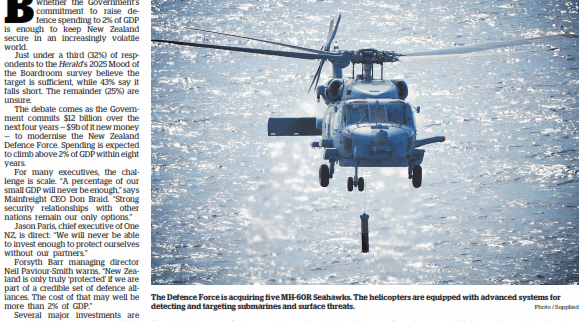
Several major investments are earmarked between now and 2028. These include replacing the ageing Boeing 757 fleet ($600m to $1b), acquiring maritime helicopters ($300m to $600m), and enhancing strike capabilities ($100m to $300m) in addition to cybersecurity, drones, and personnel housing upgrades.
Ventia executive general manager Damian Pedreschi emphasises the need to support people as well as hardware. “Our defence force will always be small but mighty,” he says. “We need to give them the appropriate living and working facilities, and up-to-date equipment to carry out their core functions.”
Several respondents highlight that the debate is as much about credibility with allies as it is about the headline figure.
“For our allies, the commitment no doubt speaks louder than the percentage,” says Institute of Directors CEO Kirsten (KP) Patterson. “It’s a signal to friends and allies that we take our shared security seriously.”
Others stress that execution is what matters. “Chronic underinvestment needs a transformational approach,” notes ServiceNow country director Kate Tulp.
“How will Defence spend that investment at pace with the current skill sets employed? This will be the determining factor.”
Chronic underfunding is repeatedly cited. “Defence has been woefully underfunded for decades. Significant investment in innovation is essential, just look at how fast things are moving in Ukraine,” says Retirement Villages Association executive director Michelle Palmer.
Dairy Holdings chairman Greg Gent adds that catch-up capital is essential, given the lift is “off a very low base”.
Auckland Business Chamber CEO Simon Bridges calls it “the right thing” but says one could argue the timeframe is on the tardy side: “A job worth doing is worth getting on with.”
Still, not all believe New Zealand should be chasing higher figures.
“We have to be realistic about our country’s balance sheet,” says Freightways chairman Mark Cairns. “Two per cent of GDP seems a sensible lift from where we have been.” “To go from 1.2% of GDP to 2% of GDP will require $30 billion of additional cumulative funding. Where is that coming from?” asks Cameron Bagrie, managing director at Bagrie Economics.
Some are sceptical of the value of the spend.
“It’s probably one where we would be better off considering carefully our diplomatic efforts than trying to build a modern navy,” says Jarden managing director Silvana Schenone.
Mood of the Boardroom: CEOs push for an independent watchdog (NZ Herald)
A clear majority of executives in this year’s Mood of the Boardroom survey — 61% — support the establishment of an independent institution such as a Parliamentary Budget Office to provide impartial oversight of government expenditure and fiscal policy. A quarter are opposed, while 14% remain unsure.
Supporters argue that such a body would strengthen transparency and accountability. Auckland Airport CEO Carrie Hurihanganui says: “Fiscal prudence is critical and an independent body, set up correctly and with the appropriate mandate, would add value.”
New Zealand Initiative chairman Roger Partridge notes Treasury’s fiscal updates often rely too heavily on ministerial assumptions: “That leaves voters and Parliament with projections that often look better on paper than in practice. Many OECD countries already benefit from such institutions. New Zealand should, too.”
Others believe the need arises from Treasury’s limited independence. “Treasury is not sufficiently independent from the Minister of Finance,” observes economist Cameron Bagrie. Deloitte chairman Thomas Pippos adds: “The more we can depoliticise the articulation of ‘facts’, the better we will be.”
“Yes — but don’t hire Elon,” jokes Cordis Auckland managing director Craig Bonnor.
But resistance remains. Critics argue it risks creating “more bureaucracy” when agencies should already be exercising discipline.
“We shouldn’t need a Parliamentary Budget Office as every department should already be delivering transparency and fiscal discipline,” says one CEO. “New Zealand is simply too small to keep creating more agencies to address systemic deficiencies.”
EMA CEO John Fraser-Mackenzie worries about duplication: “On one level it sounds appealing — but where does it end — who will monitor the monitors?
“If the incumbent officials cannot manage their expenditure, they should be replaced with those who can. In business, your operational leaders are responsible for this with oversight from the finance function.”
Others question whether it was simply Treasury’s role to begin with: “Isn’t this what Treasury should be doing?” asks an engineering CEO.
Mood of the Boardroom: Optimism slips as CEOs grow cautious (NZ Herald)
New Zealand’s top business leaders’ optimism in the economy has waned from last year’s nine-year high.
Respondents to the Herald’s 2025 Mood of the Boardroom survey rated their confidence in the New Zealand economy at 2.82/5 on a scale of 1-5, where 1 signifies “much less optimistic” than a year ago and 5 represents “much more optimistic”. That is down from last year’s score of 3.23/5.
The softer outlook reflects a fragile domestic recovery that has been overshadowed by both global trade uncertainty and lingering weakness in consumer confidence.
“Confidence is gradually, almost reluctantly, improving locally, but uncertainty caused by US tariffs and geopolitics is allowing us to hang on to our newly ingrained pessimism,” says EMA chief executive John Fraser-Mackenzie.
Others highlight that although the agribusiness sector is doing well, the traditional link between high dairy payouts and wider domestic confidence is yet to be seen.
“Consumer confidence remains very subdued and, while we are seeing recovery first in the regions, it is not at the pace one would expect given the dairy payouts that historically provide the stimulus,” says Mitre 10 New Zealand boss Andrea Scown. “Our own customer insights point to a savings mindset. Folk don’t feel out of the woods yet.”
Another CEO adds: “My sense is the economy is very gradually improving, but it is slow. New Zealand feels like it has turned the corner, and things are improving, but we will need to see more evidence of this.”
Independent chairman Craig Stobo says the shift is structural as much as cyclical: “The required painful adjustment from debt-fuelled central government expansion to a private-sector, export-led recovery is underway. The business moods in Wellington and Wyndham are very different as a result.”
Institute of Directors chief executive Kirsten Patterson adds: “We have progressed from ‘survive to 25’, to ‘survive through 25’, and are now facing ‘not yet fixed in 26’.”
Tariffs, tensions and a global drag
CEO optimism in the global economy has also slipped, dropping from 3.06/5 last year to 2.63/5. Executives cite international trade tensions and geopolitical volatility as major headwinds.
“It feels like the global economy is still deep in the tariff tailspin,” says Tourism Holdings CEO Grant Webster. “Internationally, I think the uncertainty and disruption caused by the US tariffs will offset underlying improvements.”
Pan Pac Forest Products managing director Tony Clifford points to China as a persistent drag on sentiment. “Soft market demand, driven by poor housing capital returns, was already evident before tariff wars exacerbated the situation,” he says.
A CEO recently returned from international travel, stresses that New Zealand’s challenges are not unique. “Most economies are in a similar state as our own — New Zealand is faring far better than many other countries.”
Others remain cautiously hopeful. “Hopefully, New Zealand is turning the corner and has already been through the worst of the economic reset,” says an investment boss. “The biggest risk is that, as a small open economy, we are knocked off course by the general deterioration of global trade rules and multilateralism.”
Several warn that geopolitics remains the wildcard.
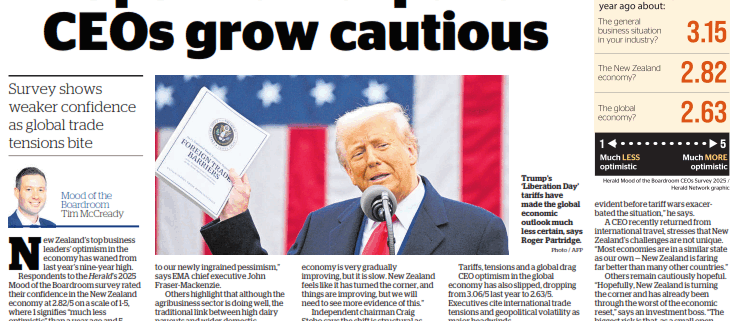
“The twin threats of geopolitical risk and the adverse effect of Trump’s ‘Liberation Day’ tariffs have made the global economic outlook much less certain,” says Roger Partridge, chairman of The New Zealand Initiative.
Mood of the Boardroom: Mood shift on Willis’ growth push (NZ Herald)
CEOs have sent a clear message to Finance Minister Nicola Willis in the Herald’s Mood of the Boardroom survey: hold the pro-growth line, sharpen delivery, and set out a long-term vision that brings investors back onside.
At the centre of the Government’s “Going for Growth” agenda are five pillars — developing talent; competitive business settings; global trade and investment; innovation, technology and science; and infrastructure — which form the backbone of Willis’ economic strategy. CEOs credit her for re-centring the conversation on growth, tightening fiscal settings, and pushing structural reforms while navigating shaky global confidence and tariff uncertainty.
But since the survey closed, scrutiny has intensified following a worse-than-expected GDP contraction — down 0.9% in the June quarter — which triggered a storm of political and economic commentary.
The result has added pressure on Willis, who just a year ago was credited with a “strong start” in her first Mood of the Boardroom survey as Finance Minister.
That feeling is clearly over. The 2025 survey reveals 43% of business leaders say Willis’ growth agenda is not appropriately positioned to lift New Zealand’s economy in 2025, compared with 35% who back it. A further 22% remain unsure.
Willis’ own performance ratings reflect that divide. She scores an average of 3.09/5 across her finance, economic growth and social investment portfolios.
This is down from last year’s score of 3.88/5.
Several business leaders see Willis as laying solid foundations. “Applaud the Investment Boost initiative. Like the focus on regulations that support growth and make it easier for business to focus on executing their commercial plans,” says EMA CEO John Fraser-Mackenzie.
Others highlight her direction.
A public sector CEO says: “The five pillars of the economic plan are good and right,” though warns the lack of intervention and focus on retail politics is undermining the impact.
Roger Partridge, chair of The New Zealand Initiative, gives “real credit for putting growth at the centre of the agenda and for championing reforms in education, housing, regulation and infrastructure that target New Zealand’s long-term productivity malaise”. A tech CEO adds: “The Willis growth agenda has some pro-growth pillars in the right place — tight fiscal settings, a clearer safe harbour pitch to attract capital, visa and FDI tweaks, and a faster planning and consent track.”
But optimism is tempered by scepticism over substance and delivery. “Sorry, what ‘growth agenda’?” asks one. “Willis’ so-called growth agenda is spin without substance. She excels at bashing business for non-issues like butter prices, but has not shown any genuine thought leadership.”
A chairperson puts it bluntly: “It feels like she has chased headlines and cheap politics. She lost massive credibility over attacking Fonterra on the price of butter when she knows it reflects international markets.”
Those critiques intensified after the GDP release and public calls from some commentators for Willis to step aside — calls rebuffed by the Beehive.
Some respondents acknowledge the constraints. “New Zealand’s debt levels, structural deficits and voter apathy for dealing with any of these means all finance ministers are in straitjackets,” says an energy CEO.
But others are less forgiving. “What has she done to create growth in New Zealand?
“I can’t think of a single thing other than the supermarkets/banking publicity, which so far has not achieved anything,” says an infrastructure boss. “New Zealand is in a growth funk and, if this is her responsibility, then she has not delivered.”
An education leader suggests “saying ‘growth, growth, growth’ doesn’t actually help. Growth just isn’t evident, and the benefits seem to be for top-end only.”
Craig Stobo, chairman of the Local Government Funding Agency, says the opportunity remains to spell out the sources of sustainable growth: “Real after-tax incomes, profitable investment and net exports and how to facilitate that … not debt-fuelled unproductive government expenditure.”
What more should be on the growth agenda?
In a follow-up question, executives were asked to give their perspective on what more should be on the Government’s growth agenda.
1. Productivity boost
If there was one word that echoed throughout the responses, it was productivity. Business leaders want a step change that includes a boost in skill, innovation, and technology — not tinkering around the edges.
“We need to lift productivity across the board — and that means retraining and reorienting our workforce, especially those at the lower end of the wage spectrum,” says an engineering CEO.
Respondents also point to reform of tax and regulatory settings to attract capital, accelerate R&D, and grow high-value sectors, alongside investment in digital transformation and AI adoption.
2. Infrastructure at scale
The second most pressing call was for major infrastructure investment, with delivery needed, not just more announcements.
“We need an infrastructure pipeline and certainty — including energy investment,” says Deloitte CEO Mike Horne. Another CEO adds: “We’ve lost too much time. It’s time to accelerate, not deliberate.”
With construction output weakening, leaders want shovel-worthy projects ready as financing costs ease. Suggestions range from a bankable housing and transport pipeline with credible delivery; to unlocking the infrastructure deficit in transport, energy, and housing; and mobilising private and foreign capital through PPPs and investment reform.
3. Immigration, education and red tape
Immigration and education settings came through strongly.
“We have lost a lot of highly skilled people out of the construction industry in the last 18 months, with the taps about to turn on, how do we ramp up to ensure there is capacity in the market?” asks an engineering CEO.
Ventia executive general manager Damian Pedreschi urges investment in “world-leading pedagogy, delivered by well-trained teachers”.
Others suggest aligning immigration with skill shortages, expanding vocational pathways, and strengthening universities’ role in innovation.
Red tape remains a major frustration. “We have become a nation that is full of overly conservative regulation and red tape, so much so, particularly in infrastructure and development, that we are uncompetitive with our peer nations.”
Mainfreight managing director Don Braid is direct: “Reduce the regulation. Get out of the way.”
4. A compelling vision
Respondents call for a clear and ambitious national vision that stretches beyond a three-year election cycle.
Foodstuffs North Island CEO Chris Quin was among those urging the Government to adopt stronger long-term thinking. “We need a stronger long-term vision that enables clear planning for infrastructure, economic direction, and achievable national goals with broad cross-party support.”
He points out that other countries are already planning decades ahead and reaping the benefits.
An infrastructure CEO: “Are we content to coast on lucky high-priced agricultural exports, or do we want to set a bold agenda in tech, tourism, and advanced manufacturing?”
The CEO of an energy firm urges the Government to “deliver a coherent vision and strategy to give New Zealanders something to get excited and committed to”.
Several directors link the vision point to investor confidence, arguing clearer long-term signals would help reverse a “wait-and-see” mindset after growth disappointments.
Investment Boost uptake is muted
The Government’s flagship Investment Boost initiative has delivered wins for some, but the survey shows most CEOs remain unconvinced. The incentive, announced in the Budget, applies to New Zealand businesses investing in productive assets like machinery, tools and equipment. It allows immediate deduction of 20% of an asset’s value from taxable income in the year of purchase, on top of standard depreciation.
Among the positive reactions, an energy CEO calls it a “great bold step”, while a CEO from the entertainment industry notes it “certainly has made business cases for such investment easier” and “removed any doubts about whether or not to invest”.
Precinct Properties chief executive Scott Pritchard says the change “provides greater certainty and a lift to an investor’s after-tax returns for developments, so it is beneficial when considering whether to deploy capital.
“Additionally, it also generates tax deductions for other investments on existing assets, which ultimately reduces the overall economic cost associated with those types of projects.”
Others see it as an “amplifier” when the fundamentals of an investment already stacked up. A public sector CEO goes further: “This is one of the best things they have done.”
But uptake is muted. Nearly half (48%) say it has not influenced their investment decisions at all, with another 25% reporting it only had a marginal effect. Just 9% credit it with significantly shaping their decisions, leaving the initiative with a weighted average score of 1.88/5 for encouraging increased investment.
The prevailing sentiment is scepticism. A tourism chairperson dismisses it, saying: “It hasn’t made any difference to making sensible business decisions.”
Dairy Holdings’ chairman Greg Gent says that over the life of an asset, the scheme represents just “a 6% saving, so commercially it makes no sense to chase it.”
Several CEOs say they have “no money left to invest”, while others describe the scheme as “not really relevant” to their business.
More scathing was one CEO, who argued the policy was “one of the most overhyped” in memory: “No serious business makes million-dollar investment decisions because IRD is feeling generous on depreciation tables … the economy needs genuine structural reform and certainty.”