
The battle to build a better city
Richard Hills explains his vision for a housing density plan to Tim McCready
As chair of Auckland Council’s Policy, Planning and Development Committee, councillor Richard Hills sits at the centre of the debate over how the city will grow.
“I really like the role because it’s complex,” Hills says. “I like details.”
Those details will shape one of the biggest questions facing Auckland: where the next generation of homes will be built.
Earlier this month councillors agreed a set of principles to guide how Auckland reduces its theoretical housing capacity from around two million homes to about 1.6 million, after the Government signalled it would lower the target.
The decision follows five years of national housing reforms requiring councils to enable significantly more housing, including rules permitting up to three homes of three storeys on most residential sites.
In Auckland, that meant the city’s planning rules had to demonstrate enough zoning capacity for roughly two million homes.
The figure was never a construction target. It simply represented the number of homes Auckland’s zoning rules could theoretically allow if every eligible site was developed. But it quickly became a lightning rod in the debate about Auckland’s future.
Under the principles agreed by councillors, any reduction in capacity would likely begin further from the city centre, including areas more than 10km from the CBD, while retaining higher densities around rapid transit, City Rail Link stations, and walkable catchments around bus corridors, town and local centres.
“Density makes sense around stations, centres and places where we’ve invested billions in infrastructure. In any major city you would expect more homes in those areas,” Hills says. “We would look first at removing development capacity on the edges of the city, preventing six-storey buildings far away from jobs or good public transport.”
For Hills, the debate is less about forcing people into a particular type of housing than about giving Aucklanders more choice. “It’s about giving people options,” he says.
The economics of the city, he adds, are already pushing in that direction.
“We expect people to live on the outskirts, commute long distances, and then we’re surprised when the cost of living goes up.”
Petrol prices alone can reshape a household budget overnight.
“You could be hundreds of dollars in the red just by a change of political conflict overseas.”
Protections for historic neighbourhoods also remain. “We are still allowed to use qualifying matters, including special character.”
For Hills, one of the hardest parts of the job is navigating the politics.
“It’s not easy because everyone expects you to help their one issue,” he says. “You’re constantly balancing the area you were elected to represent with the whole city.”
That tension has only been amplified by the stop-start nature of national policy.
“I was looking forward to this year being more proactive: more vision and more focus on what we could be doing from planning development to regeneration,” Hills says.
“But unfortunately, we’ve gone straight back to being reactive.”
He says Auckland needs clarity.
“Other councils in New Zealand have already implemented the National Policy Statement for Urban Development in their plans. Auckland — the biggest city with 40% of New Zealand’s GDP — is the only place that hasn’t rolled this out.”
What the city needs now, he says, is certainty for homeowners, firsthome buyers, developers and investors. “Nothing is ever going to be perfect,” he adds. “But we have to do something.”
The council is now waiting for the Government to finalise the legislation that will determine the next steps.
Hills says the next phase will involve councillors and local boards reviewing options for redrawing the city’s zoning maps.
“We need to protect the integrity of the 10,500 submissions that have already gone in, but also make sure people affected by changes have the ability to have their say.”
After that, the independent hearings panel will examine the detail.
“They’ll be measuring it against access to trains, the city centre, jobs, parks and amenity,” Hills says.
Beyond the policy mechanics, he says the debate ultimately comes down to the kind of city Auckland wants to be.
“My vision is a city centre that is full of people, with higher-density housing near stations where people can walk to work and access public transport easily.”
That includes homes for young people entering the housing market, and downsizing options for older residents who want to stay in their communities.
In some areas, he says, that is already happening — with older residents moving into smaller homes nearby and freeing up family houses for younger buyers.
“If you’re thinking about your parents, or your kids, or your grandkids — where are they going to live?” he says.
“The city centre is safer when it’s full of people walking around. When people pop out of stations and walk into markets, theatres and restaurants.”
Sprawling development makes that harder.
“We have to enable growth where the infrastructure investment is already going,” he says, pointing to projects such as the City Rail Link and the Central Interceptor.
Despite the controversy around intensification, Hills remains optimistic.
“I’m sick of people being negative about Auckland,” he says. “It’s a fantastic city.
“Year after year people come here and want to live here. The natural environment — our beaches and our forests — are second to none.”
Ultimately, he says, the challenge is not just building more homes, but building a better city. “We haven’t done infrastructure well for generations,” he says.
“But we’re getting on top of it. We just need to make sure we bring everyone along with us.”
Tim McCready
Diversity is a productive asset for a globally competitive city, says growth expert
Anna Kominik wants Auckland to be known as a city that proves you can build a globally-competitive, high-wage city that is also a great place to live in.
She says that too often, the growth conversation gets framed as a contest between business interests and community wellbeing. “And yet, higher wages, better public services, and stronger infrastructure are not casualties of growth. They are its point.”
A director and lead adviser of Growth New Zealand, Kominik believes Auckland’s genuine points of difference are compelling.
“It is one of the most ethnically diverse cities of its size anywhere on Earth. We have a Māori economy growing faster than the broader New Zealand economy, representing a distinctive model of indigenous capitalism that the world is increasingly admiring. And we have a disproportionate track record of producing world-class companies.”
Kominik says that connecting all this is Auckland’s diversity, which she says is a productive asset, not just a social virtue. “Cities that unlock the full creative and economic potential of all their people consistently outperform those that do not.”
Yet when set against globally ambitious peers such as Vancouver or Singapore, Kominik says Auckland is still searching for clarity. “I am not sure Auckland has decided what it wants to be yet. And that indecision has a cost, not just economically but socially.”
Cities with a clear sense of identity, she argues, build civic confidence — a shared story that attracts talent, earns trust, and sustains the longterm commitment that ambitious transformation requires.
“That settled sense of collective purpose is itself a form of capital, and Auckland is still accumulating it,” she says.
The recent economic data reinforces that challenge. Auckland’s GDP per capita declined in the year to March 2024 and likely again in 2025 — the first sustained per capita contraction since the global financial crisis.
“Those numbers are not abstract for the Aucklanders forced to make harder choices about food, housing, transport, and healthcare,” she says.
“Economic stress does not stay contained — it erodes the trust, the reciprocity, and the everyday civic participation that supports communities and prosperity to flourish.”
Infrastructure gaps compound the issue. Kominik points to delays in rapid transit, long-running uncertainty over the port, and a shortage of growth-stage capital that pushes successful companies offshore.
Against that backdrop, she argues Auckland needs to treat growth as a system rather than a set of isolated fixes.
“You cannot fix capital markets without fixing talent. You cannot retain talent without fixing housing. You cannot attract globally ambitious founders without the infrastructure that makes a city worth living in.”
She points to several priorities:
Underpinning it all is talent.
“First, attract globally: fast visa processing, competitive equity compensation, and a genuine landing pad with real connections and early capital access,” she says.
“Second, stop the outflow by fixing structural settings around tax, housing and services, that deter people from staying; and third, unlock the talent that already exists across our city and in the Auckland diaspora.”
New Zealand’s large offshore population, she says, should be treated as an economic network rather than a loss. “At the end of the day, we want New Zealand to be a place that our children want to stay in.” If those settings shift, the upside is tangible.
Kominik describes a “realistic, not fantasy” Auckland in 10 to 15 years: a city of around 2.2m people, better connected by functioning rapid transit, with a vibrant central city and infrastructure that links the harbour, suburbs and innovation precincts.
It would have a tech and cleantech ecosystem producing a steady cadence of globally-significant companies, backed by deeper domestic capital, alongside a Māori economy exceeding $100b and actively co-investing across infrastructure and industry.
Crucially, she says, growth would be more widely felt. “Nearly one in five Auckland children are growing up in households experiencing material hardship,” she says. “Every Aucklander who does not reach their potential represents lost prosperity — both as an individual and to the community.”
On that trajectory, Auckland’s global reputation would follow.
Kominik says that by around 2040, Auckland could be a city that people across the Asia-Pacific talk about in the same way they talk about Zurich or Amsterdam today. “Smaller than the giants, but sharper, more liveable, and genuinely world-class at the things it has chosen to prioritise — a city where the growth story and the wellbeing story are the same.”
Anna Kominik is an independent director, investor, adviser and innovator who recently made Auckland home. She is part of Growth New Zealand, a non-partisan group of passionate and experienced New Zealanders promoting a future where growth means lasting economic, social and environmental wellbeing, shared across the whole community.
Mood of the Boardroom: Executives divided on defence spending plan (NZ Herald)
Business leaders are split on whether the Government’s commitment to raise defence spending to 2% of GDP is enough to keep New Zealand secure in an increasingly volatile world.
Just under a third (32%) of respondents to the Herald’s 2025 Mood of the Boardroom survey believe the target is sufficient, while 43% say it falls short. The remainder (25%) are unsure.
The debate comes as the Government commits $12 billion over the next four years — $9b of it new money — to modernise the New Zealand Defence Force. Spending is expected to climb above 2% of GDP within eight years.
For many executives, the challenge is scale. “A percentage of our small GDP will never be enough,” says Mainfreight CEO Don Braid. “Strong security relationships with other nations remain our only options.”
Jason Paris, chief executive of One NZ, is direct: “We will never be able to invest enough to protect ourselves without our partners.”
Forsyth Barr managing director Neil Paviour-Smith warns, “New Zealand is only truly ‘protected’ if we are part of a credible set of defence alliances. The cost of that may well be more than 2% of GDP.”
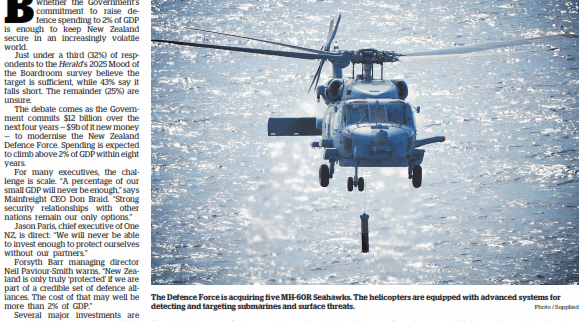
Several major investments are earmarked between now and 2028. These include replacing the ageing Boeing 757 fleet ($600m to $1b), acquiring maritime helicopters ($300m to $600m), and enhancing strike capabilities ($100m to $300m) in addition to cybersecurity, drones, and personnel housing upgrades.
Ventia executive general manager Damian Pedreschi emphasises the need to support people as well as hardware. “Our defence force will always be small but mighty,” he says. “We need to give them the appropriate living and working facilities, and up-to-date equipment to carry out their core functions.”
Several respondents highlight that the debate is as much about credibility with allies as it is about the headline figure.
“For our allies, the commitment no doubt speaks louder than the percentage,” says Institute of Directors CEO Kirsten (KP) Patterson. “It’s a signal to friends and allies that we take our shared security seriously.”
Others stress that execution is what matters. “Chronic underinvestment needs a transformational approach,” notes ServiceNow country director Kate Tulp.
“How will Defence spend that investment at pace with the current skill sets employed? This will be the determining factor.”
Chronic underfunding is repeatedly cited. “Defence has been woefully underfunded for decades. Significant investment in innovation is essential, just look at how fast things are moving in Ukraine,” says Retirement Villages Association executive director Michelle Palmer.
Dairy Holdings chairman Greg Gent adds that catch-up capital is essential, given the lift is “off a very low base”.
Auckland Business Chamber CEO Simon Bridges calls it “the right thing” but says one could argue the timeframe is on the tardy side: “A job worth doing is worth getting on with.”
Still, not all believe New Zealand should be chasing higher figures.
“We have to be realistic about our country’s balance sheet,” says Freightways chairman Mark Cairns. “Two per cent of GDP seems a sensible lift from where we have been.” “To go from 1.2% of GDP to 2% of GDP will require $30 billion of additional cumulative funding. Where is that coming from?” asks Cameron Bagrie, managing director at Bagrie Economics.
Some are sceptical of the value of the spend.
“It’s probably one where we would be better off considering carefully our diplomatic efforts than trying to build a modern navy,” says Jarden managing director Silvana Schenone.
Mood of the Boardroom: CEOs push for an independent watchdog (NZ Herald)
A clear majority of executives in this year’s Mood of the Boardroom survey — 61% — support the establishment of an independent institution such as a Parliamentary Budget Office to provide impartial oversight of government expenditure and fiscal policy. A quarter are opposed, while 14% remain unsure.
Supporters argue that such a body would strengthen transparency and accountability. Auckland Airport CEO Carrie Hurihanganui says: “Fiscal prudence is critical and an independent body, set up correctly and with the appropriate mandate, would add value.”
New Zealand Initiative chairman Roger Partridge notes Treasury’s fiscal updates often rely too heavily on ministerial assumptions: “That leaves voters and Parliament with projections that often look better on paper than in practice. Many OECD countries already benefit from such institutions. New Zealand should, too.”
Others believe the need arises from Treasury’s limited independence. “Treasury is not sufficiently independent from the Minister of Finance,” observes economist Cameron Bagrie. Deloitte chairman Thomas Pippos adds: “The more we can depoliticise the articulation of ‘facts’, the better we will be.”
“Yes — but don’t hire Elon,” jokes Cordis Auckland managing director Craig Bonnor.
But resistance remains. Critics argue it risks creating “more bureaucracy” when agencies should already be exercising discipline.
“We shouldn’t need a Parliamentary Budget Office as every department should already be delivering transparency and fiscal discipline,” says one CEO. “New Zealand is simply too small to keep creating more agencies to address systemic deficiencies.”
EMA CEO John Fraser-Mackenzie worries about duplication: “On one level it sounds appealing — but where does it end — who will monitor the monitors?
“If the incumbent officials cannot manage their expenditure, they should be replaced with those who can. In business, your operational leaders are responsible for this with oversight from the finance function.”
Others question whether it was simply Treasury’s role to begin with: “Isn’t this what Treasury should be doing?” asks an engineering CEO.
Mood of the Boardroom: Optimism slips as CEOs grow cautious (NZ Herald)
New Zealand’s top business leaders’ optimism in the economy has waned from last year’s nine-year high.
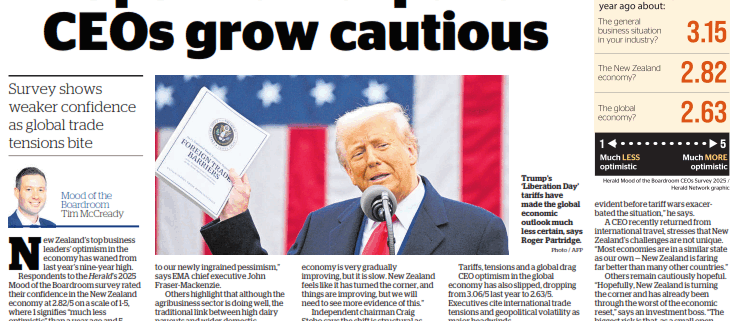
Respondents to the Herald’s 2025 Mood of the Boardroom survey rated their confidence in the New Zealand economy at 2.82/5 on a scale of 1-5, where 1 signifies “much less optimistic” than a year ago and 5 represents “much more optimistic”. That is down from last year’s score of 3.23/5.
The softer outlook reflects a fragile domestic recovery that has been overshadowed by both global trade uncertainty and lingering weakness in consumer confidence.
“Confidence is gradually, almost reluctantly, improving locally, but uncertainty caused by US tariffs and geopolitics is allowing us to hang on to our newly ingrained pessimism,” says EMA chief executive John Fraser-Mackenzie.
Others highlight that although the agribusiness sector is doing well, the traditional link between high dairy payouts and wider domestic confidence is yet to be seen.
“Consumer confidence remains very subdued and, while we are seeing recovery first in the regions, it is not at the pace one would expect given the dairy payouts that historically provide the stimulus,” says Mitre 10 New Zealand boss Andrea Scown. “Our own customer insights point to a savings mindset. Folk don’t feel out of the woods yet.”
Another CEO adds: “My sense is the economy is very gradually improving, but it is slow. New Zealand feels like it has turned the corner, and things are improving, but we will need to see more evidence of this.”
Independent chairman Craig Stobo says the shift is structural as much as cyclical: “The required painful adjustment from debt-fuelled central government expansion to a private-sector, export-led recovery is underway. The business moods in Wellington and Wyndham are very different as a result.”
Institute of Directors chief executive Kirsten Patterson adds: “We have progressed from ‘survive to 25’, to ‘survive through 25’, and are now facing ‘not yet fixed in 26’.”
Tariffs, tensions and a global drag
CEO optimism in the global economy has also slipped, dropping from 3.06/5 last year to 2.63/5. Executives cite international trade tensions and geopolitical volatility as major headwinds.
“It feels like the global economy is still deep in the tariff tailspin,” says Tourism Holdings CEO Grant Webster. “Internationally, I think the uncertainty and disruption caused by the US tariffs will offset underlying improvements.”
Pan Pac Forest Products managing director Tony Clifford points to China as a persistent drag on sentiment. “Soft market demand, driven by poor housing capital returns, was already evident before tariff wars exacerbated the situation,” he says.
A CEO recently returned from international travel, stresses that New Zealand’s challenges are not unique. “Most economies are in a similar state as our own — New Zealand is faring far better than many other countries.”
Others remain cautiously hopeful. “Hopefully, New Zealand is turning the corner and has already been through the worst of the economic reset,” says an investment boss. “The biggest risk is that, as a small open economy, we are knocked off course by the general deterioration of global trade rules and multilateralism.”
Several warn that geopolitics remains the wildcard.
“The twin threats of geopolitical risk and the adverse effect of Trump’s ‘Liberation Day’ tariffs have made the global economic outlook much less certain,” says Roger Partridge, chairman of The New Zealand Initiative.
Mood of the Boardroom: Mood shift on Willis’ growth push (NZ Herald)
CEOs have sent a clear message to Finance Minister Nicola Willis in the Herald’s Mood of the Boardroom survey: hold the pro-growth line, sharpen delivery, and set out a long-term vision that brings investors back onside.
At the centre of the Government’s “Going for Growth” agenda are five pillars — developing talent; competitive business settings; global trade and investment; innovation, technology and science; and infrastructure — which form the backbone of Willis’ economic strategy. CEOs credit her for re-centring the conversation on growth, tightening fiscal settings, and pushing structural reforms while navigating shaky global confidence and tariff uncertainty.
But since the survey closed, scrutiny has intensified following a worse-than-expected GDP contraction — down 0.9% in the June quarter — which triggered a storm of political and economic commentary.
The result has added pressure on Willis, who just a year ago was credited with a “strong start” in her first Mood of the Boardroom survey as Finance Minister.
That feeling is clearly over. The 2025 survey reveals 43% of business leaders say Willis’ growth agenda is not appropriately positioned to lift New Zealand’s economy in 2025, compared with 35% who back it. A further 22% remain unsure.
Willis’ own performance ratings reflect that divide. She scores an average of 3.09/5 across her finance, economic growth and social investment portfolios.
This is down from last year’s score of 3.88/5.
Several business leaders see Willis as laying solid foundations. “Applaud the Investment Boost initiative. Like the focus on regulations that support growth and make it easier for business to focus on executing their commercial plans,” says EMA CEO John Fraser-Mackenzie.
Others highlight her direction.
A public sector CEO says: “The five pillars of the economic plan are good and right,” though warns the lack of intervention and focus on retail politics is undermining the impact.
Roger Partridge, chair of The New Zealand Initiative, gives “real credit for putting growth at the centre of the agenda and for championing reforms in education, housing, regulation and infrastructure that target New Zealand’s long-term productivity malaise”. A tech CEO adds: “The Willis growth agenda has some pro-growth pillars in the right place — tight fiscal settings, a clearer safe harbour pitch to attract capital, visa and FDI tweaks, and a faster planning and consent track.”
But optimism is tempered by scepticism over substance and delivery. “Sorry, what ‘growth agenda’?” asks one. “Willis’ so-called growth agenda is spin without substance. She excels at bashing business for non-issues like butter prices, but has not shown any genuine thought leadership.”
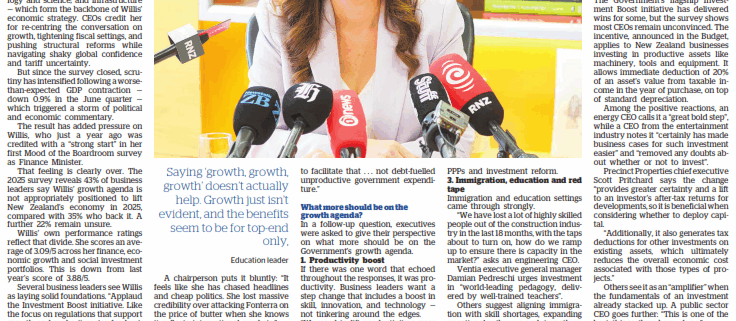
A chairperson puts it bluntly: “It feels like she has chased headlines and cheap politics. She lost massive credibility over attacking Fonterra on the price of butter when she knows it reflects international markets.”
Those critiques intensified after the GDP release and public calls from some commentators for Willis to step aside — calls rebuffed by the Beehive.
Some respondents acknowledge the constraints. “New Zealand’s debt levels, structural deficits and voter apathy for dealing with any of these means all finance ministers are in straitjackets,” says an energy CEO.
But others are less forgiving. “What has she done to create growth in New Zealand?
“I can’t think of a single thing other than the supermarkets/banking publicity, which so far has not achieved anything,” says an infrastructure boss. “New Zealand is in a growth funk and, if this is her responsibility, then she has not delivered.”
An education leader suggests “saying ‘growth, growth, growth’ doesn’t actually help. Growth just isn’t evident, and the benefits seem to be for top-end only.”
Craig Stobo, chairman of the Local Government Funding Agency, says the opportunity remains to spell out the sources of sustainable growth: “Real after-tax incomes, profitable investment and net exports and how to facilitate that … not debt-fuelled unproductive government expenditure.”
What more should be on the growth agenda?
In a follow-up question, executives were asked to give their perspective on what more should be on the Government’s growth agenda.
1. Productivity boost
If there was one word that echoed throughout the responses, it was productivity. Business leaders want a step change that includes a boost in skill, innovation, and technology — not tinkering around the edges.
“We need to lift productivity across the board — and that means retraining and reorienting our workforce, especially those at the lower end of the wage spectrum,” says an engineering CEO.
Respondents also point to reform of tax and regulatory settings to attract capital, accelerate R&D, and grow high-value sectors, alongside investment in digital transformation and AI adoption.
2. Infrastructure at scale
The second most pressing call was for major infrastructure investment, with delivery needed, not just more announcements.
“We need an infrastructure pipeline and certainty — including energy investment,” says Deloitte CEO Mike Horne. Another CEO adds: “We’ve lost too much time. It’s time to accelerate, not deliberate.”
With construction output weakening, leaders want shovel-worthy projects ready as financing costs ease. Suggestions range from a bankable housing and transport pipeline with credible delivery; to unlocking the infrastructure deficit in transport, energy, and housing; and mobilising private and foreign capital through PPPs and investment reform.
3. Immigration, education and red tape
Immigration and education settings came through strongly.
“We have lost a lot of highly skilled people out of the construction industry in the last 18 months, with the taps about to turn on, how do we ramp up to ensure there is capacity in the market?” asks an engineering CEO.
Ventia executive general manager Damian Pedreschi urges investment in “world-leading pedagogy, delivered by well-trained teachers”.
Others suggest aligning immigration with skill shortages, expanding vocational pathways, and strengthening universities’ role in innovation.
Red tape remains a major frustration. “We have become a nation that is full of overly conservative regulation and red tape, so much so, particularly in infrastructure and development, that we are uncompetitive with our peer nations.”
Mainfreight managing director Don Braid is direct: “Reduce the regulation. Get out of the way.”
4. A compelling vision
Respondents call for a clear and ambitious national vision that stretches beyond a three-year election cycle.
Foodstuffs North Island CEO Chris Quin was among those urging the Government to adopt stronger long-term thinking. “We need a stronger long-term vision that enables clear planning for infrastructure, economic direction, and achievable national goals with broad cross-party support.”
He points out that other countries are already planning decades ahead and reaping the benefits.
An infrastructure CEO: “Are we content to coast on lucky high-priced agricultural exports, or do we want to set a bold agenda in tech, tourism, and advanced manufacturing?”
The CEO of an energy firm urges the Government to “deliver a coherent vision and strategy to give New Zealanders something to get excited and committed to”.
Several directors link the vision point to investor confidence, arguing clearer long-term signals would help reverse a “wait-and-see” mindset after growth disappointments.
Investment Boost uptake is muted
The Government’s flagship Investment Boost initiative has delivered wins for some, but the survey shows most CEOs remain unconvinced. The incentive, announced in the Budget, applies to New Zealand businesses investing in productive assets like machinery, tools and equipment. It allows immediate deduction of 20% of an asset’s value from taxable income in the year of purchase, on top of standard depreciation.
Among the positive reactions, an energy CEO calls it a “great bold step”, while a CEO from the entertainment industry notes it “certainly has made business cases for such investment easier” and “removed any doubts about whether or not to invest”.
Precinct Properties chief executive Scott Pritchard says the change “provides greater certainty and a lift to an investor’s after-tax returns for developments, so it is beneficial when considering whether to deploy capital.
“Additionally, it also generates tax deductions for other investments on existing assets, which ultimately reduces the overall economic cost associated with those types of projects.”
Others see it as an “amplifier” when the fundamentals of an investment already stacked up. A public sector CEO goes further: “This is one of the best things they have done.”
But uptake is muted. Nearly half (48%) say it has not influenced their investment decisions at all, with another 25% reporting it only had a marginal effect. Just 9% credit it with significantly shaping their decisions, leaving the initiative with a weighted average score of 1.88/5 for encouraging increased investment.
The prevailing sentiment is scepticism. A tourism chairperson dismisses it, saying: “It hasn’t made any difference to making sensible business decisions.”
Dairy Holdings’ chairman Greg Gent says that over the life of an asset, the scheme represents just “a 6% saving, so commercially it makes no sense to chase it.”
Several CEOs say they have “no money left to invest”, while others describe the scheme as “not really relevant” to their business.
More scathing was one CEO, who argued the policy was “one of the most overhyped” in memory: “No serious business makes million-dollar investment decisions because IRD is feeling generous on depreciation tables … the economy needs genuine structural reform and certainty.”
Mood of the Boardroom: CEO survey says Councils ‘broken’ (NZ Herald)
New Zealand’s top business leaders say local government is broken — slow, unaccountable and failing to deliver.
The Herald’s Mood of the Boardroom survey shows an appetite for reform, but frustration with the choices facing voters in next month’s local council elections.
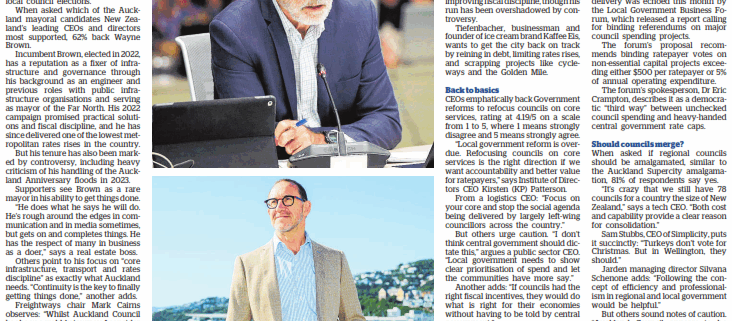
When asked which of the Auckland mayoral candidates New Zealand’s leading CEOs and directors most supported, 62% back Wayne Brown.
Incumbent Brown, elected in 2022, has a reputation as a fixer of infrastructure and governance through his background as an engineer and previous roles with public infrastructure organisations and serving as mayor of the Far North. His 2022 campaign promised practical solutions and fiscal discipline, and he has since delivered one of the lowest metropolitan rates rises in the country.
But his tenure has also been marked by controversy, including heavy criticism of his handling of the Auckland Anniversary floods in 2023.
Supporters see Brown as a rare mayor in his ability to get things done.
“He does what he says he will do. He’s rough around the edges in communication and in media sometimes, but gets on and completes things. He has the respect of many in business as a doer,” says a real estate boss.
Others point to his focus on “core infrastructure, transport and rates discipline” as exactly what Auckland needs. “Continuity is the key to finally getting things done,” another adds.
Freightways chair Mark Cairns observes: “Whilst Auckland Council has been a wobbly journey, I consider it is getting plenty of runs on the board under Wayne Brown’s leadership.”
Yet for some, Brown’s abrupt approach is deemed too divisive.
“Anyone but Wayne Brown. His leadership style is everything we have fought to change in recent times. Action, yes, but the how is unacceptable,” says the head of a construction firm.
While none of the other candidates received any significant support from respondents, a hefty 35% said none appeal, reflecting a lack of enthusiasm in the options available.
In Wellington, Andrew Little emerges with 38% support. Little, a former Labour MP and senior Cabinet Minister, is campaigning on a promise of “serious leadership and real change.”
Drawing on his background as a lawyer and union leader, Little argues he has the experience to steady Wellington after years of instability.
His platform focuses on fiscal discipline, keeping rates under control, protecting community assets, and making housing and public transport more affordable.
“Andrew Little would be great,” says an engineering CEO. “He understands politics, is credible and experienced.”
Most respondents, however, are united in despair at the state of the capital.
A recruiter described Wellington as “a basket case” — suffering from “catastrophic mismanagement,” with debt ballooning, pipes crumbling, and rates climbing.
“Public trust is destroyed,” says another, accusing the council of neglecting its mandate while households are left to shoulder the consequences.
The head of a consulting firm adds: “While Andrew Little is the favourite, a moderate central candidate will be best placed to take the city forward.”
Of the remaining candidates, only Ray Chung and Karl Tiefenbacher register any support, each with just 1%.
An overwhelming 60% of respondents say ‘none of the above’.
Chung is a sitting Wellington councillor making his second mayoral bid, campaigning on cutting costs and improving fiscal discipline, though his run has been overshadowed by controversy.
Tiefenbacher, businessman and founder of ice cream brand Kaffee Eis, wants to get the city back on track by reining in debt, limiting rates rises, and scrapping projects like cycleways and the Golden Mile.
Back to basics
CEOs emphatically back Government reforms to refocus councils on core services, rating at 4.19/5 on a scale from 1 to 5, where 1 means strongly disagree and 5 means strongly agree.
“Local government reform is overdue. Refocusing councils on core services is the right direction if we want accountability and better value for ratepayers,” says Institute of Directors CEO Kirsten (KP) Patterson.
From a logistics CEO: “Focus on your core and stop the social agenda being delivered by largely left-wing councillors across the country.”
But others urge caution. “I don’t think central government should dictate this,” argues a public sector CEO. “Local government needs to show clear prioritisation of spend and let the communities have more say.”
Another adds: “If councils had the right fiscal incentives, they would do what is right for their economies without having to be told by central government.”
Behind the criticism lies frustration at a system business leaders say actively resists growth. CEOs and directors gave their own local councils a rating of 2.34/5 for performance in enabling growth and development, particularly in water, housing, and core services.
“All talk and consultation, no action,” says the CEO of a major law firm. Another put it more bluntly: “It’s broken.”
A key issue is that councils carry the cost of new housing and water infrastructure while central government collects the lion’s share of tax revenue.
“Until we reform local government funding so councils share directly in the benefits of growth, housing supply and infrastructure investment will continue to lag behind demand,” says Roger Partridge, chair of the New Zealand Initiative.
The result, according to Anne Gaze, founder of Campus Link Foundation, is decades of “glacial progress” and infrastructure “forever scrambling to catch up rather than leading delivery.”
“After decades of rate hikes and rhetoric, Aucklanders are left with housing they can’t afford and water they can’t swim in,” she says.
The theme of accountability and delivery was echoed this month by the Local Government Business Forum, which released a report calling for binding referendums on major council spending projects.
The forum’s proposal recommends binding ratepayer votes on non-essential capital projects exceeding either $500 per ratepayer or 5% of annual operating expenditure.
The forum’s spokesperson, Dr Eric Crampton, describes it as a democratic “third way” between unchecked council spending and heavy-handed central government rate caps.
Should councils merge?
When asked if regional councils should be amalgamated, similar to the Auckland Supercity amalgamation, 81% of respondents say yes.
“It’s crazy that we still have 78 councils for a country the size of New Zealand,” says a tech CEO. “Both cost and capability provide a clear reason for consolidation.”
Sam Stubbs, CEO of Simplicity, puts it succinctly: “Turkeys don’t vote for Christmas. But in Wellington, they should.”
Jarden managing director Silvana Schenone adds: “Following the concept of efficiency and professionalism in regional and local government would be helpful.”
But others sound notes of caution. “Auckland Council appears to be more inefficient and more costly to run than prior to amalgamation,” says the chairperson of an investment firm.
Michelle Palmer, executive director of the Retirement Villages Association, points to mixed lessons: “The amalgamation of Auckland as a super city has taken decades to start showing efficiencies and improved service delivery. Te Pūkenga is another case in point where amalgamation does not provide the anticipated benefits.”
Independent director Fraser Whineray takes it further: “Structural changes sound good. But Auckland Supercity hasn’t delivered. What’s better is blistering transparency. Swiss-style localism does that because the municipalities are so small.
“The first thing to sort is transparency and performance benchmarking. The Regulatory Standards Board should provide this service to local councils so that ratepayers can have comfort on local government policy.”
Mood of the Boardroom: Business leaders deliver blunt verdict on Hipkins (NZ Herald)
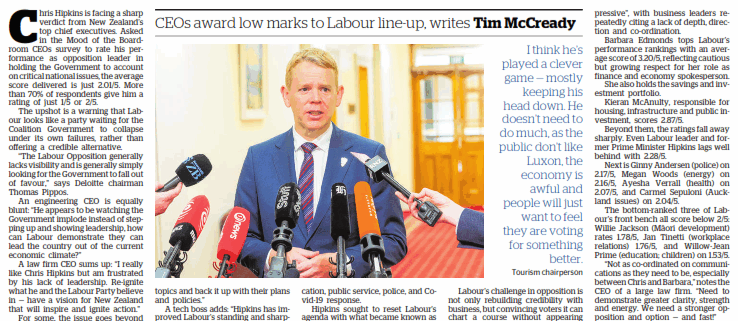
Chris Hipkins is facing a sharp verdict from New Zealand’s top chief executives. Asked in the Mood of the Boardroom CEOs survey to rate his performance as opposition leader in holding the Government to account on critical national issues, the average score delivered is just 2.01/5. More than 70% of respondents give him a rating of just 1/5 or 2/5.
The upshot is a warning that Labour looks like a party waiting for the Coalition Government to collapse under its own failures, rather than offering a credible alternative.
“The Labour Opposition generally lacks visibility and is generally simply looking for the Government to fall out of favour,” says Deloitte chairman Thomas Pippos.
An engineering CEO is equally blunt: “He appears to be watching the Government implode instead of stepping up and showing leadership, how can Labour demonstrate they can lead the country out of the current economic climate?”
A law firm CEO sums up: “I really like Chris Hipkins but am frustrated by his lack of leadership. Re-ignite what he and the Labour Party believe in — have a vision for New Zealand that will inspire and ignite action.”
For some, the issue goes beyond opposition tactics to credibility. “I find it difficult to reconcile responsibility for the policies of the last Government with critiques of the current Government’s attempts at managing the consequences of those policies,” says Local Government Funding Agency chairman Craig Stobo.
Others highlight his public absence from the Covid inquiry, his unwillingness to front mistakes from Labour’s past term, and a tendency to focus on political point-scoring rather than solutions.
But most want clearer direction. “He’s good in some areas, weak in others,” says Ventia executive general manager Damian Pedreschi. “It’s time to hear more clearly what his and his party’s position is on key topics and back it up with their plans and policies.”
A tech boss adds: “Hipkins has improved Labour’s standing and sharpened accountability on key policy areas, pending clearer, costed alternatives across the board.”
Not all verdicts are so uncompromising. Some see merit in Hipkins’ cautious approach.
“I think he’s played a clever game — mostly keeping his head down,” says a tourism chairperson. “He doesn’t need to do much, as the public don’t like Luxon, the economy is awful and people will just want to feel they are voting for something better.”
But business leaders agree the current strategy cannot hold indefinitely.
After Jacinda Ardern’s resignation in early 2023, Chris Hipkins was swiftly elevated to Labour’s leadership. A senior minister under Ardern, he had held portfolios including education, public service, police, and Covid-19 response.
Hipkins sought to reset Labour’s agenda with what became known as his “policy bonfire”, including shelving the RNZ-TVNZ merger, withdrawing proposed hate speech laws, delaying the social insurance scheme, and changes to Three Waters. He framed the shift as a move back to “bread and butter” economic issues, an attempt to narrow Labour’s focus and reconnect with middle New Zealand.
Since Labour’s defeat in 2023, Hipkins has sought to reset Labour with a deliberately lower profile.
While in some ways this has worked — he has polled close to Prime Minister Christopher Luxon this year and is now leading in some preferred leader surveys — many in the boardroom say the strategy risks being perceived as too quiet and too often absent from the policy debate.
Labour’s challenge in opposition is not only rebuilding credibility with business, but convincing voters it can chart a course without appearing constrained by its potential coalition partners. With polling suggesting Labour cannot govern alone, many in the boardroom fear power-sharing with theGreens and Te Pāti Māori could hand too much influence to more activist policy positions.
Hipkins has sought to allay those concerns by stressing “jobs, homes and health” as Labour’s core priorities, while keeping up regular engagement through business roundtables and economic briefings. But doubts remain.
Labour’s invisible frontbench leaves business wanting more
The survey reflects those doubts. Most of Labour’s frontbench are rated closer to “not impressive” than “impressive”, with business leaders repeatedly citing a lack of depth, direction and co-ordination.
Barbara Edmonds tops Labour’s performance rankings with an average score of 3.20/5, reflecting cautious but growing respect for her role as finance and economy spokesperson.
She also holds the savings and investment portfolio.
Kieran McAnulty, responsible for housing, infrastructure and public investment, scores 2.87/5.
Beyond them, the ratings fall away sharply. Even Labour leader and former Prime Minister Hipkins lags well behind with 2.28/5.
Next is Ginny Andersen (police) on 2.17/5, Megan Woods (energy) on 2.16/5, Ayesha Verrall (health) on 2.07/5, and Carmel Sepuloni (Auckland issues) on 2.04/5.
The bottom-ranked three of Labour’s front bench all score below 2/5: Willie Jackson (Māori development) rates 1.78/5, Jan Tinetti (workplace relations) 1.76/5, and Willow-Jean Prime (education; children) on 1.53/5.
“Not as co-ordinated on communications as they need to be, especially between Chris and Barbara,” notes the CEO of a large law firm. “Need to demonstrate greater clarity, strength and energy. We need a stronger opposition and option — and fast!”
There are some serious doubts about competence. “Very few are in command of their portfolios or give a clear sense of strategic direction,” says a recruitment boss. Others argue Labour has “lost any fight and leadership” and remains “largely anonymous and impossible to understand what their policies might be.”
Even those more sympathetic emphasise the need for urgency. “I hope the Labour Party is biding its time and doing some serious policy work behind the scenes a year before elections,” suggests Auckland Business Chamber CEO Simon Bridges.
“Regardless of what the outcome may be, New Zealand deserves an Opposition that is keeping things competitive.”