
The battle to build a better city (NZ Herald)
The battle to build a better city
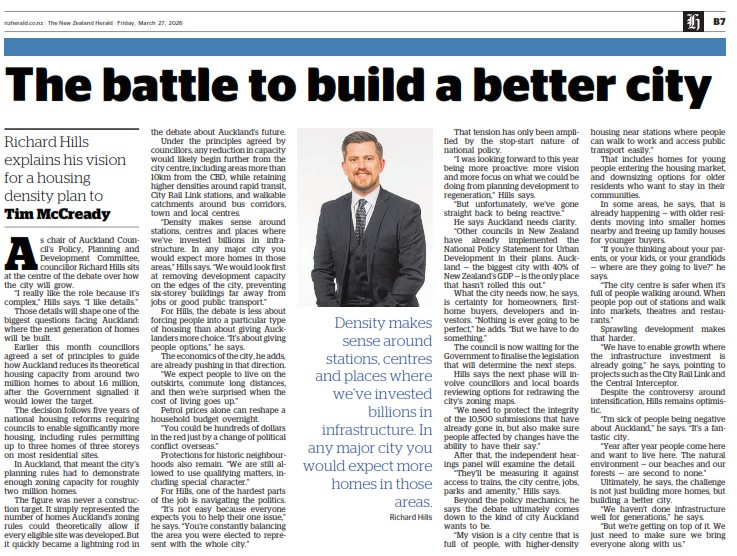
Richard Hills explains his vision for a housing density plan to Tim McCready
As chair of Auckland Council’s Policy, Planning and Development Committee, councillor Richard Hills sits at the centre of the debate over how the city will grow.
“I really like the role because it’s complex,” Hills says. “I like details.”
Those details will shape one of the biggest questions facing Auckland: where the next generation of homes will be built.
Earlier this month councillors agreed a set of principles to guide how Auckland reduces its theoretical housing capacity from around two million homes to about 1.6 million, after the Government signalled it would lower the target.
The decision follows five years of national housing reforms requiring councils to enable significantly more housing, including rules permitting up to three homes of three storeys on most residential sites.
In Auckland, that meant the city’s planning rules had to demonstrate enough zoning capacity for roughly two million homes.
The figure was never a construction target. It simply represented the number of homes Auckland’s zoning rules could theoretically allow if every eligible site was developed. But it quickly became a lightning rod in the debate about Auckland’s future.
Under the principles agreed by councillors, any reduction in capacity would likely begin further from the city centre, including areas more than 10km from the CBD, while retaining higher densities around rapid transit, City Rail Link stations, and walkable catchments around bus corridors, town and local centres.
“Density makes sense around stations, centres and places where we’ve invested billions in infrastructure. In any major city you would expect more homes in those areas,” Hills says. “We would look first at removing development capacity on the edges of the city, preventing six-storey buildings far away from jobs or good public transport.”
For Hills, the debate is less about forcing people into a particular type of housing than about giving Aucklanders more choice. “It’s about giving people options,” he says.
The economics of the city, he adds, are already pushing in that direction.
“We expect people to live on the outskirts, commute long distances, and then we’re surprised when the cost of living goes up.”
Petrol prices alone can reshape a household budget overnight.
“You could be hundreds of dollars in the red just by a change of political conflict overseas.”
Protections for historic neighbourhoods also remain. “We are still allowed to use qualifying matters, including special character.”
For Hills, one of the hardest parts of the job is navigating the politics.
“It’s not easy because everyone expects you to help their one issue,” he says. “You’re constantly balancing the area you were elected to represent with the whole city.”
That tension has only been amplified by the stop-start nature of national policy.
“I was looking forward to this year being more proactive: more vision and more focus on what we could be doing from planning development to regeneration,” Hills says.
“But unfortunately, we’ve gone straight back to being reactive.”
He says Auckland needs clarity.
“Other councils in New Zealand have already implemented the National Policy Statement for Urban Development in their plans. Auckland — the biggest city with 40% of New Zealand’s GDP — is the only place that hasn’t rolled this out.”
What the city needs now, he says, is certainty for homeowners, firsthome buyers, developers and investors. “Nothing is ever going to be perfect,” he adds. “But we have to do something.”
The council is now waiting for the Government to finalise the legislation that will determine the next steps.
Hills says the next phase will involve councillors and local boards reviewing options for redrawing the city’s zoning maps.
“We need to protect the integrity of the 10,500 submissions that have already gone in, but also make sure people affected by changes have the ability to have their say.”
After that, the independent hearings panel will examine the detail.
“They’ll be measuring it against access to trains, the city centre, jobs, parks and amenity,” Hills says.
Beyond the policy mechanics, he says the debate ultimately comes down to the kind of city Auckland wants to be.
“My vision is a city centre that is full of people, with higher-density housing near stations where people can walk to work and access public transport easily.”
That includes homes for young people entering the housing market, and downsizing options for older residents who want to stay in their communities.
In some areas, he says, that is already happening — with older residents moving into smaller homes nearby and freeing up family houses for younger buyers.
“If you’re thinking about your parents, or your kids, or your grandkids — where are they going to live?” he says.
“The city centre is safer when it’s full of people walking around. When people pop out of stations and walk into markets, theatres and restaurants.”
Sprawling development makes that harder.
“We have to enable growth where the infrastructure investment is already going,” he says, pointing to projects such as the City Rail Link and the Central Interceptor.
Despite the controversy around intensification, Hills remains optimistic.
“I’m sick of people being negative about Auckland,” he says. “It’s a fantastic city.
“Year after year people come here and want to live here. The natural environment — our beaches and our forests — are second to none.”
Ultimately, he says, the challenge is not just building more homes, but building a better city. “We haven’t done infrastructure well for generations,” he says.
“But we’re getting on top of it. We just need to make sure we bring everyone along with us.”

