
The right mix for success
Tim McCready
Diversity is a productive asset for a globally competitive city, says growth expert
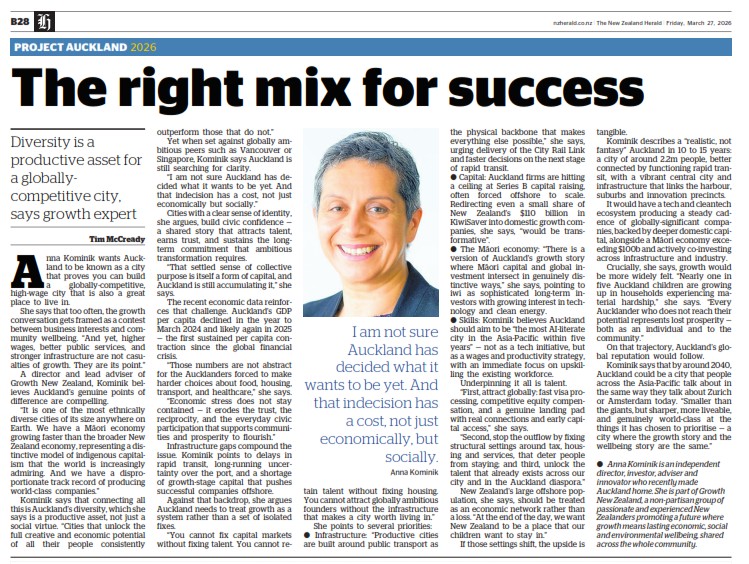
Anna Kominik wants Auckland to be known as a city that proves you can build a globally-competitive, high-wage city that is also a great place to live in.
She says that too often, the growth conversation gets framed as a contest between business interests and community wellbeing. “And yet, higher wages, better public services, and stronger infrastructure are not casualties of growth. They are its point.”
A director and lead adviser of Growth New Zealand, Kominik believes Auckland’s genuine points of difference are compelling.
“It is one of the most ethnically diverse cities of its size anywhere on Earth. We have a Māori economy growing faster than the broader New Zealand economy, representing a distinctive model of indigenous capitalism that the world is increasingly admiring. And we have a disproportionate track record of producing world-class companies.”
Kominik says that connecting all this is Auckland’s diversity, which she says is a productive asset, not just a social virtue. “Cities that unlock the full creative and economic potential of all their people consistently outperform those that do not.”
Yet when set against globally ambitious peers such as Vancouver or Singapore, Kominik says Auckland is still searching for clarity. “I am not sure Auckland has decided what it wants to be yet. And that indecision has a cost, not just economically but socially.”
Cities with a clear sense of identity, she argues, build civic confidence — a shared story that attracts talent, earns trust, and sustains the longterm commitment that ambitious transformation requires.
“That settled sense of collective purpose is itself a form of capital, and Auckland is still accumulating it,” she says.
The recent economic data reinforces that challenge. Auckland’s GDP per capita declined in the year to March 2024 and likely again in 2025 — the first sustained per capita contraction since the global financial crisis.
“Those numbers are not abstract for the Aucklanders forced to make harder choices about food, housing, transport, and healthcare,” she says.
“Economic stress does not stay contained — it erodes the trust, the reciprocity, and the everyday civic participation that supports communities and prosperity to flourish.”
Infrastructure gaps compound the issue. Kominik points to delays in rapid transit, long-running uncertainty over the port, and a shortage of growth-stage capital that pushes successful companies offshore.
Against that backdrop, she argues Auckland needs to treat growth as a system rather than a set of isolated fixes.
“You cannot fix capital markets without fixing talent. You cannot retain talent without fixing housing. You cannot attract globally ambitious founders without the infrastructure that makes a city worth living in.”
She points to several priorities:
- Infrastructure: “Productive cities are built around public transport as the physical backbone that makes everything else possible,” she says, urging delivery of the City Rail Link and faster decisions on the next stage of rapid transit.
- Capital: Auckland firms are hitting a ceiling at Series B capital raising, often forced offshore to scale. Redirecting even a small share of New Zealand’s $110 billion in KiwiSaver into domestic growth companies, she says, “would be transformative”.
- The Māori economy: “There is a version of Auckland’s growth story where Ma ¯ ori capital and global investment intersect in genuinely distinctive ways,” she says, pointing to iwi as sophisticated long-term investors with growing interest in technology and clean energy.
- Skills: Kominik believes Auckland should aim to be “the most AI-literate city in the Asia-Pacific within five years” — not as a tech initiative, but as a wages and productivity strategy, with an immediate focus on upskilling the existing workforce.
Underpinning it all is talent.
“First, attract globally: fast visa processing, competitive equity compensation, and a genuine landing pad with real connections and early capital access,” she says.
“Second, stop the outflow by fixing structural settings around tax, housing and services, that deter people from staying; and third, unlock the talent that already exists across our city and in the Auckland diaspora.”
New Zealand’s large offshore population, she says, should be treated as an economic network rather than a loss. “At the end of the day, we want New Zealand to be a place that our children want to stay in.” If those settings shift, the upside is tangible.
Kominik describes a “realistic, not fantasy” Auckland in 10 to 15 years: a city of around 2.2m people, better connected by functioning rapid transit, with a vibrant central city and infrastructure that links the harbour, suburbs and innovation precincts.
It would have a tech and cleantech ecosystem producing a steady cadence of globally-significant companies, backed by deeper domestic capital, alongside a Māori economy exceeding $100b and actively co-investing across infrastructure and industry.
Crucially, she says, growth would be more widely felt. “Nearly one in five Auckland children are growing up in households experiencing material hardship,” she says. “Every Aucklander who does not reach their potential represents lost prosperity — both as an individual and to the community.”
On that trajectory, Auckland’s global reputation would follow.
Kominik says that by around 2040, Auckland could be a city that people across the Asia-Pacific talk about in the same way they talk about Zurich or Amsterdam today. “Smaller than the giants, but sharper, more liveable, and genuinely world-class at the things it has chosen to prioritise — a city where the growth story and the wellbeing story are the same.”
Anna Kominik is an independent director, investor, adviser and innovator who recently made Auckland home. She is part of Growth New Zealand, a non-partisan group of passionate and experienced New Zealanders promoting a future where growth means lasting economic, social and environmental wellbeing, shared across the whole community.

