
India FTA throws the door wide open for agribusiness opportunities
Trade agreements open doors. The New Zealand-India free trade agreement has thrown one wide open – but people still need to walk through it.
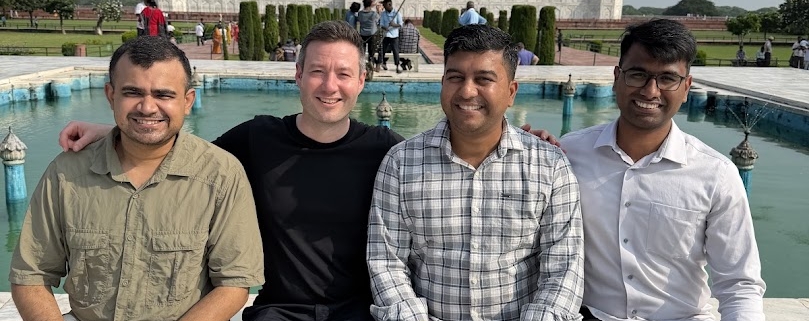
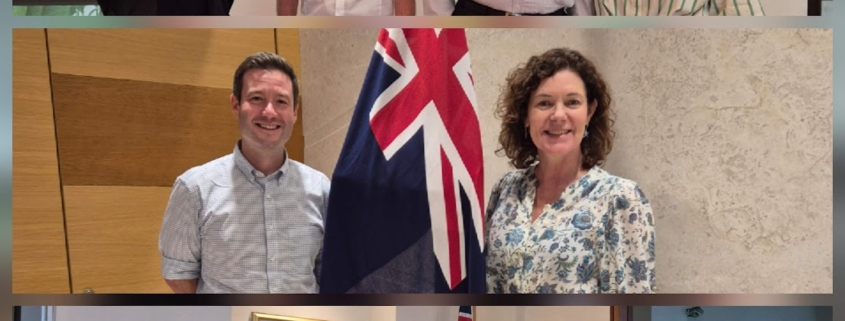
I saw that first-hand last month, accompanying 10 of India’s brightest agribusiness entrepreneurs and business leaders during a week-long visit to New Zealand.
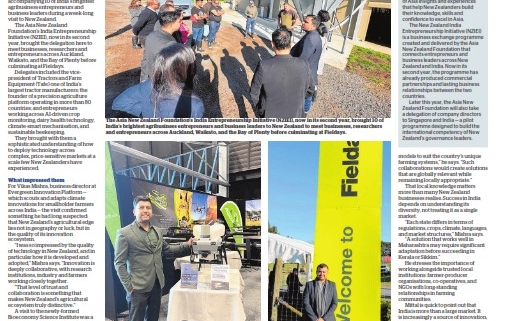
The Asia New Zealand Foundation’s India Entrepreneurship Initiative (NZIEI), now in its second year, brought the delegation here to meet businesses, researchers and entrepreneurs across Auckland, Waikato, and the Bay of Plenty before culminating at Fieldays.
Delegates included the vice-president of Tractors and Farm Equipment (Tafe) one of India’s largest tractor manufacturers; the founder of a precision agriculture platform operating in more than 80 countries; and entrepreneurs working across AI-driven crop monitoring, dairy health technology, climate-smart mechanisation, and sustainable beekeeping.
They brought with them a sophisticated understanding of how to deploy technology across complex, price-sensitive markets at a scale few New Zealanders have experienced.
For Vikas Mishra, business director at Evergreen Innovation Platform – which scouts and adapts climate innovations for smallholder farmers across India – the visit confirmed something he had long suspected: that New Zealand’s agricultural edge lies not in geography or luck, but in the quality of its innovation ecosystem.
“I was so impressed by the quality of technology in New Zealand, and in particular how it is developed and adopted,” Mishra says. “Innovation is deeply collaborative, with research institutions, industry and farmers working closely together.
“That level of trust and collaboration is something that makes New Zealand’s agricultural ecosystem truly distinctive.”
Mishra was impressed that producers are involved in developing new technologies from the outset, testing and refining innovations before they reach the market.
“Rather than being passive end-users, they actively participate in validating innovations, making the final products far more relevant and practical,” he says.
For Pulkit Mittal, vice-president at Tafe, it was the commercial model that stood out.
“New Zealand consistently creates value beyond the farm gate,” he says, citing Zespri and Comvita as examples of how the country turns agricultural science into globally competitive businesses.
“Innovation here is not technology for technology’s sake, but instead it is designed to solve real problems for growers and producers.”
Fieldays made a strong impression too.
Swapnil Jadhav, founder and CEO of Map My Crop, has attended agricultural trade shows in more than 25 countries. He called Fieldays one of the best he has seen – for the technology on display, but also for the setting, the culture, and the willingness of New Zealand farmers to engage with new ideas.
Several memoranda of understanding were signed during the visit, with further partnerships already under negotiation.
Rohan Ursal, who joined last year’s inaugural delegation, has since introduced the New Zealand apple variety Rouge to India, where an entire container sold out in a single day.
He is now importing Royal Gala through his company and is receiving inbound interest from New Zealand growers seeking Indian buyers.
“This year, we have people connecting with us – new suppliers and small growers from New Zealand trying to seek new markets and new buyers like us in India,” Ursal says.
He credits both the FTA and Rouge’s commercial success for the growing interest from New Zealand suppliers.
“In the next five years, I think we will see very good growth in this sector.”
But New Zealand would be making a mistake if it viewed India simply as an export destination. Both Mishra and Mittal were clear that the value runs both ways.
“The opportunities are significant because our strengths are highly complementary,” Mittal says.
“New Zealand brings world-class expertise in dairy, horticulture, sustainability and agricultural science, while India offers scale, manufacturing capability, digital innovation and a rapidly growing agritech ecosystem.”
Mishra sees horticulture innovation as particularly promising.
He suggests technologies developed for New Zealand apple orchards could be adapted for apple growers in Shimla and Kashmir, or for orange farmers in Maharashtra.
“The opportunity lies in developing technologies together and then adapting deployment models to suit the country’s unique farming systems,” he says. “Such collaborations would create solutions that are globally relevant while remaining locally appropriate.”
That local knowledge matters more than many New Zealand businesses realise. Success in India depends on understanding its diversity, not treating it as a single market.
“Each state differs in terms of regulations, crops, climate, languages, and market structures,” Mishra says.
“A solution that works well in Maharashtra may require significant adaptation before succeeding in Kerala or Sikkim.”
He stresses the importance of working alongside trusted local institutions: farmer-producer organisations, co-operatives, and NGOs with long-standing relationships in farming communities.
Mittal is quick to point out that India is more than a large market. It is increasingly a source of innovation, engineering talent and technology solutions.
“The greatest opportunities will come from partnerships and co-development rather than simply exporting products,” he says.
The NZIEI programme is designed to build those relationships. Next year, the Foundation will take a reciprocal delegation of New Zealand businesses to India.
When they go, Mishra has some advice:
“I encourage New Zealand businesses not to underestimate Indian farmers,” he says. “They are remarkably knowledgeable, entrepreneurial, and practical. They quickly recognise technologies that genuinely solve problems – and are equally quick to reject those that do not.”
The free trade agreement has created the opportunity. Whether New Zealand captures it will depend on relationships, trust, and a willingness to see India as a long-term partner rather than just another export market.
The door is open. Now it’s time to walk through it.
The Asia New Zealand Foundation is New Zealand’s leading provider of Asia insights and experiences that help New Zealanders build their knowledge, skills and confidence to excel in Asia.
The New Zealand India Entrepreneurship Initiative (NZIEI) is a business exchange programme created and delivered by the Asia New Zealand Foundation that connects entrepreneurs and business leaders across New Zealand and India. Now in its second year, the programme has already produced commercial partnerships and lasting business relationships between the two countries.
Later this year, the Foundation will also take a delegation of company directors to Singapore and India – a pilot programme designed to build the international competency of New Zealand’s governance leaders.
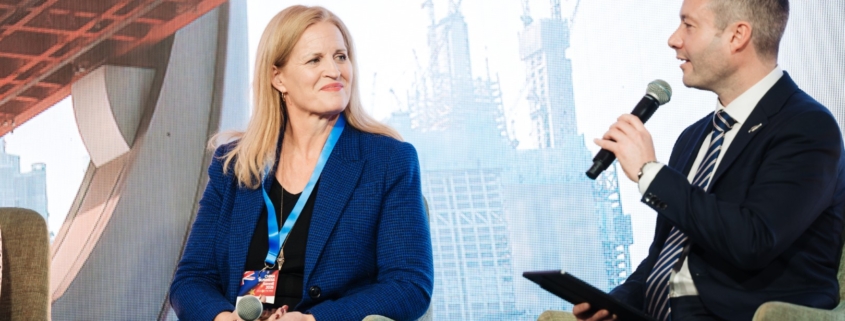
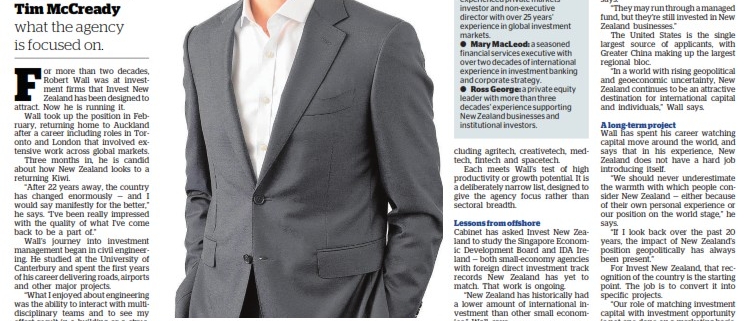
Robert Wall has returned home to lead Invest New Zealand. Three months in as the inaugural chief executive, he tells Tim McCready what the agency is focused on.
For more than two decades, Robert Wall was at investment firms that Invest New Zealand has been designed to attract. Now he is running it.
Wall took up the position in February, returning home to Auckland after a career that included roles in Toronto and London and involved extensive work across global markets.
Three months in, Wall is candid about how New Zealand looks to a returning Kiwi.
“After 22 years away, the country has changed enormously – and I would say manifestly for the better,” he says.
“I’ve been really impressed with the quality of what I’ve come back to be a part of.”
Wall’s journey into investment management began in civil engineering. He studied at the University of Canterbury and spent the first years of his career delivering roads, airports and other major projects.
“What I enjoyed about engineering was the ability to interact with multi-disciplinary teams and to see my effort result in a building or a structure or something that we could look back on,” he says.
“But I realised that is just a small piece of the puzzle. I thought, wouldn’t it be great to be involved in that whole lifecycle? Who had the idea? How did they get the money to build it?”
That curiosity took him into private infrastructure investing. Wall was a founding member of the infrastructure investments team at the Canada Pension Plan Investment Board, then a partner at United States-headquartered Federated Hermes.
He joined Lazard Asset Management in 2021 as head of sustainable private infrastructure and was most recently managing director and co-head of the firm’s quantitative and alternative investment management committee.
Through those roles he ran investment strategies for sovereign wealth funds, pension giants and insurance companies – the same pools of capital he is now tasked with attracting into New Zealand.
A two-way mandate
Wall is clear about Invest New Zealand’s mandate.
“We are the single co-ordinating entity for engaging with international capital on behalf of New Zealand,” he says. “Our focus is on working with international investors to find ways in which to improve and invest in the future productivity and growth in New Zealand businesses.”
That involves two-way engagement. The agency spends a lot of time with international capital providers, to understand where they want to invest, and where they are running into constraints.
“We are in a unique position in that we can take what the world is telling us, work with the Government to change constraints or create incentives for that capital to flow.
“We need to listen to where the large pools of capital want to invest. We have high quality businesses that have very attractive characteristics for investors in today’s world. We should use that position, this opportunity, go out and communicate that.”
When asked what international investors find difficult about doing business in New Zealand, Wall is candid that he is too early in the role to be definitive. But an opportunity he sees for further investment into New Zealand is that of scale.
“We have lots of high-quality businesses that are small in a global context. We want to be able to use capital and expertise that’s internationally available to unlock that growth potential.”
New Zealand’s distance to the investors Invest New Zealand is trying to attract does not concern him.
“Distance is less of an issue when you’re working in easy-to-move knowledge, telecommunications, and people skills – rather than commodities,” Wall says.
“The challenge as an international investor is in finding countries you can really trust and work with for the long term.”
Stable politics, attractive demographics and rule of law, he says, will always outweigh distance.
Priority sector focus
Wall is explicit that the agency cannot succeed without long-term clarity of focus.
“Not every dollar of capital has the same impact on an economy,” he says.
“A dollar of capital invested in a company or sector that has high productivity or high growth potential will allow us to address the economic challenges in the future.”
That has shaped a set of five priority sectors for the agency: private infrastructure; renewable energy; data centres and AI infrastructure; advanced manufacturing and processing facilities; and technologies including agritech, creativetech, medtech, fintech and spacetech.
Each meets Wall’s test of high productivity or growth potential. It is a deliberately narrow list, designed to give the agency focus rather than sectoral breadth.
Lessons from offshore
Cabinet has asked Invest New Zealand to study the Singapore Economic Development Board and IDA Ireland – both small-economy agencies with FDI track records New Zealand has yet to match. That work is ongoing.
“New Zealand has historically had a lower amount of international investment than other small economies,” Wall says. “We should look at comparable countries and how they’ve succeeded.” He cites Singapore, Denmark, Sweden and, to a degree, Greece and Italy.
Wall acknowledges the limits of direct replication but says there are opportunities for New Zealand to learn from other countries.
“New Zealand has an incredible diaspora. We are part of the Indo-Pacific. While we may not have the same scale of incentives, we can look to replicate some tools that similar-sized countries have used successfully.”
Attracting human and financial capital
The Active Investor Plus (AIP) visa is intended to attract investors who take an active role in helping companies access global knowledge networks, capital and markets. It is designed to generate higher business productivity and job growth.
Settings were refreshed in April last year, introducing two investment categories: Growth (higher-risk investments with a minimum $5 million investment over three years) and Balanced (mixed investments with a minimum of $10 million over five).
Uptake has been substantial. As of May, Immigration New Zealand had received 730 applications under the new settings, representing a potential total minimum investment of $4.26 billion.
Resident visas have been approved and granted to 288 applicants, with $1.69 billion of capital committed into the New Zealand economy.
For Wall, the visa is doing what it was designed to do – bringing into New Zealand both capital and the people behind it.
“The Active Investor Plus is an important part of what we do where it connects the human capital and financial capital that individuals can bring,” he says. “We have a really interesting group of people who have elected to commit their capital and time and want to be a part of New Zealand.”
The majority of AIP capital has so far flowed through Invest New Zealand-approved managed funds and bonds.
“Investments into managed funds are an active contributor to the New Zealand economy and growth,” Wall says. “They may run through a managed fund, but they’re still invested in New Zealand businesses.”
The United States is the single largest source of applicants, with Greater China making up the largest regional bloc.
“In a world with rising geopolitical and geoeconomic uncertainty, New Zealand continues to be an attractive destination for international capital and individuals,” Wall says.
A long-term project
Wall has spent his career watching capital move around the world, and says that in his experience, New Zealand does not have a hard job introducing itself.
“We should never underestimate the warmth with which people consider New Zealand – either because of their own personal experience or our position in the world stage,” he says. “If I look back over the past 20 years, the impact of New Zealand’s position geopolitically has always been present.”
For Invest New Zealand, that recognition of the country is the starting point. The job is to convert it into specific projects.
“Our role of matching investment capital with investment opportunity is not one done on a marketing basis. It’s done on a project-specific basis,” Wall says.
“We’re not an organisation that presents New Zealand at a high level, but one where we go and understand what the international investor is looking for.”
Invest New Zealand was stood up last July, with a board chaired by Rob Morrison confirmed late last year. Wall arrived in February. Visible results – by his own admission – are months and years away.
The challenge ahead is substantial. At the announcement of the Invest New Zealand board last December, Trade and Investment Minister Todd McClay was blunt about the gap.
New Zealand’s stock of foreign direct investment, he said, sat at 37% of GDP against an OECD average of 53%, placing the country 27th of 38 OECD economies on stock and 31st on inflows.
“Chronically low levels of overseas investment have starved this country of capital for infrastructure and business,” McClay said. “Quite simply, we need more capital.”
Closing that gap is the challenge Wall and his team have been handed.
“We have to view this as a long-term project,” Wall says.
“I’m confident we are already seeing the benefit for New Zealand. I see that in some of the projects we’re working on and the impact we’re having with international investors.
“But there is a lot more to do. We’re still in the early innings of this game.”
Who’s on the Invest New Zealand board
Rob Morrison: chairman, an investment banker and corporate leader with a distinguished international career in finance, governance, and sustainability.
Carmel Fisher: deputy chairperson, who is a seasoned investment professional with more than 30 years’ experience in New Zealand’s investment industry.
David Tapsell: a respected legal and governance professional with a career spanning law, Māori economic development, and corporate leadership.
Richard Hedley: an experienced private markets investor and non-executive director with over 25 years’ experience in global investment markets.
Mary MacLeod: a seasoned financial services executive with over two decades of international experience in investment banking and corporate strategy.
Ross George: a private equity leader with more than three decades’ experience supporting New Zealand businesses and institutional investors.
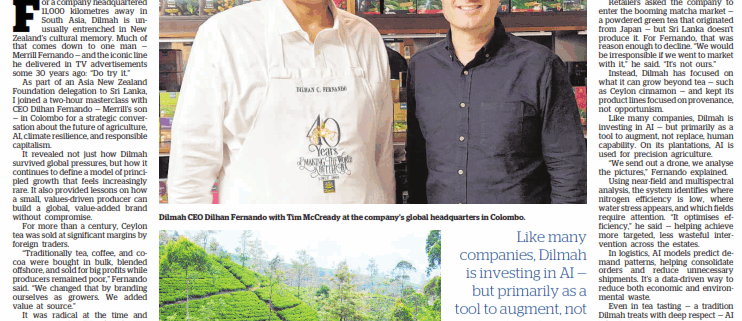
For a company headquartered 11,000 kilometres away in South Asia, Dilmah is unusually entrenched in New Zealand’s cultural memory. Much of that comes down to one man – Merrill Fernando – and the iconic line he delivered in TV advertisements some 30 years ago: “Do try it.”
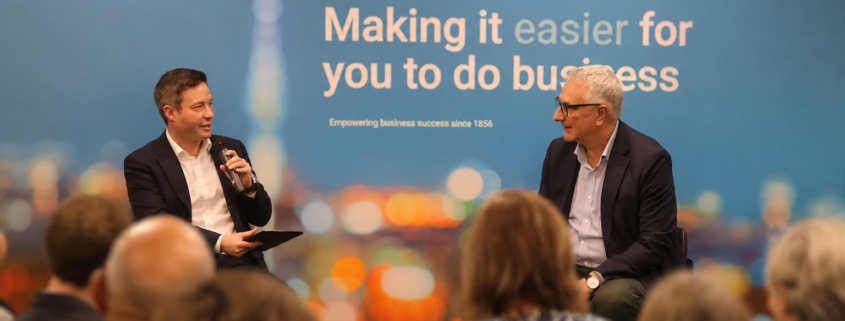
As part of an Asia New Zealand Foundation delegation to Sri Lanka, I joined a two-hour masterclass with CEO Dilhan Fernando – Merrill’s son – in Colombo for a strategic conversation about the future of agriculture, AI, climate resilience, and responsible capitalism.
It was a session that revealed not just how Dilmah survived global pressures, but how it continues to define a model of principled growth that feels increasingly rare. It also provided lessons for New Zealand on how a small, values-driven producer can build a global, value-added brand without compromise.
For more than a century, Ceylon tea was sold at significant margins by foreign traders.
That simple act was radical at the time and remains central to Dilmah’s identity. It’s a mindset he says New Zealanders instinctively understand.
“New Zealanders understand the connection between nature and taste,” said Fernando. “While the importance of ingredients is shared by your wine and dairy industries, around the world I see that respect for artisanship and for ingredients disappearing, sacrificed to discounts and so on.”
Many organisations have been softening or retreating from environmental, social, and governance (ESG) commitments recently, driven by regulatory uncertainty, political pushback, and rising scepticism about real-world impact and costs. Yet Dilmah has held firm – even when it costs.
“Of course, we took the logical step and walked away”.
The decision significantly dropped Dilmah’s market share overnight, but for Fernando, the company’s purpose was non-negotiable.
“Most CEOs have a three-month timeframe. But we think in generations. We are responsible for an ecosystem that includes people and nature.”
Last year was Dilmah’s worst on record for profit – yet it was its greatest for impact.
More than one billion Sri Lankan rupees were invested through its foundation in education, healthcare, disability services, climate science, food programmes, and Sri Lanka’s post-conflict rehabilitation.
“Success is important,” said Fernando. “But significance is success expressed in the lives of others.”
The commitment extends beyond Sri Lanka. “We work in New Zealand with hospice, with the homeless through different organisations,” he said. “In Australia as well, through the Salvation Army, with people struggling with substance abuse and with the homeless.”
Together, these efforts shape a view of business that goes beyond profit. “You realise the purpose of business,” Fernando said. “And you understand what really motivates a business to do more.”
But he was also frank about the pressure ethical businesses face. “The challenge businesses have in doing the right thing today is something exceptional.”
He outlined the realities of sustainable farming: “Looking after the soil, using biochar, biological control for pest management, agroforestry methods. Unfortunately, when you do the right thing, you generally pay a high price for it.”
And yet, that struggle is central to Dilmah’s identity. “It motivates us,” he said simply. “It makes us leaner, fitter.”
Dilmah’s approach to product development also reflects a refusal to compromise.
Retailers asked the company to enter the booming matcha market – a powdered green tea that originated from Japan – but Sri Lanka doesn’t produce it. For Fernando, that was reason enough to decline.
“We would be irresponsible if we went to market with it,” he said. “It’s not ours.”
Instead, Dilmah has focused on what it can grow beyond tea – such as Ceylon cinnamon – and kept its product lines focused on provenance, not opportunism.
Like many companies, Dilmah is investing in AI – but primarily as a tool to augment, not replace, human capability.
On its plantations, AI is used for precision agriculture. “We send out a drone, we analyse the pictures,” Fernando explained. Using near-field and multispectral analysis, the system identifies where nitrogen efficiency is low, where water stress appears, and which fields require attention. “It optimises efficiency,” he said – helping achieve more targeted, less wasteful intervention across the estates.
In logistics, AI models predict demand patterns, helping consolidate orders and reduce unnecessary shipments. It’s a data-driven way to reduce both economic and environmental waste.
Even in tea tasting – a tradition Dilmah treats with deep respect – AI is beginning to play a supporting role. Dilmah’s team tastes around 12,000 teas each week, selecting only the best for its range.
“We use AI to augment that,” Fernando said. Liquor from each batch is run through hyperspectral analysis, creating detailed flavour profiles. The goal is to “create a flavour map” of the many terroirs across the island. “It’s not a replacement for tasters, but another element to support them in their evaluation.”
In a global market where it’s becoming easier to dilute principles than hold them, Dilmah has built a business by refusing to compromise.
Thirty years after Merrill Fernando first invited New Zealanders to “Do try it”, the line still resonates – not only as a tagline for tea, but as a challenge to the business world.
Tim McCready joined the Asia New Zealand Foundation’s delegation to Sri Lanka.