New Zealand investment: Shortage of investment projects and talent holds back growth (NZ Herald)

New Zealand investment: Shortage of investment projects and talent holds back growth (NZ Herald)

Asked how their company’s appetite for investment in New Zealand compared with 12 months ago, a third (32.5%) of respondents to this year’s Mood of the Boardroom survey say it is greater, including 5.5% who say it is much greater. More than half (55.5%) say it is about the same, and just 12% say their appetite is lower.

But a willingness to invest does not necessarily translate into investment. The challenge is finding opportunities that can attract capital, deliver returns and ultimately help build the next generation of internationally successful New Zealand businesses.

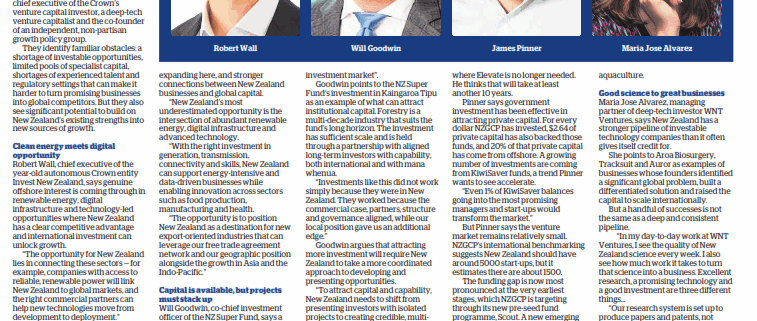
The Herald talked to five people at the heart of New Zealand’s investment system: the chief executive of the Government’s new investment promotion agency, the co-chief investment officer of the country’s sovereign wealth fund, the chief executive of the Crown’s venture capital investor, a deep-tech venture capitalist and the co-founder of an independent, non-partisan growth policy group.

They identify familiar obstacles: a shortage of investable opportunities, limited pools of specialist capital, shortages of experienced talent and regulatory settings that can make it harder to turn promising businesses into global competitors. But they also see significant potential to build on New Zealand’s existing strengths into new sources of growth.

Clean energy meets digital opportunity

Robert Wall, chief executive of the year-old autonomous Crown entity Invest New Zealand, says genuine offshore interest is coming through in renewable energy, digital infrastructure and technology-led opportunities where New Zealand has a clear competitive advantage and international investment can unlock growth.

“The opportunity for New Zealand lies in connecting these sectors — for example, companies with access to reliable, renewable power will link New Zealand to global markets, and the right commercial partners can help new technologies move from development to deployment.”

Wall says investors value New Zealand’s stability, trusted institutions and ease of doing business, balancing that against the practical challenge of a small market that is distant from major global centres. He says recent reforms to overseas investment screening have made the regime faster and more proportionate for lower-risk transactions, but the work on the fundamentals must continue.

“New Zealand needs to keep improving the fundamental drivers of growth that support existing companies and the industries we want to attract in the future, including resilient digital and physical infrastructure, consistent regulation, and confidence in a pipeline of investment opportunities.”

The Active Investor Plus programme is one way of bringing new capital into productive businesses.

“Invest New Zealand assesses applications for managed funds and direct investments under the growth category of the programme, with over $2 billion of capital committed since April 2025,” says Wall.

“These managed funds and direct investments are investing in productive businesses and Invest New Zealand’s role is connecting new capital and capability with credible opportunities and partnerships.”

Success in five years, in Wall’s view, would mean a deeper pipeline of projects at the scale international investors require, more international companies establishing and expanding here, and stronger connections between New Zealand businesses and global capital.

“New Zealand’s most underestimated opportunity is the intersection of abundant renewable energy, digital infrastructure and advanced technology.

“With the right investment in generation, transmission, connectivity and skills, New Zealand can support energy-intensive and data-driven businesses while enabling innovation across sectors such as food production, manufacturing and health.

“The opportunity is to position New Zealand as a destination for new export-oriented industries that can leverage our free trade agreement network and our geographic position alongside the growth in Asia and the Indo-Pacific.”

Capital is available, but projects must stack up

Will Goodwin, co-chief investment officer of the NZ Super Fund, says a large investor isn’t simply asking whether an asset or project is worthwhile. It is asking whether the opportunity is the best use of its risk, liquidity, capability and management attention, relative to the alternatives available globally.

The fund’s local networks, sovereign status and long horizon can create an investment advantage.

“But that is an advantage, not an automatic allocation. New Zealand opportunities must still compete with global alternatives.”

Goodwin says that while New Zealand is consistently rated as an easy place to do business, attracting major investors requires opportunities of sufficient scale.

“Our view is that the issue is often not a shortage of capital, but a shortage of well-prepared, appropriately scaled propositions with robust economics, clear risk allocation and a willingness to include international delivery capability.”

Goodwin says the fund’s discussions with international investors suggest growing interest in New Zealand. Some see it as a standalone market, while others see it as “Australia-adjacent”.

But he says investors raise concerns about policy changes across political cycles, construction capacity, lengthy approval processes and past project setbacks.

He says international peers would characterise New Zealand as “a credible but developing institutional investment market”.

Goodwin points to the NZ Super Fund’s investment in Kaingaroa Tipu as an example of what can attract institutional capital. Forestry is a multi-decade industry that suits the fund’s long horizon. The investment has sufficient scale and is held through a partnership with aligned long-term investors with capability, both international and with mana whenua.

“Investments like this did not work simply because they were in New Zealand. They worked because the commercial case, partners, structure and governance aligned, while our local position gave us an additional edge.”

Goodwin argues that attracting more investment will require New Zealand to take a more coordinated approach to developing and presenting opportunities.

“To attract capital and capability, New Zealand needs to shift from presenting investors with isolated projects to creating credible, multi-year investment pipelines.”

He says the challenge is to connect the investment New Zealand needs with the institutional capital looking for opportunities internationally.

“That requires us to present opportunities with sufficient scale, robust commercial economics, clear risk allocation, durable policy settings and credible execution. New Zealand’s institutions, natural advantages and relationships give it a strong base, but those advantages need to be converted into an investable and repeatable pipeline.”

Venture capital grows, but gaps remain

James Pinner, chief executive of NZ Growth Capital Partners (NZGCP), says New Zealand’s venture market has come a long way since the Elevate NZ Venture Fund launched, though there is still a long way to go.

“Our role has been to catalyse more capital into private venture firms and that has undoubtedly happened. We have now seen over a billion dollars of money go into private VC firms (which flows down into the most promising start-ups) over the first five years of Elevate, more than was seen in the prior 15 years to Elevate launching.”

Several funds are now on their third and fourth vintages, building the track records that Pinner hopes will draw more institutional money over time. The end goal is a deeper and broader cohort of managers backed by institutional investors, to the point where Elevate is no longer needed. He thinks that will take at least another 10 years.

Pinner says government investment has been effective in attracting private capital. For every dollar NZGCP has invested, $2.64 of private capital has also backed those funds, and 20% of that private capital has come from offshore. A growing number of investments are coming from KiwiSaver funds, a trend Pinner wants to see accelerate.

“Even 1% of KiwiSaver balances going into the most promising managers and start-ups would transform the market.”

But Pinner says the venture market remains relatively small. NZGCP’s international benchmarking suggests New Zealand should have around 5000 start-ups, but it estimates there are about 1500.

The funding gap is now most pronounced at the very earliest stages, which NZGCP is targeting through its new pre-seed fund programme, Scout. A new emerging manager fund of funds, Launch, announced in Budget 2026, will back more first-time managers.

Pinner says the global surge in investment into artificial intelligence has made it harder for businesses outside the sector, including medtech and climate tech companies, to attract international funding.

“That means that the bar for those companies raising capital internationally is higher and domestic funds are having to back them for longer along their development journeys than previously.”

He also believes New Zealand needs to do more to encourage entrepreneurial ambition and accept the risks that come with it.

“We should be celebrating those who try, even if they fail. And we should certainly celebrate more those who do succeed.”

Pinner sees growing opportunities in deep technology, particularly industrial clean technology spanning wastewater treatment, recycling, e-waste and the processing of mining and manufacturing waste. Medtech remains a strength, although he says some of New Zealand’s biggest successes continue to come from software.

He points to Rocket Lab and favourable regulatory settings as helping create a new generation of space companies and believes New Zealand could replicate that success in marine technology, from environmental monitoring to aquaculture.

Good science to great businesses

Maria Jose Alvarez, managing partner of deep-tech investor WNT Ventures, says New Zealand has a stronger pipeline of investable technology companies than it often gives itself credit for.

She points to Aroa Biosurgery, Tracksuit and Auror as examples of businesses whose founders identified a significant global problem, built a differentiated solution and raised the capital to scale internationally.

But a handful of successes is not the same as a deep and consistent pipeline.

“In my day-to-day work at WNT Ventures, I see the quality of New Zealand science every week. I also see how much work it takes to turn that science into a business. Excellent research, a promising technology and a good investment are three different things…

“Our research system is set up to produce papers and patents, not founders. Investability is not something we simply find in a company; we have to strategically build it.”

Nor, in her view, is the capital base set up for deep tech — at least not at the scale New Zealand’s potential needs.

She says part of the problem lies in how New Zealanders invest their savings, with much of the country’s wealth tied up in property and offshore listed markets. KiwiSaver has become one of the country’s largest pools of capital, but she says relatively little reaches the private companies with the potential to lift productivity.

“Deep tech needs 10- to 15-year horizons, investors who can judge technical risk, and money held in reserve to follow on through several rounds. Our capital base is thin on all three.”

Alvarez says companies frequently struggle when moving from technical proof of concept to commercial and industrial validation — a stage where both capital and specialist commercial expertise are in short supply.

She wants government investment to be targeted at opportunities that would struggle to attract private capital on their own.

“Its capital should go where it makes the difference: backing the companies and fund managers that would not otherwise exist, so the private sector can decide whether to keep backing them once they have proven themselves.”

Alvarez says founders must also think internationally much earlier in a company’s development.

“The strongest companies use New Zealand as their research base and proving ground, but they are built for global markets from the start. That is what makes them attractive to international investors.”

Despite the challenges, Alvarez believes New Zealand has already demonstrated that it can produce globally successful technology businesses.

“We no longer need to prove that globally successful technology companies can come from New Zealand. The next step is moving from individual success stories to a repeatable way of creating, funding and scaling them.”

Keeping more of the gains in NZ

Bowen Pan, co-founder of Growth NZ, says New Zealand has the opportunity to create many more global champions, and to keep them anchored here long enough to retain a significant share of the value they create.

“Companies like Fisher & Paykel Healthcare, Xero, Partly and Gallagher all show that New Zealand can produce global winners. But too often they succeed despite our settings rather than because of them.”

Technology is already New Zealand’s third-largest export earner, Pan notes, but the country still lacks depth in experienced scale-up talent and growth capital — and the two reinforce each other.

“Talent attracts capital, successful companies build experience, and that experience creates the next generation of founders and operators.”

To help address the talent shortage, Growth NZ has proposed a Catalyst visa that would allow up to 300 exceptional international specialists to enter New Zealand each year, without requiring a job offer upfront.

Applicants would need to demonstrate independently verified, internationally exceptional achievement and would have 12 months to begin qualifying work. Visa holders could take up employment, establish companies or work independently across multiple organisations. “A small, targeted intake would bring experience hard to build quickly at home.”

Growth NZ also wants to make it easier for skilled migrants to change jobs and work across organisations, alongside faster, batched processing for workers already on Accredited Employer Work Visas.

On growth capital, Pan says New Zealand has made progress, although the market remains relatively immature.

“There’s much more capital than there used to be, but we’re still in the early innings.”

He wants more of New Zealand’s large pools of long-term capital, including KiwiSaver funds and iwi, to participate in high-growth companies, while continuing to welcome international capital and expertise.

Pan says he would double down on sectors already getting real traction, from software and space to agritech, biotech, and climate and energy technology.

“At the same time, our small size should also be an advantage: for example, we can use our regulatory agility to make New Zealand one of the best places in the world to test, incubate and scale new ideas.”

He believes global expansion and maintaining a strong New Zealand base need not be competing objectives.

“The goal isn’t to keep every job or activity in New Zealand. It’s to keep enough of the company anchored here — ownership, intellectual property, research and development, leadership and high-value jobs — so New Zealand continues to participate meaningfully in the wealth created as these companies become global winners.”
 

Fuel crisis tops NZ business leaders’ global concerns (NZ Herald)

Fuel crisis tops NZ business leaders’ global concerns (NZ Herald)

A year ago, tariffs and great-power rivalry dominated boardroom concerns. This year, the fuel crisis and oil prices have taken over.

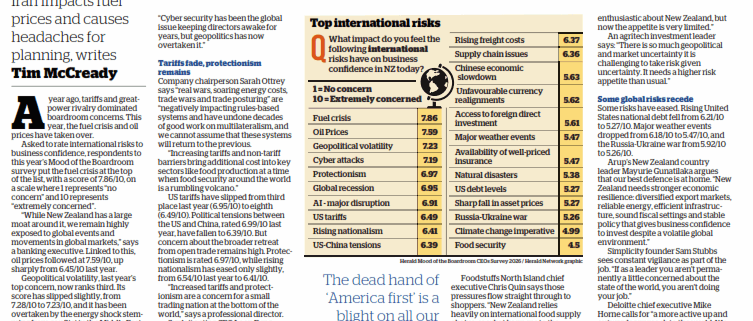
Asked to rate international risks to business confidence, respondents to this year’s Mood of the Boardroom survey put the fuel crisis at the top of the list, with a score of 7.86/10, on a scale where 1 represents “no concern” and 10 represents “extremely concerned”.

“While New Zealand has a large moat around it, we remain highly exposed to global events and movements in global markets,” says a banking executive. Linked to this, oil prices followed at 7.59/10, up sharply from 6.45/10 last year.

Geopolitical volatility, last year’s top concern, now ranks third. Its score has slipped slightly, from 7.28/10 to 7.23/10, and it has been overtaken by the energy shock stemming from conflict in the Middle East.

For some, the conflicts have made planning almost impossible. “The wars in Iran and Ukraine make forecasting very difficult,” says one chief executive.

“Geopolitical risk has gone backwards since the last survey,” says one investment firm director.

Institute of Directors chief executive Kirsten Patterson says the shift is showing up in the boardroom. “Cyber security has been the global issue keeping directors awake for years, but geopolitics has now overtaken it.”

Tariffs fade, protectionism remains

Company chair Sarah Ottrey says “real wars, soaring energy costs, trade wars and trade posturing” are “negatively impacting rules-based systems and have undone decades of good work on multilateralism, and we cannot assume that these systems will return to the previous.

“Increasing tariffs and non-tariff barriers bring additional cost into key sectors like food production at a time when food security around the world is a rumbling volcano.”

US tariffs have slipped from third place last year (6.95/10) to eighth (6.49/10). Political tensions between the US and China, rated 6.99/10 last year, have fallen to 6.39/10. But concern about the broader retreat from open trade remains high. Protectionism is rated 6.97/10, while rising nationalism has eased only slightly, from 6.54/10 last year to 6.41/10.

“Increased tariffs and protectionism are a concern for a small trading nation at the bottom of the world,” says a professional director.

Synlait acting CEO Leon Fung names the “global trend of nationalism, protectionism and geopolitical tensions” among the top issues facing the nation.

Another respondent is blunt: “The dead hand of ‘America first’ is a blight on all our houses.”

New Zealand International Business Forum’s Felicity Roxburgh warns: “Conflict in our own region would be severely damaging for exporters and our access to global supply chains.”

Supply chain issues have risen to 6.36/10, from 5.75/10, while rising freight costs have climbed to 6.37/10, from 5.68/10, as higher energy prices feed through the system.

Foodstuffs North Island chief executive Chris Quin says those pressures flow straight through to shoppers. “New Zealand relies heavily on international food supply chains, so what happens to the exchange rate, as well as international supply and shipping costs, ultimately flows through to what New Zealanders pay for many products.”

Concern about access to foreign direct investment has also crept up, from 5.34/10 to 5.61/10.

One professional services CEO says the shift is already visible: “Our global parent had been very enthusiastic about New Zealand, but now the appetite is very limited.”

An agritech investment leader says: “There is so much geopolitical and market uncertainty it is challenging to take risk given uncertainty. It needs a higher risk appetite than usual.”

Some global risks recede

Some risks have eased. Rising United States national debt fell from 6.21/10 to 5.27/10. Major weather events dropped from 6.18/10 to 5.47/10, and the Russia-Ukraine war from 5.92/10 to 5.26/10.

Arup’s New Zealand country leader Mayurie Gunatilaka argues that our best defence is at home. “New Zealand needs stronger economic resilience: diversified export markets, reliable energy, efficient infrastructure, sound fiscal settings and stable policy that gives business confidence to invest despite a volatile global environment.”

Simplicity founder Sam Stubbs sees constant vigilance as part of the job. “If, as a leader you aren’t permanently a little concerned about the state of the world, you aren’t doing your job.”

Deloitte chief executive Mike Horne calls for “a more active up and outwards approach to the world. We are an island nation, but can’t be an island as to how we approach the global economy, technology and connectedness.”

Ottrey sees an upside. “Negative global impacts highlight the competitive advantage that is Aotearoa New Zealand — a stunning, safe destination for travel and the world-class producer of high-quality, trusted protein and other food.”

NZ Super age: 82% of business leaders back raising eligibility (NZ Herald)

NZ Super age: 82% of business leaders back raising eligibility (NZ Herald)

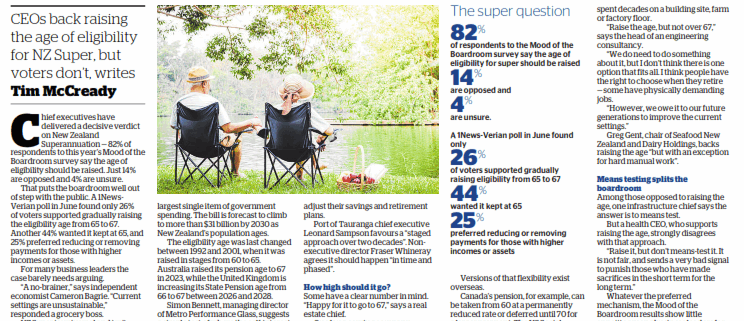
Chief executives have delivered a decisive verdict on New Zealand Superannuation – 82% of respondents to this year’s Mood of the Boardroom survey say the age of eligibility should be raised. Just 14% are opposed and 4% are unsure.

That puts the boardroom well out of step with the public. A 1News-Verian poll in June found only 26% of voters supported gradually raising the eligibility age from 65 to 67. Another 44% wanted it kept at 65, and 25% preferred reducing or removing payments for those with higher incomes or assets.

For many business leaders the case barely needs arguing.

“A no-brainer,” independent economist Cameron Bagrie says. “Current settings are unsustainable,” responded a grocery boss.

NZ Super is universal and isn’t means-tested. It is paid to everyone aged 65 and over who meets the residency requirements, regardless of their income, assets or whether they are still working. That simplicity has long been one of its strengths. But as the population ages, it comes with an increasingly large fiscal bill.

More than 960,000 New Zealanders get NZ Super, at a cost of about $24.7 billion a year. That makes it the largest single item of government spending. The bill is forecast to climb to more than $31b by 2030 as New Zealand’s population ages.

The eligibility age was last changed between 1992 and 2001, when it was raised in stages from 60 to 65. Australia raised its pension age to 67 in 2023, while the United Kingdom is increasing its State Pension age from 66 to 67 between 2026 and 2028.

Simon Bennett, managing director of Metro Performance Glass, suggests a simple test of where the self-interest lies: “Ask for a show of hands in the room of all those over 60. Ask them to keep them raised if they need super when they’re 65.”

But support for a higher eligibility age does not mean CEOs want an abrupt change.

The most common theme from respondents is that any change must be gradual and signalled well in advance, so people have time to adjust their savings and retirement plans.

Port of Tauranga chief executive Leonard Sampson favours a “staged approach over two decades”. Non-executive director Fraser Whineray agrees it should happen “in time and phased”.

How high should it go?

Some have a clear number in mind. “Happy for it to go to 67,” a real estate chief says.

One long-serving company director goes further and would raise the age to 70 over 10 years.

Under her proposal, people could still elect to receive NZ Super from 67 at a lower rate, with payments calibrated so the expected lifetime value was broadly the same.

This would see the total value of payments over a person’s retirement be about the same whichever age they chose to start.

Versions of that flexibility exist overseas.

Canada’s pension, for example, can be taken from 60 at a permanently reduced rate or deferred until 70 for a larger payment. The US Social Security system also adjusts payments according to the age at which they are claimed.

One age does not fit all

A recurring qualification is fairness for people in physically demanding jobs. Several respondents point out that asking a 67-year-old lawyer to work longer is very different from asking the same of someone who has spent decades on a building site, farm or factory floor.

“Raise the age, but not over 67,” the head of an engineering consultancy says.

“We do need to do something about it, but I don’t think there is one option that fits all. I think people have the right to choose when they retire – some have physically demanding jobs.

“However, we owe it to our future generations to improve the current settings.”

Greg Gent, chair of Seafood New Zealand and Dairy Holdings, backs raising the age “but with an exception for hard manual work”.

Means-testing splits the boardroom

Among those opposed to raising the age, one infrastructure chief says the answer is to means-test.

But a health CEO, who supports raising the age, strongly disagrees with that approach.

“Raise it, but don’t means-test it. It is not fair, and sends a very bad signal to punish those who have made sacrifices in the short term for the long term.”

Whatever the preferred mechanism, the Mood of the Boardroom results show little appetite among business leaders for leaving the system untouched.

For most, the question is about how quickly, how far, and what protections should accompany it.

An energy CEO frames the argument in intergenerational terms: “This needs to happen – it is bloody selfish to be burdening our tamariki and mokopuna [children and grandchildren] with the long-term debt levels caused by the refusal to raise the retirement age.”

Supermarket shake-up policies score below 2 out of 5 in boardroom survey (NZ Herald)

Supermarket shake-up policies score below 2 out of 5 in boardroom survey (NZ Herald)

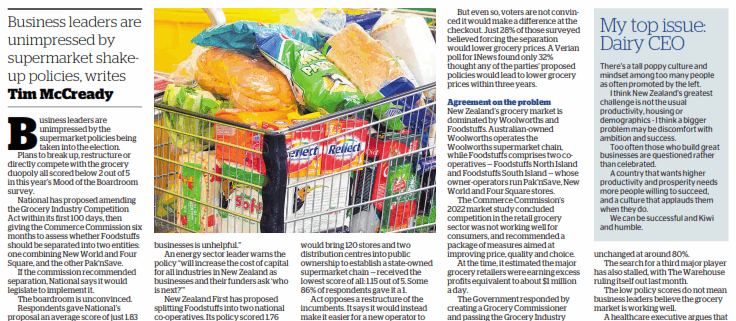
Business leaders are unimpressed by supermarket shake-up policies, writes Tim McCready

Business leaders are unimpressed by the supermarket policies being taken into the election.

Plans to break up, restructure or directly compete with the grocery duopoly all scored below 2 out of 5 in this year’s Mood of the Boardroom survey.

National has proposed amending the Grocery Industry Competition Act within its first 100 days, then giving the Commerce Commission six months to assess whether Foodstuffs should be separated into two entities: one combining New World and Four Square, and the other Pak’nSave.

If the commission recommended separation, National says it would legislate to implement it.

The boardroom is unconvinced

Respondents gave National’s proposal an average score of just 1.83 out of 5, where 1 was ‘not impressive’ and 5 was ‘very impressive’. More than half — 51% — gave it the lowest possible score of 1 out of 5.

“The Foodstuffs move seems to be driven more by the need to be seen to be doing something than by any strong rationale,” says a property sector director.

Another non-executive director is similarly sceptical: “Signalling the potential break-up of privately held businesses is unhelpful.”

An energy sector leader warns the policy “will increase the cost of capital for all industries in New Zealand as businesses and their funders ask ‘who is next?’”

New Zealand First has proposed splitting Foodstuffs into two national co-operatives. Its policy scored 1.76 out of 5.

Labour would require Foodstuffs and Woolworths to operate independent wholesale businesses, guarantee smaller grocers access to wholesale supply on fair terms, and free Four Square operators from restraints of trade.

This policy scores 1.81/5, with 47% rating it 1/5.

The Green Party’s KiwiMart proposal — a $2.8 billion plan that would bring 120 stores and two distribution centres into public ownership to establish a state-owned supermarket chain — received the lowest score of all: 1.15 out of 5. Some 86% of respondents gave it a 1.

Act opposes a restructure of the incumbents. It says it would instead make it easier for a new operator to enter the market, through streamlined consenting and fewer council hurdles.

Boardroom out of step with voters

The boardroom’s verdict is much harsher than the public’s. A Talbot Mills poll commissioned by Foodstuffs found 45% of respondents supported National’s policy to investigate separating Pak’nSave from New World, with 38% opposed.

But even so, voters are not convinced it would make a difference at the checkout. Just 28% of those surveyed believed forcing the separation would lower grocery prices. A Verian poll for 1News found only 32% thought any of the parties’ proposed policies would lead to lower grocery prices within three years.

Agreement on the problem

New Zealand’s grocery market is dominated by Woolworths and Foodstuffs. Australian-owned Woolworths operates the Woolworths supermarket chain, while Foodstuffs comprises two co-operatives — Foodstuffs North Island and Foodstuffs South Island — whose owner-operators run Pak’nSave, New World and Four Square stores.

The Commerce Commission’s 2022 market study concluded competition in the retail grocery sector was not working well for consumers, and recommended a package of measures aimed at improving price, quality and choice.

At the time, it estimated the major grocery retailers were earning excess profits equivalent to about $1 million a day.

The Government responded by creating a Grocery Commissioner and passing the Grocery Industry Competition Act. In 2024, the commission declined clearance for the two Foodstuffs co-operatives to merge, saying it was not satisfied the deal would avoid substantially lessening competition.

Progress since has been slow. The commission’s latest annual grocery report, released in June, found “little observable change in core competition metrics”, with the two groups’ combined market share essentially unchanged at around 80%.

The search for a third major player has also stalled, with The Warehouse ruling itself out last month.

The low policy scores do not mean business leaders believe the grocery market is working well.

A healthcare executive argues that addressing cost-of-living pressures “requires targeting monopolies”.

They support “formal inquiries into margins across major banks, the grocery duopoly and energy gentailers to lower everyday costs”.

While many accept there is a competition problem in groceries, there is little confidence that structural decisions designed in the heat of an election campaign will solve it.

Mood of the Boardroom 2026 (NZ Herald)


Election policy uncertainty tops NZ CEOs’ concerns

Each year the Mood of the Boardroom asks CEOs to assess their level of concern about a range of domestic issues. This year, boardroom anxieties have shifted away from electricity and towards politics and the price of fuel.

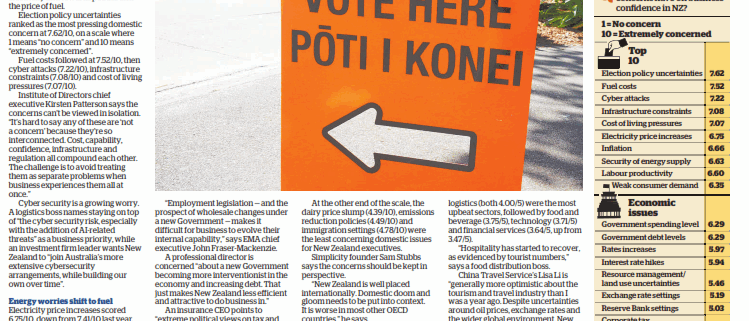
Election policy uncertainties ranked as the most pressing domestic concern at 7.62/10, on a scale where 1 means “no concern” and 10 means “extremely concerned”.

Fuel costs followed at 7.52/10, then cyber attacks (7.22/10), infrastructure constraints (7.08/10) and cost of living pressures (7.07/10).

Institute of Directors chief executive Kirsten Patterson says the concerns can’t be viewed in isolation.

“It’s hard to say any of these are ‘not a concern’ because they’re so interconnected. Cost, capability, confidence, infrastructure and regulation all compound each other. The challenge is to avoid treating them as separate problems when business experiences them all at once.”

Cyber security is a growing worry. A logistics boss names staying on top of “the cyber security risk, especially with the addition of AI-related threats” as a business priority, while an investment firm leader wants New Zealand to “join Australia’s more extensive cybersecurity arrangements, while building our own over time”.

Energy worries shift to fuel

Electricity price increases scored 6.75/10, down from 7.41/10 last year. Security of energy supply fell from 7.26/10 to 6.63/10.

Some respondents say concerns about energy have shifted towards fuel and gas rather than electricity.

“My rating on security of energy supply relates to petroleum-based fuel security,” says an energy sector director. “I am a lot less concerned about security of supply in the electricity sector, and indeed overall energy security and total energy costs would improve if we had more energy independence — largely electricity-driven.”

Another respondent singles out “gas availability and price”.

Policy risk

With the election approaching, many respondents worry about what a change of government could mean for business settings.

“Employment legislation — and the prospect of wholesale changes under a new Government — makes it difficult for business to evolve their internal capability,” says EMA chief executive John Fraser-Mackenzie.

A professional director is concerned “about a new Government becoming more interventionist in the economy and increasing debt. That just makes New Zealand less efficient and attractive to do business in.”

An insurance CEO points to “extreme political views on tax and the belief that success should not be celebrated. This leads us to mediocrity.”

Others cite “sovereign risk” and “poor quality politicians” among their domestic concerns.

An energy CEO warns against derailing what they see as a healthier recovery.

“The economy is experiencing a real recovery rather than an artificial consumer demand-driven one.

“We need to take care not to tip it upside down with ill-thought-out policy settings that punish those in primary industries and energy who are driving the recovery.”

Concern about labour productivity remains high at 6.60/10.

“The real issue is productivity, not simply growth,” says Arup’s New Zealand country leader Mayurie Gunatilaka.

At the other end of the scale, the dairy price slump (4.39/10), emissions reduction policies (4.49/10) and immigration settings (4.78/10) were the least concerning domestic issues for New Zealand executives.

Simplicity founder Sam Stubbs says the concerns should be kept in perspective.

“New Zealand is well placed internationally. Domestic doom and gloom needs to be put into context. It is worse in most other OECD countries,” he says.

Mixed fortunes across industries

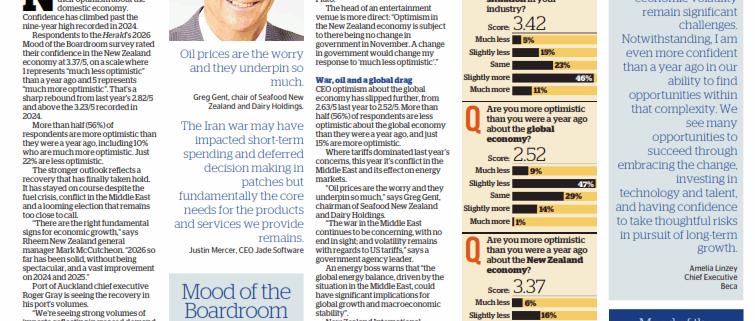
Despite those concerns, optimism about conditions within executives’ own industries has lifted overall. On a scale where 1 means ‘much less optimistic’ than a year ago and 5 means ‘much more optimistic’, respondents rated the business situation in their own industry at 3.42/5. This compares to 2.47/5 in the last election year.

Some 57% of respondents are more optimistic than a year ago, including 11% who are much more optimistic. Just 20% are less optimistic.

The biggest turnaround is in energy. Utilities and energy respondents rated their industry at 3.93/5, up from 2.40/5 last year, when they were near the bottom of the table.

Manufacturing, and transport and logistics (both 4.00/5) were the most upbeat sectors, followed by food and beverage (3.75/5), technology (3.71/5) and financial services (3.64/5, up from 3.47/5).

“Hospitality has started to recover, as evidenced by tourist numbers,” says a food distribution boss.

China Travel Service’s Lisa Li is “generally more optimistic about the tourism and travel industry than I was a year ago. Despite uncertainties around oil prices, exchange rates and the wider global environment, New Zealand’s inbound tourism continues to grow in both volume and value.”

Last year’s leaders have lost ground. Agriculture and agribusiness optimism slipped from 3.80/5 to 3.54/5, while real estate fell further, from 3.80/5 to 3.20/5.

“Political leadership at a local level is not there,” says an agribusiness leader. “Far too much populism driving very short-term decision making.”

Professional services is now the least optimistic of the major sectors, at 2.85/5, down from 3.47/5 last year.

Entertainment and leisure has recovered from the bottom of last year’s table, rising from 2.20/5 to 3.20/5, though challenges remain. One venue chief executive cites “the current constraints of attracting major entertainment content to New Zealand”.

Business confidence hits nine-year high

Business confidence hits nine-year high

New Zealand’s top business leaders have rediscovered their optimism about the domestic economy. Confidence has climbed past the nine-year high recorded in 2024.

Respondents to the Herald’s 2026 Mood of the Boardroom survey rated their confidence in the New Zealand economy at 3.37/5, on a scale where 1 represents “much less optimistic” than a year ago and 5 represents “much more optimistic”. That’s a sharp rebound from last year’s 2.82/5 and above the 3.23/5 recorded in 2024.

More than half (56%) of respondents are more optimistic than they were a year ago, including 10% who are much more optimistic. Just 22% are less optimistic.

The stronger outlook reflects a recovery that has finally taken hold. It has stayed on course despite the fuel crisis, conflict in the Middle East and a looming election that remains too close to call.

“There are the right fundamental signs for economic growth,” says Rheem New Zealand general manager Mark McCutcheon. “2026 so far has been solid, without being spectacular, and a vast improvement on 2024 and 2025.”

Port of Auckland chief executive Roger Gray is seeing the recovery in his port’s volumes.

“We’re seeing strong volumes of imports, reflecting increased demand and economic activity.”

Simplicity founder Sam Stubbs says the economy has proven more resilient than many expected.

“If Kiwis had been told 10 years ago that house prices would be down 20% but the economy was still growing, they wouldn’t have believed it. But that’s exactly what’s happening, pointing to better times ahead.”

Not everyone is convinced the recovery has fully arrived. “Conditions generally do feel like they are improving, but not yet at a level suggesting sustained growth has arrived,” says an energy sector director.

Auckland Business Chamber chief executive Simon Bridges questions whether “okay” is enough.

“The New Zealand economy is okay, but the global economy does concern me …

“On that basis, is just an ‘okay’ economy good enough? I’d argue we need significant reforms that enable us to perform above the mean, not at it.”

A banking executive is more cautious. “New and ongoing global geopolitical events, higher fuel prices, rising interest rates and general election uncertainty have introduced more pessimism than optimism.”

The election factor

For many, this year’s optimism depends on the outcome of the election. “If we have the Government re-elected, I will be much more optimistic,” says Plato Creative’s John Plato.

The head of an entertainment venue is more direct: “Optimism in the New Zealand economy is subject to there being no change in government in November. A change in government would change my response to ‘much less optimistic’.”

War, oil and a global drag

CEO optimism about the global economy has slipped further, from 2.63/5 last year to 2.52/5. More than half (56%) of respondents are less optimistic about the global economy than they were a year ago, and just 15% are more optimistic.

Where tariffs dominated last year’s concerns, this year it’s conflict in the Middle East and its effect on energy markets.

“Oil prices are the worry and they underpin so much,” says Greg Gent, chairman of Seafood New Zealand and Dairy Holdings.

“The war in the Middle East continues to be concerning, with no end in sight; and volatility remains with regards to US tariffs,” says a government agency leader.

An energy boss warns that “the global energy balance, driven by the situation in the Middle East, could have significant implications for global growth and macroeconomic stability”.

New Zealand International Business Forum executive director Felicity Roxburgh says exporters are still finding a way through.

“Unprecedented disruption overseas has meant the international trading environment is tough, but our exports are booming due to our great market access through FTAs, and our high-quality premium goods, which consumers are prepared to pay more for. Plus commodity prices are high and the dollar is weak.”

Some see an opportunity in global uncertainty. “International uncertainty and volatility is our friend, making New Zealand, as an investment destination, even more attractive. We should exploit it as far as we are able,” says an energy CEO.

Non-executive director Fraser Whineray agrees. “The fog lights are on, but we can’t afford to stop. When the rest of the world pauses in certain areas, that is the time for pushing forward with New Zealand’s comparative advantages and structural reform for the long term.”

Company director Rob Campbell provides a measured view: “Optimism is not a business virtue. Neither is pessimism. Realism is.”

AI ranks second among CEOs’ concerns

AI ranks second among CEOs’ concerns

Artificial intelligence has quickly become a topic NZ’s chief executives cannot ignore, writes Tim McCready

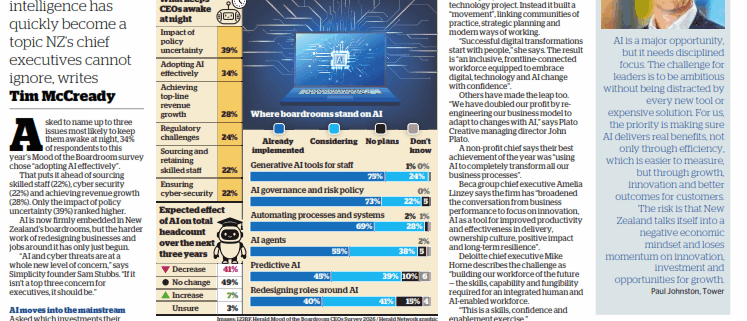
Asked to name up to three issues most likely to keep them awake at night, 34% of respondents to this year’s Mood of the Boardroom survey chose “adopting AI effectively”.

That puts it ahead of sourcing skilled staff (22%), cyber security (22%) and achieving revenue growth (28%). Only the impact of policy uncertainty (39%) ranked higher.

AI is now firmly embedded in New Zealand’s boardrooms, but the harder work of redesigning businesses and jobs around it has only just begun.

“AI and cyber threats are at a whole new level of concern,” says Simplicity founder Sam Stubbs. “If it isn’t a top three concern for executives, it should be.”

AI moves into the mainstream

Asked which investments their companies plan to make in the next 12 months, almost every respondent is either already giving staff generative AI tools or considering doing so.

Some 75% say they have already rolled out generative AI tools, and another 24% are considering it.

The pattern is similar for automating processes and systems: 69% are already doing it and 28% are considering it.

AI agents — software that can carry out entire workflows rather than assisting with individual tasks — are moving quickly into business. Just over half (55%) of respondents say they are already using them, and a further 38% are considering doing so.

Governance policies are keeping pace with adoption. Some 75% already have an AI governance and risk policy in place, and 24% are considering one.

The harder work starts now

Only 40% of respondents say they have redesigned roles around AI — less than half the proportion already giving staff AI tools.

It is also the area with the largest group still undecided: 41% are considering redesigning roles and a further 15% have no plans to.

Predictive AI, which uses data to forecast demand, risk or customer behaviour, has a similar profile: 45% are already using it and 41% are considering it.

AsureQuality, which won this year’s Best ICT Team Culture & Inclusion Award, was one of the few respondents to have already made every AI investment on the survey’s list, including redesigning roles around AI. Yet it expects no material change in headcount as a result.

Chief executive Kim Ballinger says the company didn’t treat AI as a technology project. Instead, it built a “movement”, linking communities of practice, strategic planning and modern ways of working.

“Successful digital transformations start with people,” she says. The result is “an inclusive, frontline-connected workforce equipped to embrace digital, technology and AI change with confidence”.

Others have made the leap too. “We have doubled our profit by re-engineering our business model to adapt to changes with AI,” says Plato Creative managing director John Plato.

A non-profit chief says their best achievement of the year was “using AI to completely transform all our business processes”.

Beca group chief executive Amelia Linzey says the firm has “broadened the conversation from business performance to focus on innovation, AI as a tool for improved productivity and effectiveness in delivery, ownership culture, positive impact and long-term resilience”.

Deloitte chief executive Mike Horne describes the challenge as “building our workforce of the future — the skills, capability and fungibility required for an integrated human and AI-enabled workforce.

“This is a skills, confidence and enablement exercise.”

A financial services leader credits “rapid training, adoption and implementation of AI alongside a permissive risk culture to support the use of these tools”.

AI as a cost-cutting tool

As businesses brace for economic uncertainty, AI has become one of their main tools for cutting costs.

Asked what actions they are taking or contemplating to safeguard against economic challenges over the next 12 months, 54% say they are already using AI to reduce costs and a further 39% are considering it. Just 6% have no plans to.

Only general operating cost reductions (57%) are more widespread. By comparison, just 25% say they are reducing their workforce, 15% have imposed hiring freezes and 15% are slowing investment.

Fewer jobs or different jobs?

Asked what effect AI will have on their company’s total headcount over the next three years, 41% of respondents expect a decrease. A further 49% expect no material change, and just 7% expect AI to increase their headcount. The companies furthest down the AI path are the most likely to expect fewer staff. Among respondents expecting a lower headcount, 62% are already using AI agents, compared with 40% of those expecting no change.

Even so, most expect the change to be modest. A banking executive expects AI to cut headcount “around the edges, but not dramatically”. An infrastructure services boss also expects a decrease, but only a “marginal” one. For others, the nature of the workforce limits the impact. A food distribution boss points to the company’s “large blue-collar workforce”.

Several leaders stress that AI is meant to augment staff, not replace them. “We don’t see AI replacing our workforce. We see it enhancing our people’s skills and capabilities,” says an engineering CEO. “We will still need the human-to-human and critical thinking element.”

A real estate chief who has rolled out AI tools for salespeople and property managers says: “Where we save through AI, we want to move those people into other areas to keep them in employment if they have the skills.”

Investment in people is keeping pace. Some 68% of respondents are already upskilling their workforce in priority areas, and 24% are considering it. The minority expecting AI to grow their workforce see it as an engine of growth rather than a cost-cutting tool. “It’s an opportunity that we should grab with both hands,” says an energy CEO.

NZ’s productivity opportunity

Executives say the stakes are higher for New Zealand than any one company’s bottom line.

Many respondents see AI as one of the few levers that could make a meaningful difference to the country’s long-running productivity problem.

But some see scale as a barrier. “The size of the New Zealand market limits the return on investment for larger capital automation projects, ultimately placing New Zealand at a GDP per capita disadvantage,” says Rheem New Zealand general manager Mark McCutcheon.

An energy sector director sees AI as a potential “game changer in terms of health, education and productivity benefits”, but warns that New Zealand “should grasp the opportunity or risk being left behind”.

The missing ingredient in Election 2026: A vision for New Zealand (NZ Herald)

The missing ingredient in Election 2026: A vision for New Zealand
Tim McCready

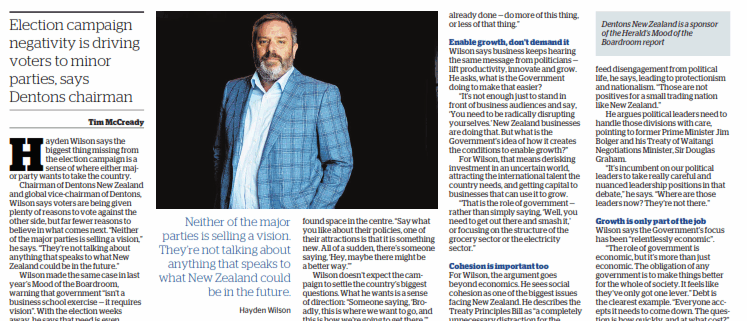
Hayden Wilson says the biggest thing missing from the election campaign is a sense of where either major party wants to take the country.

The chairman of Dentons New Zealand and global vice-chairman of Dentons, Wilson says voters are being given plenty of reasons to vote against the other side, but far fewer reasons to believe in what comes next.

“Neither of the major parties is selling a vision,” he says. “They’re not talking about anything that speaks to what New Zealand could be in the future.”

Wilson made the same case in last year’s Mood of the Boardroom, warning that government “isn’t a business school exercise – it requires vision”. A year on, with the election weeks away, he says that need is even greater.

Both major parties, he argues, are campaigning on a variation of the same line: “we’re not the other guys”.

“It’s relentlessly negative. And I get it – it’s negative because it probably works.”

The cost, he says, is that voters are looking elsewhere. “For me, that is probably the primary driver of the rise of the minor parties.”

He points to the Opportunity Party, which has found space in the centre. “Say what you like about their policies, one of their attractions is that it is something new. All of a sudden, there’s someone saying, ‘Hey, maybe there might be a better way.’”

Wilson doesn’t expect the campaign to settle the country’s biggest questions. What he wants is a sense of direction: “Someone saying, ‘Broadly, this is where we want to go, and this is how we’re going to get there.’”

He lists the “big rocks” New Zealand will need to tackle over the coming decades: funding superannuation, closing the infrastructure deficit, and lifting investment in defence and security as the world grows more volatile.

But the ideas on offer, he says, are recycled. “No one’s talking about how to solve those problems or offering new ways to do it. They’re all variants on things we’ve already done – do more of this thing, or less of that thing.”

Enable growth, don’t just demand it

Wilson says business keeps hearing the same message from politicians – lift productivity, innovate and grow. His question is, what is the Government doing to make that easier?

“It’s not enough just to stand in front of business audiences and say, ‘You need to be radically disrupting yourselves.’ New Zealand businesses are doing that. But what is the Government’s idea of how it creates the conditions to enable growth?”

For Wilson, that means derisking investment in an uncertain world, attracting the international talent the country needs, and getting capital to businesses that can use it to grow.

“That is the role of government – rather than simply saying, ‘Well, you need to get out there and smash it,’ or focusing on the structure of the grocery sector or the electricity sector.”

Cohesion is important too

For Wilson, the argument goes beyond economics. He sees social cohesion as one of the biggest issues facing New Zealand.

He describes the Treaty Principles Bill as “a completely unnecessary distraction for the Government, for a policy that was never going to proceed. It created a platform for a really unpleasant debate on something that needs to be dealt with very carefully.”

Then there’s the growing perception of a K-shaped country, “where some people are doing quite well and some people are really, really struggling”.

Those are the kinds of things that feed disengagement from political life, he says, leading to protectionism and nationalism. “Those are not positives for a small trading nation like New Zealand.”

He argues political leaders need to handle those divisions with care, pointing to former Prime Minister Jim Bolger and his Treaty of Waitangi Negotiations Minister, Sir Douglas Graham.

“It’s incumbent on our political leaders to take really careful and nuanced leadership positions in that debate,” he says. “Where are those leaders now? They’re not there.”

Growth is only part of the job

Wilson says the Government’s focus has been “relentlessly economic”.

“The role of government is economic, but it’s more than just economic. The obligation of any government is to make things better for the whole of society. It feels like they’ve only got one lever.”

Debt is the clearest example. “Everyone accepts it needs to come down. The question is how quickly, and at what cost?”

Ultimately, Wilson sees growth and cohesion as part of the same challenge.

“Where’s the political leadership to say, ‘Look, we’re all in this together.’ How do we ensure New Zealanders as a whole community succeed in the next five, 10, 15, 50 years?’

“For me, that ties back to the same questions: where’s the leadership, and where’s the vision?”