
The missing ingredient in Election 2026: A vision for New Zealand (NZ Herald)
The missing ingredient in Election 2026: A vision for New Zealand
Tim McCready
Hayden Wilson says the biggest thing missing from the election campaign is a sense of where either major party wants to take the country.
The chairman of Dentons New Zealand and global vice-chairman of Dentons, Wilson says voters are being given plenty of reasons to vote against the other side, but far fewer reasons to believe in what comes next.
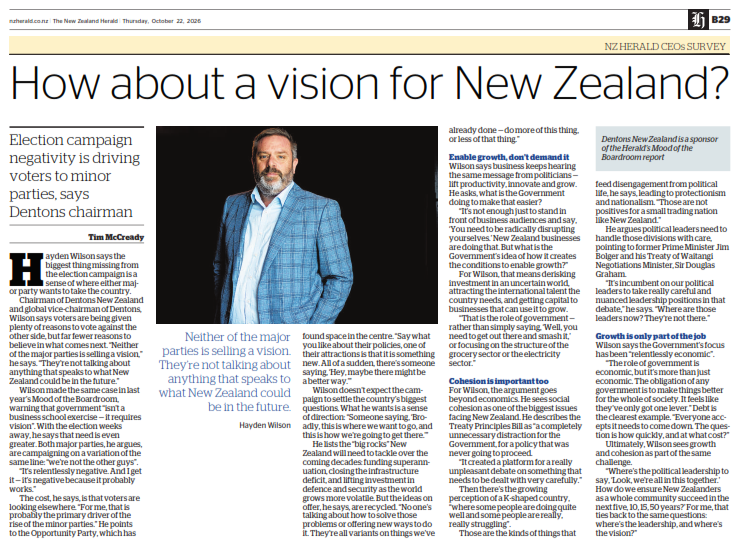
“Neither of the major parties is selling a vision,” he says. “They’re not talking about anything that speaks to what New Zealand could be in the future.”
Wilson made the same case in last year’s Mood of the Boardroom, warning that government “isn’t a business school exercise – it requires vision”. A year on, with the election weeks away, he says that need is even greater.
Both major parties, he argues, are campaigning on a variation of the same line: “we’re not the other guys”.
“It’s relentlessly negative. And I get it – it’s negative because it probably works.”
The cost, he says, is that voters are looking elsewhere. “For me, that is probably the primary driver of the rise of the minor parties.”
He points to the Opportunity Party, which has found space in the centre. “Say what you like about their policies, one of their attractions is that it is something new. All of a sudden, there’s someone saying, ‘Hey, maybe there might be a better way.’”
Wilson doesn’t expect the campaign to settle the country’s biggest questions. What he wants is a sense of direction: “Someone saying, ‘Broadly, this is where we want to go, and this is how we’re going to get there.’”
He lists the “big rocks” New Zealand will need to tackle over the coming decades: funding superannuation, closing the infrastructure deficit, and lifting investment in defence and security as the world grows more volatile.
But the ideas on offer, he says, are recycled. “No one’s talking about how to solve those problems or offering new ways to do it. They’re all variants on things we’ve already done – do more of this thing, or less of that thing.”
Enable growth, don’t just demand it
Wilson says business keeps hearing the same message from politicians – lift productivity, innovate and grow. His question is, what is the Government doing to make that easier?
“It’s not enough just to stand in front of business audiences and say, ‘You need to be radically disrupting yourselves.’ New Zealand businesses are doing that. But what is the Government’s idea of how it creates the conditions to enable growth?”
For Wilson, that means derisking investment in an uncertain world, attracting the international talent the country needs, and getting capital to businesses that can use it to grow.
“That is the role of government – rather than simply saying, ‘Well, you need to get out there and smash it,’ or focusing on the structure of the grocery sector or the electricity sector.”
Cohesion is important too
For Wilson, the argument goes beyond economics. He sees social cohesion as one of the biggest issues facing New Zealand.
He describes the Treaty Principles Bill as “a completely unnecessary distraction for the Government, for a policy that was never going to proceed. It created a platform for a really unpleasant debate on something that needs to be dealt with very carefully.”
Then there’s the growing perception of a K-shaped country, “where some people are doing quite well and some people are really, really struggling”.
Those are the kinds of things that feed disengagement from political life, he says, leading to protectionism and nationalism. “Those are not positives for a small trading nation like New Zealand.”
He argues political leaders need to handle those divisions with care, pointing to former Prime Minister Jim Bolger and his Treaty of Waitangi Negotiations Minister, Sir Douglas Graham.
“It’s incumbent on our political leaders to take really careful and nuanced leadership positions in that debate,” he says. “Where are those leaders now? They’re not there.”
Growth is only part of the job
Wilson says the Government’s focus has been “relentlessly economic”.
“The role of government is economic, but it’s more than just economic. The obligation of any government is to make things better for the whole of society. It feels like they’ve only got one lever.”
Debt is the clearest example. “Everyone accepts it needs to come down. The question is how quickly, and at what cost?”
Ultimately, Wilson sees growth and cohesion as part of the same challenge.
“Where’s the political leadership to say, ‘Look, we’re all in this together.’ How do we ensure New Zealanders as a whole community succeed in the next five, 10, 15, 50 years?’
“For me, that ties back to the same questions: where’s the leadership, and where’s the vision?”

