
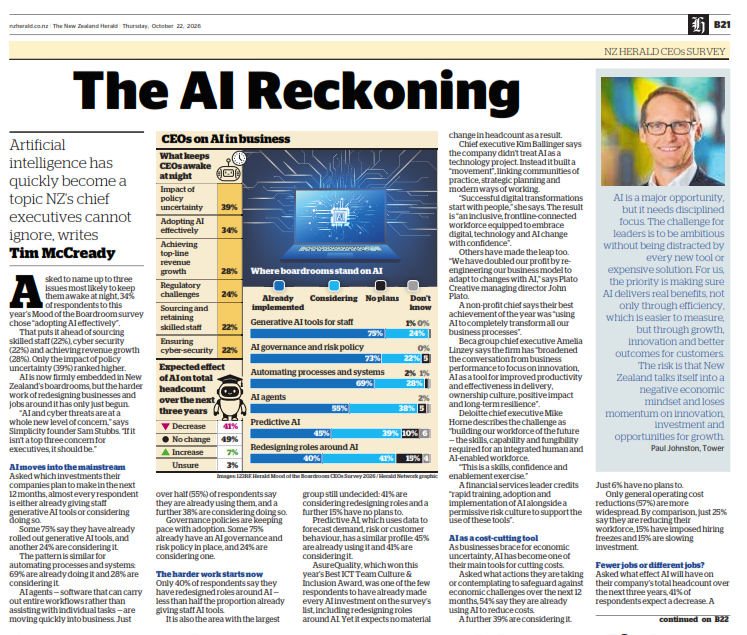
AI ranks second among CEOs’ concerns
AI ranks second among CEOs’ concerns
Artificial intelligence has quickly become a topic NZ’s chief executives cannot ignore, writes Tim McCready
Asked to name up to three issues most likely to keep them awake at night, 34% of respondents to this year’s Mood of the Boardroom survey chose “adopting AI effectively”.
That puts it ahead of sourcing skilled staff (22%), cyber security (22%) and achieving revenue growth (28%). Only the impact of policy uncertainty (39%) ranked higher.
AI is now firmly embedded in New Zealand’s boardrooms, but the harder work of redesigning businesses and jobs around it has only just begun.
“AI and cyber threats are at a whole new level of concern,” says Simplicity founder Sam Stubbs. “If it isn’t a top three concern for executives, it should be.”
AI moves into the mainstream
Asked which investments their companies plan to make in the next 12 months, almost every respondent is either already giving staff generative AI tools or considering doing so.
Some 75% say they have already rolled out generative AI tools, and another 24% are considering it.
The pattern is similar for automating processes and systems: 69% are already doing it and 28% are considering it.
Governance policies are keeping pace with adoption. Some 75% already have an AI governance and risk policy in place, and 24% are considering one.
The harder work starts now
Only 40% of respondents say they have redesigned roles around AI — less than half the proportion already giving staff AI tools.
It is also the area with the largest group still undecided: 41% are considering redesigning roles and a further 15% have no plans to.
Predictive AI, which uses data to forecast demand, risk or customer behaviour, has a similar profile: 45% are already using it and 41% are considering it.
AsureQuality, which won this year’s Best ICT Team Culture & Inclusion Award, was one of the few respondents to have already made every AI investment on the survey’s list, including redesigning roles around AI. Yet it expects no material change in headcount as a result.
Chief executive Kim Ballinger says the company didn’t treat AI as a technology project. Instead, it built a “movement”, linking communities of practice, strategic planning and modern ways of working.
“Successful digital transformations start with people,” she says. The result is “an inclusive, frontline-connected workforce equipped to embrace digital, technology and AI change with confidence”.
Others have made the leap too. “We have doubled our profit by re-engineering our business model to adapt to changes with AI,” says Plato Creative managing director John Plato.
A non-profit chief says their best achievement of the year was “using AI to completely transform all our business processes”.
Beca group chief executive Amelia Linzey says the firm has “broadened the conversation from business performance to focus on innovation, AI as a tool for improved productivity and effectiveness in delivery, ownership culture, positive impact and long-term resilience”.
Deloitte chief executive Mike Horne describes the challenge as “building our workforce of the future — the skills, capability and fungibility required for an integrated human and AI-enabled workforce.
“This is a skills, confidence and enablement exercise.”
A financial services leader credits “rapid training, adoption and implementation of AI alongside a permissive risk culture to support the use of these tools”.
AI as a cost-cutting tool
As businesses brace for economic uncertainty, AI has become one of their main tools for cutting costs.
Asked what actions they are taking or contemplating to safeguard against economic challenges over the next 12 months, 54% say they are already using AI to reduce costs and a further 39% are considering it. Just 6% have no plans to.
Only general operating cost reductions (57%) are more widespread. By comparison, just 25% say they are reducing their workforce, 15% have imposed hiring freezes and 15% are slowing investment.
Fewer jobs or different jobs?
Asked what effect AI will have on their company’s total headcount over the next three years, 41% of respondents expect a decrease. A further 49% expect no material change, and just 7% expect AI to increase their headcount. The companies furthest down the AI path are the most likely to expect fewer staff. Among respondents expecting a lower headcount, 62% are already using AI agents, compared with 40% of those expecting no change.
Even so, most expect the change to be modest. A banking executive expects AI to cut headcount “around the edges, but not dramatically”. An infrastructure services boss also expects a decrease, but only a “marginal” one. For others, the nature of the workforce limits the impact. A food distribution boss points to the company’s “large blue-collar workforce”.
Several leaders stress that AI is meant to augment staff, not replace them. “We don’t see AI replacing our workforce. We see it enhancing our people’s skills and capabilities,” says an engineering CEO. “We will still need the human-to-human and critical thinking element.”
A real estate chief who has rolled out AI tools for salespeople and property managers says: “Where we save through AI, we want to move those people into other areas to keep them in employment if they have the skills.”
Investment in people is keeping pace. Some 68% of respondents are already upskilling their workforce in priority areas, and 24% are considering it. The minority expecting AI to grow their workforce see it as an engine of growth rather than a cost-cutting tool. “It’s an opportunity that we should grab with both hands,” says an energy CEO.
NZ’s productivity opportunity
Executives say the stakes are higher for New Zealand than any one company’s bottom line.
Many respondents see AI as one of the few levers that could make a meaningful difference to the country’s long-running productivity problem.
But some see scale as a barrier. “The size of the New Zealand market limits the return on investment for larger capital automation projects, ultimately placing New Zealand at a GDP per capita disadvantage,” says Rheem New Zealand general manager Mark McCutcheon.
An energy sector director sees AI as a potential “game changer in terms of health, education and productivity benefits”, but warns that New Zealand “should grasp the opportunity or risk being left behind”.

