Biosecurity, trade deals and water storage top KPMG agribusiness priorities

Biosecurity, trade deals and water storage top KPMG agribusiness priorities

Tim McCready

New Zealand’s food and fibre sector could disappear tomorrow and global markets would barely notice.

That was the provocation from one industry leader during this year’s KPMG Agribusiness Agenda roundtable discussions on international markets.

They qualified it: while New Zealand is a relatively small cog in an enormous system, it would absolutely be missed.

Customers do not choose New Zealand because we are the cheapest producer. They choose New Zealand for attributes that are harder to replicate, including its stability, world-class biosecurity, sustainable production systems, adherence to international trade rules, high food safety standards and reputation as an ethical and transparent partner.

Those attributes have earned New Zealand a place in global value chains. The challenge now, as the Agribusiness Agenda outlines, is for the food and fibre sector to build on these strengths while continuously evolving to meet the changing needs of our customers.

New Zealand will never compete by being the biggest producer. New Zealand is a small producer in global terms and geographically distant from almost every customer.

There is consensus among contributors that the peak of globalisation has passed. Governments, rather than markets, are setting the rules for global trade, and geopolitical shifts have become one of the most significant risks exporters now face.

Against that backdrop, several argue that New Zealand’s stability, biosecurity status and reputation for playing by the rules matter as much to buyers as anything coming off the farm.

That conversation sits behind the entire 2026 Agribusiness Agenda.

KPMG challenged contributors with a broad question: whether existing settings remain fit for purpose, or whether more fundamental shifts are required to secure long-term success.

Around three-quarters of contributors favour change over the status quo, noting that current settings and processes may constrain the sector’s potential as it responds to disruption such as climate change and geopolitical shifts.

This doesn’t mean abandoning New Zealand’s strengths. Rather, contributors repeatedly argue for continuous evolution – ensuring products, production systems and business models evolve alongside customer demand instead of relying on historical competitive advantages.

The report identifies 24 “global future shapers” that will reshape food systems over the next quarter century.

They range from geopolitical fragmentation, cyber risk and changing demographics, to AI, water scarcity, climate change and the growing convergence of food and pharmaceuticals.

Others point to the integration of nature into business models – including the rise of the circular bioeconomy – and increasing pressure on ageing infrastructure.

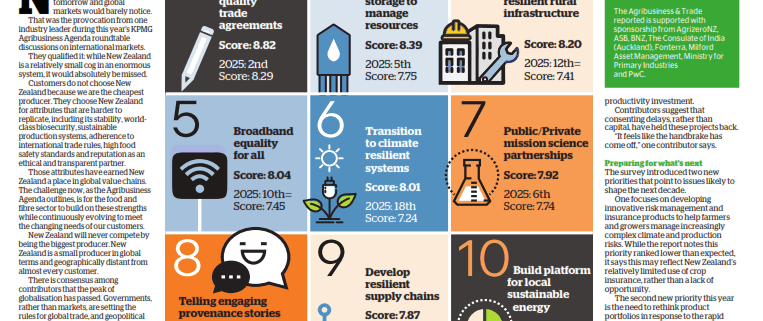
Each year, KPMG asks contributors to score a set of priorities for the organisations they represent in the food and fibre sector. This year, 105 leaders worked through 39 priorities on a scale of 1 to 10, with 10 indicating that the issue is considered a critical priority.

For the 16th consecutive year, world-class biosecurity remains the sector’s highest priority. This year’s score (9.40 out of 10) is the highest score reported for any priority since 2018 – the year Mycoplasma bovis and Myrtle Rust pushed biosecurity to an all-time survey record of 9.62, demonstrating the enormous economic cost of a single biosecurity failure.

The concern now is that future incursions become harder to prevent. Increasing international connectivity and evolving production systems create new pathways for pests and diseases to enter New Zealand.

Contributors point out that many of the country’s most important export sectors are built on monocultures, making a single breach a bigger risk to economic resilience than is often acknowledged – and one that alignment between industry and government is critical to managing.

Signing high-quality trade agreements again ranked second in the survey. Contributors also say that existing agreements need to be actively managed and evolve to remain fit for purpose, and investment is required in regulatory systems and infrastructure to ensure organisations can fully utilise the market access already secured.

Building resilience

Several priorities recorded significant movements in this year’s survey, reflecting how leaders see the sector adapting to a more uncertain future.

Resilient rural infrastructure jumped from 12th-equal last year to fourth place.

Contributors link it directly to operational efficiency – and to the sector’s ability to attract the best talent.

Transition to climate-resilient farming systems rose from 18th last year to sixth, a sharp turnaround for a priority that was ranked lowest of all in 2024.

Building a platform for local sustainable energy climbed into the Top 10 for the first time this year, from 27th in its debut year in 2024, to 12th equal last year, to 10th now.

The rise in water storage as a priority reflects a similar shift. It reached third place – its highest ranking since 2013. Contributors frame water infrastructure as a strategic capability that underpins productivity, social licence and diversification, rather than simply a productivity investment.

Contributors suggest that consenting delays, rather than capital, have held these projects back.

“It feels like the handbrake has come off,” one contributor says.

Preparing for what’s next

The survey introduced two new priorities that point to issues likely to shape the next decade.

One focuses on developing innovative risk management and insurance products to help farmers and growers manage increasingly complex climate and production risks. While the report notes this priority ranked lower than expected, it says this may reflect New Zealand’s relatively limited use of crop insurance, rather than a lack of opportunity.

The second new priority this year is the need to rethink product portfolios in response to the rapid uptake of GLP-1 weight-loss medicines.

This priority ranked 37th with a score of 6.25 – near the bottom of the survey. The report suggests the ranking may understate the significance of the issue.

Around the world, food companies are already reshaping product portfolios as consumer preferences evolve. For New Zealand, the shift may prove more opportunity than threat. Protein sectors broadly are seen as well placed to benefit, with red meat among those already seeing early demand and pricing effects offshore.

Technology, particularly artificial intelligence, sits beneath many of this year’s priorities.

AI is rapidly changing how global consumer packaged goods companies understand consumers, develop products and forecast demand, contributors say. It is no longer a source of competitive advantage in itself. The report describes it as a “ticket to play” – a capability that organisations must have to remain relevant.

That is the thread running through the entire Agribusiness Agenda.

If New Zealand disappeared tomorrow, the world would continue eating. Global commodity markets would adjust. But customers who value trusted supply, ethical production and dependable partners would notice.

The challenge is ensuring they still notice 25 years from now.

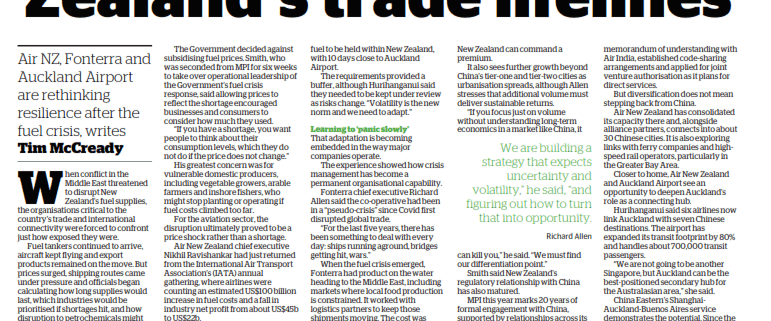
Air New Zealand, Fonterra and Auckland Airport rethink resilience after fuel crisis

Air New Zealand, Fonterra and Auckland Airport rethink resilience after fuel crisis

Tim McCready

When conflict in the Middle East threatened to disrupt New Zealand’s fuel supplies, the organisations critical to the country’s trade and international connectivity were forced to confront just how exposed they were.

Fuel tankers continued to arrive, aircraft kept flying and export products remained on the move. But prices surged, shipping routes came under pressure and officials began calculating how long supplies would last, which industries would be prioritised if shortages hit, and how disruption to petrochemicals might spread through the wider economy.

Those questions framed the opening panel at last month’s China Business Summit, where leaders from Fonterra, Air New Zealand, Auckland Airport and the Ministry for Primary Industries described how repeated shocks have changed the way they manage supply chains, markets and China.

A system with little slack

Ray Smith, director-general of the Ministry for Primary Industries (MPI), said about 30% of New Zealand’s refined fuel comes from Singapore and 60% from South Korea.

Tankers leave for New Zealand almost every other day, a regular flow that received little attention until it came under threat. “We have talked a lot about transition in our fuel supplies and what we do as we move into a greener world, but all of a sudden fossil fuels were disappearing on us quickly,” Smith said.

“There was huge concern about how we would power up the economy.”

Diesel underpins freight, food production and manufacturing. Jet fuel carries passengers, but it also keeps high-value exports moving as cargo.

The exposure extends beyond fuel.

New Zealand produces about a third of its fertiliser and imports the rest, much of it from the Middle East. Plastics, agrochemicals and pharmaceuticals are also vulnerable to disruption in the petrochemical supply chain.

The Government decided against subsidising fuel prices. Smith, who was seconded from MPI for six weeks to take over operational leadership of the Government’s fuel crisis response, said allowing prices to reflect the shortage encouraged businesses and consumers to consider how much they used.

“If you have a shortage, you want people to think about their consumption levels, which they do not do if the price does not change.”

His greatest concern was for vulnerable domestic producers, including vegetable growers, arable farmers and inshore fishers, who might stop planting or operating if fuel costs climbed too far.

For the aviation sector, the disruption ultimately proved to be a price shock rather than a shortage.

Air New Zealand chief executive Nikhil Ravishankar had just returned from the International Air Transport Association’s (IATA) annual gathering, where airlines were counting an estimated US$100 billion increase in fuel costs and a fall in industry net profit from about US$45b to US$22b.

Despite that hit, he said the mood at IATA was buoyant.

“Everyone realised the fuel supply lines were more robust than anyone had imagined,” Ravishankar said. “This wasn’t a supply crisis as much as a commercial crisis.”

Air New Zealand had recovered between 25% and 40% of its additional fuel costs, but Ravishankar said the airline could not simply pass the full increase on to passengers. “If we kept putting prices up, we would fly empty planes.”

The airline also faces a timing mismatch: tickets can be sold a year before travel, while the fuel is bought when the aircraft flies. Ravishankar said fares could therefore remain elevated for a period as airlines recovered losses and rebuilt their balance sheets for the next disruption.

Auckland Airport chief executive Carrie Hurihanganui said minimum stockholding obligations introduced in recent years have proved their value. These require 24 days of jet fuel to be held within New Zealand, with 10 days close to Auckland Airport.

The requirements provided a buffer, although Hurihanganui said they needed to be kept under review as risks change.

“Volatility is the new norm and we need to adapt.”

Learning to ‘panic slowly’

That adaptation is becoming embedded in the way major companies operate.

The experience showed how crisis management has become a permanent organisational capability.

Fonterra chief executive Richard Allen said the co-operative had been in a “pseudo-crisis” since Covid first disrupted global trade.

“For the last five years, there has been something to deal with every day: ships running aground, bridges getting hit, wars.”

When the fuel crisis emerged, Fonterra had product on the water heading to the Middle East, including markets where local food production is constrained.

It worked with logistics partners to keep those shipments moving. The cost was significant, but maintaining supply to customers took priority.

Air New Zealand has adopted a similar discipline. Ravishankar described the airline leadership approach as “panic slowly”.

The objective is to contain the problem, make clear who is responsible for managing it, and allow the rest of the airline to continue operating its roughly 500 daily flights.

Engine problems, the flooding of Auckland Airport and the upheaval of Covid have helped build those reflexes.

“Resiliency is the new reliability,” Ravishankar said.

China changes the equation

The same capacity to adapt is shaping how the organisations approach China.

The market remains critical to New Zealand, but the competitive environment has changed markedly.

Allen said the Chinese dairy industry has invested in advanced factories and lifted its ability to produce high-quality products locally. Fonterra cannot assume the strategy that worked over the past quarter-century will carry it through the next.

“What worked for the last 20 to 25 years is unlikely to work for the next 25 without modifications,” he said.

Fonterra’s strategy is focused on ingredients and food service, retaining control of the Anchor brand in China, localising its route to market and concentrating on areas where New Zealand can command a premium.

It also sees further growth beyond China’s tier-one and tier-two cities as urbanisation spreads, although Allen stresses that additional volume must deliver sustainable returns.

“If you focus just on volume without understanding long-term economics in a market like China, it can kill you,” he said. “We must find our differentiation point.”

Smith said New Zealand’s regulatory relationship with China has also matured.

MPI this year marks 20 years of formal engagement with China, supported by relationships across its customs, agriculture, market regulation and forestry agencies.

The relationship is built on “trust, confidence and respect”, Smith said, and gave New Zealand access many competing countries did not enjoy.

That trust carries direct commercial value. New Zealand officials are permitted to audit infant formula producers on China’s behalf, helping protect an export trade worth about $2 billion.

China’s food production and safety systems have also advanced. Where a Western label once carried an automatic advantage, Smith said products made in China increasingly enjoy the same standing with consumers.

New Zealand exporters now have to compete more sharply on brand, provenance and health attributes.

More routes, more options

Diversification provides another layer of resilience.

Primary sector exports to China peaked at about 35% in 2023 and have since eased to around 30%.

Smith identified forestry as the clearest concentration risk, with 54% of its export revenue tied to China and demand exposed to the country’s subdued residential construction market.

Weakness in Chinese construction was already being felt through plant closures in New Zealand, he said.

The India trade agreement provides another avenue for growth. Air New Zealand has signed a memorandum of understanding with Air India, established code-sharing arrangements and applied for joint venture authorisation as it plans for direct services.

But diversification does not mean stepping back from China.

Air New Zealand has consolidated its capacity there and, alongside alliance partners, connects into about 30 Chinese cities. It is also exploring links with ferry companies and high-speed rail operators, particularly in the Greater Bay Area.

Closer to home, Air New Zealand and Auckland Airport see an opportunity to deepen Auckland’s role as a connecting hub.

Hurihanganui said six airlines now link Auckland with seven Chinese destinations. The airport has expanded its transit footprint by 80% and handles about 700,000 transit passengers.

“We are not going to be another Singapore, but Auckland can be the best-positioned secondary hub for the Australasian area,” she said.

China Eastern’s Shanghai-Auckland-Buenos Aires service demonstrates the potential. Since the route was introduced, direct Shanghai-Auckland passenger numbers have increased by 25% and cargo tonnage to South America has risen by more than 120%.

For Ravishankar, New Zealand’s distance can become an advantage while aircraft remain unable to fly non-stop from China or Southeast Asia to South America. Auckland provides a practical connection between the two regions.

The wider opportunity lies in moving faster and being more precise about where New Zealand can add value. Hurihanganui said New Zealand needs to match the speed at which China moves, while Ravishankar sees potential for companies from both countries to co-develop and co-innovate. Smith pointed to advanced nutrition and

China’s green transition, and Allen stressed the need to identify areas where New Zealand can maintain a genuine advantage.

The fuel shock exposed how narrow the margins keeping New Zealand’s economy moving can be. Greater resilience into the future will come from stronger relationships, more routes to market and a clearer understanding of where New Zealand can still command a premium.

For Allen, uncertainty now sits at the centre of the strategy rather than at its edges.

“We are building a strategy that expects uncertainty and volatility,” he said, “and figuring out how to turn that into opportunity.”

Dynamic Business: Dilhan Fernando on how Dilmah stays true to values in a profit‑first world

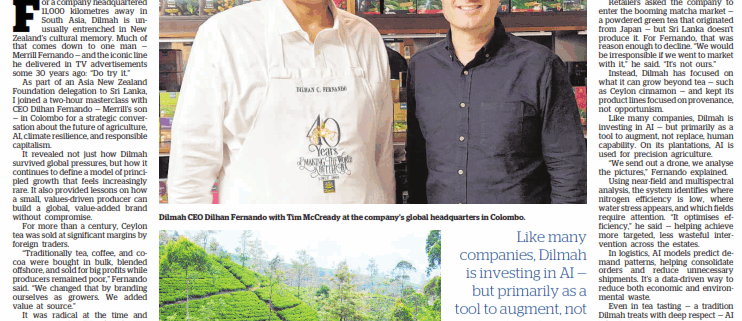
For a company headquartered 11,000 kilometres away in South Asia, Dilmah is unusually entrenched in New Zealand’s cultural memory. Much of that comes down to one man – Merrill Fernando – and the iconic line he delivered in TV advertisements some 30 years ago: “Do try it.”

As part of an Asia New Zealand Foundation delegation to Sri Lanka, I joined a two-hour masterclass with CEO Dilhan Fernando – Merrill’s son – in Colombo for a strategic conversation about the future of agriculture, AI, climate resilience, and responsible capitalism.

It was a session that revealed not just how Dilmah survived global pressures, but how it continues to define a model of principled growth that feels increasingly rare. It also provided lessons for New Zealand on how a small, values-driven producer can build a global, value-added brand without compromise.

The cost of doing the right thing

For more than a century, Ceylon tea was sold at significant margins by foreign traders.

That simple act was radical at the time and remains central to Dilmah’s identity. It’s a mindset he says New Zealanders instinctively understand.

“New Zealanders understand the connection between nature and taste,” said Fernando. “While the importance of ingredients is shared by your wine and dairy industries, around the world I see that respect for artisanship and for ingredients disappearing, sacrificed to discounts and so on.”

Many organisations have been softening or retreating from environmental, social, and governance (ESG) commitments recently, driven by regulatory uncertainty, political pushback, and rising scepticism about real-world impact and costs. Yet Dilmah has held firm – even when it costs.

“Oddly in the global market, we can be terribly penalised for doing the right thing,” Fernando said, recalling an Australian retailer who demanded an increased margin to stay on the shelf, and suggested Dilmah cut its charitable spend to make up the difference.

“Of course, we took the logical step and walked away”.

The decision significantly dropped Dilmah’s market share overnight, but for Fernando, the company’s purpose was non-negotiable.

“Most CEOs have a three-month timeframe. But we think in generations. We are responsible for an ecosystem that includes people and nature.”

Last year was Dilmah’s worst on record for profit – yet it was its greatest for impact.

More than one billion Sri Lankan rupees were invested through its foundation in education, healthcare, disability services, climate science, food programmes, and Sri Lanka’s post-conflict rehabilitation.

“Success is important,” said Fernando. “But significance is success expressed in the lives of others.”

The commitment extends beyond Sri Lanka. “We work in New Zealand with hospice, with the homeless through different organisations,” he said. “In Australia as well, through the Salvation Army, with people struggling with substance abuse and with the homeless.”

Dilmah is also recognised for its strong environmental credentials: from renewable energy and reforestation to waste reduction, biodiversity and sustainable agriculture. It achieved carbon neutrality in 2017 and aims to be carbon negative by 2030.

Together, these efforts shape a view of business that goes beyond profit. “You realise the purpose of business,” Fernando said. “And you understand what really motivates a business to do more.”

But he was also frank about the pressure ethical businesses face. “The challenge businesses have in doing the right thing today is something exceptional.”

He outlined the realities of sustainable farming: “Looking after the soil, using biochar, biological control for pest management, agroforestry methods. Unfortunately, when you do the right thing, you generally pay a high price for it.”

And yet, that struggle is central to Dilmah’s identity. “It motivates us,” he said simply. “It makes us leaner, fitter.”

Dilmah’s approach to product development also reflects a refusal to compromise.

Retailers asked the company to enter the booming matcha market – a powdered green tea that originated from Japan – but Sri Lanka doesn’t produce it. For Fernando, that was reason enough to decline.

“We would be irresponsible if we went to market with it,” he said. “It’s not ours.”

Instead, Dilmah has focused on what it can grow beyond tea – such as Ceylon cinnamon – and kept its product lines focused on provenance, not opportunism.

AI that strengthens tradition

Like many companies, Dilmah is investing in AI – but primarily as a tool to augment, not replace, human capability.

On its plantations, AI is used for precision agriculture. “We send out a drone, we analyse the pictures,” Fernando explained. Using near-field and multispectral analysis, the system identifies where nitrogen efficiency is low, where water stress appears, and which fields require attention. “It optimises efficiency,” he said – helping achieve more targeted, less wasteful intervention across the estates.

In logistics, AI models predict demand patterns, helping consolidate orders and reduce unnecessary shipments. It’s a data-driven way to reduce both economic and environmental waste.

Even in tea tasting – a tradition Dilmah treats with deep respect – AI is beginning to play a supporting role. Dilmah’s team tastes around 12,000 teas each week, selecting only the best for its range.

“We use AI to augment that,” Fernando said. Liquor from each batch is run through hyperspectral analysis, creating detailed flavour profiles. The goal is to “create a flavour map” of the many terroirs across the island. “It’s not a replacement for tasters, but another element to support them in their evaluation.”

In a global market where it’s becoming easier to dilute principles than hold them, Dilmah has built a business by refusing to compromise.

Thirty years after Merrill Fernando first invited New Zealanders to “Do try it”, the line still resonates – not only as a tagline for tea, but as a challenge to the business world.

Tim McCready joined the Asia New Zealand Foundation’s delegation to Sri Lanka.

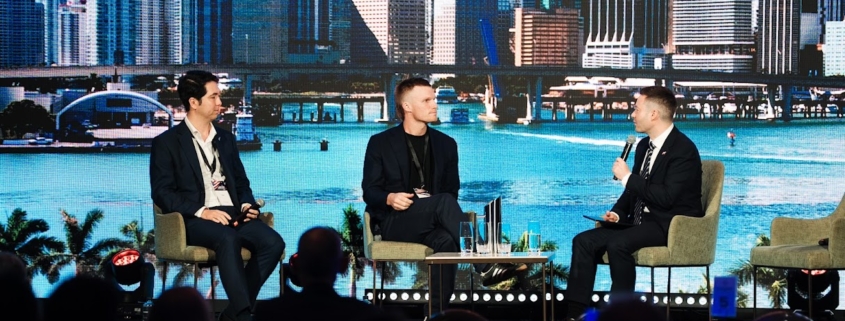
US Business Summit 2025: What it takes to win big – Bowen Pan & Craig Piggott (video)

Rocket Lab, Sky TV’s Sophie Moloney, Carmel Fisher big winners at the Deloitte Top 200 Awards

Rocket Lab, Sky TV CEO Sophie Moloney and financial services pioneer Carmel Fisher headlined this year’s Deloitte Top 200 Awards, one of the most anticipated events in New Zealand’s corporate calendar.

With the theme “Celebrating those who move Aotearoa forward”, the black-tie gala at Auckland’s Viaduct Events Centre brought together more than 800 business leaders, politicians and media. Hosted by Jack Tame and Stacey Morrison, the evening recognised outstanding performance, decisive leadership and the organisations driving New Zealand’s economic future.

Rocket Lab was the night’s standout, winning Company of the Year for a performance that has redefined what is possible for a New Zealand business on the global stage.

Its Nasdaq-listed share price doubled over the past year, giving the company a recent market capitalisation of US$21 billion, and its order book has swelled beyond US$500m as demand grows for both its Electron and next-generation Neutron rockets.

Strategic acquisitions in the United States and Europe have expanded Rocket Lab’s capabilities into areas such as missile tracking and laser communications, broadening its footprint and vertical integration across the space industry.

This year also saw a milestone interplanetary mission send two Rocket Lab spacecraft to Mars. The mission will help scientists better understand how the Red Planet lost its atmosphere.

The panel of high-profile judges, convened by NZME’s Fran O’Sullivan, praised Rocket Lab for securing a rare global leadership position for a New Zealand company, saying its success is “inspiring our next generation of young engineering and science talent”.

Sky chief executive Sophie Moloney is this year’s Chief Executive of the Year, recognised for reshaping the company through a people-first strategy and her ability to act decisively during a string of transformative deals.

After early-year turbulence from satellite issues, Sky delivered major strategic wins – including the $1 acquisition of Three and ThreeNow from Warner Bros, a five-year rugby rights deal, and Olympic broadcasting rights through to 2032. Judges say Moloney’s leadership helped propel Sky’s share price to five-year highs and restore investor confidence.

The only award that is given without finalists — the Visionary Leader — went to Carmel Fisher, honoured for her pioneering work in the financial services industry.

Fisher began investing in the early 1980s and quickly earned a strong reputation through a series of roles.

In 1998, she and her husband Hugh launched Fisher Funds from home with $17m in seed capital from Sovereign, making investing accessible through low minimums and nationwide town hall roadshows. The firm grew from a single managed fund to more than $25b in assets under management and 500,000 clients.

Judges describe Fisher as a trailblazer, and Fisher Funds chief executive Simon Power says her influence remains “present and enduring”, even after she stepped back from day-to-day leadership in 2017 following nearly two decades at the helm.

A2 Milk’s David Muscat, named Chief Financial Officer of the Year, was recognised for steering the dual-listed milk and infant formula company through a complex series of transactions.

Muscat oversaw the acquisition of Yashili’s Pōkeno plant, the sale of Mataura Valley Milk and the establishment of a long-term supply agreement with Fonterra. Operating across multiple markets and with significant exposure to the renminbi, he has built a finance function that supports disciplined decision-making and transparent investor communication.

Judges praise his humility, competence and “extraordinary impact for a CFO”, noting his role in restoring confidence after the company’s 2020-21 earnings slump and helping deliver a 49% total shareholder return over the year to September.

Fonterra chairman Peter McBride was named Chairperson of the Year, recognising his calm and unifying governance during a period of significant strategic change for New Zealand’s largest exporter. This is a rare repeat win in this category, with McBride also taking out the award in 2018 during his time chairing Zespri – underscoring a governance career defined by clarity, stability and deep commitment to New Zealand’s primary sector.

Since taking the role in 2020, McBride has guided the co-op through capital structure reform, strong performance, and the landmark $4.22b sale of its consumer brands to Lactalis. Fonterra delivered a $1.079b net profit this year, with strong performance from its high-value ingredients business.

Judges say McBride has rebuilt shareholder trust and ended factionalism on the board, highlighting the significant farmer support for the 2021 capital reform vote as a turning point.

Fisher & Paykel Healthcare won Best Growth Strategy for its long-term, organic approach that has seen the company double revenue every five to six years without relying on acquisitions.

It posted $2.021b in revenue and $377m in net profit this year, driven by its respiratory care products and sleep apnoea technology. With more than 1000 R&D staff and $226.9m invested in R&D, the company maintains a tight strategic focus.

Judges praise its clarity, discipline and willingness to plan decades ahead as it expands manufacturing in Auckland and overseas, calling it a model of innovation-led, patient, long-horizon growth.

Tower won Most Improved Performance for its transformation that delivered on both digital execution and financial growth.

The major transformation replaced legacy technology systems with a single modern, cloud-based digital platform across New Zealand and its Pacific markets, streamlining operations and enabling sophisticated risk-based pricing.

Home policy growth helped lift gross written premiums from $385m to $595m over five years, while the share price rose 40% over the last 12 months. Judges praise Tower’s strong shareholder returns, customer growth, and leadership in pricing transparency.

Air New Zealand’s Kate Boyer, named Young Executive of the Year, impressed judges with her energy, drive, and rapid impact as GM Airports, a role she stepped into at age 30.

She inherited a complex operation still recovering from the pandemic, with more than half the workforce newly hired and considerable leadership instability. Three weeks into the job, a spike in serious near-miss airport incidents required immediate action.

Boyer led a safety reset that reduced serious incidents by 60% and launched an Airport Champions Network to bridge the gap between agile product development and day-to-day operations. She also implemented productivity improvements that saved more than $10m while improving engagement.

Judges say her leadership maturity, people-first approach, and execution at scale place her firmly on a trajectory towards senior executive roles.

Precinct Properties took home the Sustainability Leadership award for a commercially grounded approach that has begun to shift practices across the construction sector.

Recognising that a significant contributor to emissions in property development occurs during construction, Precinct has prioritised understanding and measuring embodied carbon. Its most advanced project in this space, the Deloitte Centre development, achieved a 67% reduction in embodied carbon.

Judges highlight its influence over contractors and suppliers, as well as its long-standing partnership with Ngāti Whātua Ōrākei.

Energy group Clarus received the Diversity & Inclusion Leadership award for its Building Belonging programme, launched in 2022 to create a workplace where everyone feels connected, supported and empowered.

The initiative strengthened foundations through online training, campaigns on topics like neurodiversity, and team values workshops. D&I was also added to every manager’s performance plan.

It introduced targeted workstreams for women, Māori and older workers, with gender-neutral recruitment, improved parental leave and early-career pathways. It has also more than halved the gender pay gap and lifted female hiring from 29% to 43%.

Judges praise the programme’s maturity, authenticity and strong executive sponsorship.

The judges’ recognition award this year went to Fran O’Sullivan, acknowledging her long-standing contribution to the Deloitte Top 200 judging panel.

O’Sullivan is stepping down this year after 12 years as a judge and as convenor of the judging panel, a tenure defined by her rigorousness, independence and commitment to celebrating the best of New Zealand business excellence.

The Deloitte Top 200 Index consists of New Zealand’s largest entities ranked by revenue. These include publicly listed companies, large unlisted entities, New Zealand subsidiaries and branches of overseas companies and the commercial operations of Māori entities; also producer boards, co-operatives, local authority trading enterprises and state-owned enterprises.

An overview of the Top 200 Index – along with New Zealand’s Top 30 finance companies – is provided at the end of this report, including detailed analysis of revenue, profitability, efficiency and other key performance metrics. Together, these figures offer a clear snapshot of how New

Zealand’s largest organisations are performing, supported by commentary from the Herald’s business reporting team.

The high-level view of the Top 200 this year shows steady but subdued growth. Total revenues rose 2.1%, a slower pace than the previous two years, while underlying earnings (Ebitda) increased 5.1%. Profit after tax rebounded strongly, rising 23.7% and reversing last year’s 57.2% decrease.

In the financial sector, the Top 30 finance companies showed a return to growth across most key indicators, reversing the contraction seen last year. Their combined asset base grew 3.2%, and cumulative profits lifted 10.6%.

ANZ remains the largest bank by a wide margin, with $199b in assets — more than $63b ahead of second-placed Westpac. ANZ also continues to lead the sector in both profitability and equity.

Deloitte Top 200: Sustainability Leadership Award 2025 - Precinct

Precinct has won the Deloitte Top 200 Sustainability Leadership award for 2025, recognising its ambitious, commercially grounded and sector-shaping approach to sustainability in the built environment.

A finalist last year, Precinct impressed judges with the breadth of its activity and the way it continues to evolve its sustainability efforts.

They highlight Precinct’s climate adaptation and operational resilience plans, and its commitment to working collaboratively to tackle challenges that no single organisation can address alone. Judges also note the recent expansion of Precinct’s sustainability team as further evidence of its commitment to long-term impact.

“Precinct’s sustainability initiatives are underpinned by a strong business case for why such actions add value to the company,” says Deloitte Top 200 sustainability judge Katie Beith. “It has also made good headway in influencing contractors and suppliers to source locally and sustainably – and is incentivising them to reduce emissions if they want to be eligible for future contracts.”

Precinct’s head of sustainability, Lisa Hinde, says sustainability is a core element of Precinct’s strategy, taking a long-term view that delivers enduring value for clients, investors and the wider community.

“It isn’t just the right thing to do, our track record shows it goes hand in hand with commercial success, ensuring our portfolio retains its value for future generations,” she says. This commercially grounded approach was highlighted by the judges as a standout feature of Precinct’s performance this year.

Recognising that a significant contributor to emissions in property development occurs during construction, Precinct has prioritised understanding and measuring embodied carbon.

It publishes upfront data for assessed development projects, ensuring visibility and accountability on its journey to net zero. Its most advanced project in this space, the Deloitte Centre development, achieved a 67% reduction in embodied carbon. The judges praise Precinct’s innovative methods for understanding and reducing embodied carbon – an area where it is helping set the pace.

“Precinct is proud to lead on addressing upfront embodied carbon in our development projects, which makes up more than 50% of annual emissions,” says Hinde.

“The biggest challenge is influencing emissions across our value chain, where we don’t have such direct control, but it’s also where we can create the greatest impact through procurement.”

Precinct is also progressing a broader initiative to decarbonise key construction materials, including steel, concrete and aluminium – with 10-year annual step-down targets planned from FY26.

In 2025, Precinct improved its score in the Global Real Estate Sustainability Benchmark to 91 out of 100, retaining its position for the second year running in the top 20% of more than 2000 participating funds and entities.

Earlier this year, Precinct development Beca House – New Zealand’s largest urban regeneration project – achieved a 6-star “World Leadership” Green Star Design rating. The building hosts Precinct’s largest rooftop solar array, part of a total 309kW of rooftop solar across Auckland’s Wynyard Quarter. The Deloitte Centre, Te Kaha, also received a 6-star certification – the first mixed-use office and hotel development in New Zealand to do so. These projects demonstrate how adaptive reuse (Deloitte Centre) and high-performance design can deliver strong commercial and sustainability outcomes.

Precinct also delivered New Zealand’s first NABERSNZ water ratings, achieving 4.5 to 5 stars across four commercial office buildings.

In FY25, Precinct introduced a national waste management strategy across its full portfolio to support a transition to circular economy principles. Through its quarterly ESG reporting programme, it shares energy, water and waste data with clients and runs workshops to support tenants in estimating their first NABERSNZ tenancy ratings – reflecting its commitment to sector-wide capability building.

Judges also recognise Precinct’s long-standing partnership with mana whenua, demonstrating its approach to partnership grounded in Te Tiriti o Waitangi and mana whenua engagement. It has formed a joint venture with Ngāti Whātua Ōrākei, alongside global investor PAG, to invest in the regeneration of the Te Tōangaroa precinct in Auckland’s city centre.

“Our partnerships with mana whenua are fundamental to our purpose and performance,” says Hinde. “They uphold cultural integrity, foster inclusive design, and strengthen our supply chain to deliver social and environmental outcomes that matter to the communities we serve.”

She says it is rewarding to see the mutually beneficial outcomes these relationships bring, from joint venture ownership to cultural advisory roles, service provision, and enduring connections that enrich both the built environment and society.

The judges commend Precinct’s focused and commercial approach to sustainability: “Precinct is focused on where it can achieve impact within its own value chain, how this adds value to the business and how it can drive progress across the broader sector.”

Its work continues to set benchmarks in sustainable property development – by reducing carbon as well as reshaping how commercial buildings are designed, delivered, and operated in New Zealand.

The Sustainability Leadership award is sponsored by Credibl.

Finalist: BNZ

Bank of New Zealand (BNZ) has been named a finalist for Sustainability Leadership, recognised for the depth and breadth of its approach, and its strong commitment to long-term resilience.

At the heart of BNZ’s strategy is Te Pae Tawhiti, a name that reflects a distant horizon and inter-generational mindset. Launched in 2020, it has two core pillars: Kaitiakitanga, focused on accelerating a just transition to a net-zero emissions economy that supports building back nature, and Manaakitanga, aimed at enhancing the long-term well-being of New Zealanders.

The judges note that BNZ is impressive for the comprehensiveness of its approach: “It is commendable to see it holding firm on commitments when other international banks are walking away.”

BNZ chief sustainability officer, Rebekah Cain, says the bank set ambitious targets when it committed to supporting customers to build a regenerative, resilient, and inclusive future.

“Climate impacts are real and are impacting our business and our customers now; they are crystallising faster than anticipated. It makes commercial sense to continue to support our customers and communities to adapt to those impacts and to stay relevant to international markets.”

Judges also highlight that “ensuring a healthy, growing and thriving business into the future is a core motivator,” noting BNZ’s focus on long-term resilience.

BNZ has set 2030 decarbonisation targets across high-emitting sectors including energy, residential real estate and agriculture, and is on track to meet its commitment to exit all lending to thermal coal mining by the end of 2025 – and all remaining coal mining-related lending by 2030.

“We recognise the important role that guidance, frameworks, and local laws have played in helping us build capability, plan, and set emissions targets,” says Cain. “These measures have set us on a pathway to help New Zealand reach net zero by 2050.”

In FY24, operational emissions were down 49% from 2019, with 96% of the bank’s purchased electricity needs sourced from renewables.

BNZ is also supporting customers in transition-exposed industries. Judges note the bank “is engaging to support customers in transition‑exposed industries, including acute challenges like energy resilience, with ESG fully integrated into the credit process.”

It has delivered $8.8 billion in sustainable finance since 2020 and aims to reach $10b this year. An additional $93m in green consumer lending in FY24 has helped over 2300 households to electrify transport or improve home resilience and efficiency.

“We’re confident we’ll surpass our $10b sustainable finance target in 2025,” says Cain. “Over the past five years, this lending has supported our customers, who represent a variety of sectors, to build models of resilience, and invest in things like energy efficiency, sustainable product innovation, water infrastructure and irrigation, preventing pollution, protecting and restoring biodiversity, social housing, and diversification of land.”

BNZ is also demonstrating leadership in nature regeneration. The BNZ Foundation supports biodiversity efforts such as depositing green-lipped mussels in the Hauraki Gulf as part of the “Revive Our Gulf” restoration project, and is a leading partner of the Aotearoa Circle, advancing sustainability through cross-sector collaboration.

The bank continues to invest in financial well-being and inclusion, having delivered $42.4 million in no- or low-interest loans to disrupt predatory lending and assisting over 350,000 New Zealanders to become scam-savvy through targeted education and tools.

BNZ’s integrated strategy positions it as a leader among New Zealand’s financial institutions, focused on creating long-term value for customers, communities and the environment.

Finalist: Goodman Property Trust

Goodman Property Trust (GMT) has been recognised as a finalist for its bold and forward-looking approach to sustainability leadership and its decision to press ahead with new emissions targets despite growing uncertainty in global markets.

As a long-term property investor, GMT’s decision-making is guided by a business strategy that aims to deliver positive outcomes for all its stakeholders. It includes targets for a lower-carbon and more resilient portfolio.

Judges say GMT’s leadership was clear in its actions. “The key development in 2025 was setting science-based emissions reduction targets, including for embodied carbon, which reflects the vast majority of the company’s footprint. While this may not seem special on its own, it was done at a time when other companies were pulling back from net-zero aspirations.”

GMT’s CFO, Andy Eakin, who also has overall responsibility for the organisation’s sustainability efforts, says that confidence came from the depth of analysis behind the targets.

“A significant amount of work has been undertaken to align our 2030 carbon reduction pathway with science-based targets. Expert advice, supported by an independent review from Toitū, has provided confidence that while our targets are ambitious, they remain both credible and achievable.”

GMT’s updated emissions reduction targets include a 43% reduction in corporate emissions and a 30% reduction in embodied carbon intensity by 2030.

To help meet these goals, GMT launched an Embodied Carbon Innovation Fund (ECIF), using an internal carbon price to replace the purchase of offsets. This fund is directed toward lower-emission materials and construction techniques across future projects. The judges found this to be a key differentiator for the company in an emissions-intensive sector.

Eakin says the ECIF is already shifting the way GMT approaches construction.

“The fund allows us to think more broadly about development, looking at all aspects of the process and the specifics of individual projects. We have already invested in a new initiative to critically assess the materials efficiency of our current building design, which aims to reduce the amount of building materials required to deliver to our designs, reducing materials, cost and embodied carbon.”

GMT’s commitment to sustainable development includes targeting a minimum 5 Green Star Built rating for all new projects. Its FY25 development programme has seen three project completions, with a reduction in upfront embodied carbon of 27%. Its sustainability initiatives have included the installation of electrical submetering, customer and public EV chargers, LED lighting upgrades, rooftop solar energy systems, and water-saving technologies.

“Committing to a minimum 5 Green Star Built rating since 2021 reflects a base building standard that is both highly sustainable and operationally efficient,” says Eakin. “We’ve developed over $750 million of properties that have achieved 5 Star or World Leadership 6 Green Star Built ratings.” He adds that partnering closely with customers has been key to reducing emissions across both new developments and existing buildings.

Governance is central to GMT’s sustainability strategy. Progress is reviewed quarterly at board level, underpinned by a Sustainable Finance Framework that has enabled over $600m in green bonds and loans to date.

The judges also recognise GMT’s growing social and environmental efforts.

Employee retention is high at nearly 99%, with an engagement score of 87%. GMT maintains inclusive workplace policies and achieved 33% female representation across its board and executive team.

Biodiversity initiatives include native planting and urban regeneration, and features such as beehives across larger estates to enhance and protect the natural environment.

GMT’s approach balances ambition with delivery, showing that climate leadership is possible even amid economic headwinds. Judges say this “embodies courageous leadership, and a board willing to take bold decisions on sustainability.”

Mood of the Boardroom: Playing catch-up with Artificial Intelligence (NZ Herald)

Mood of the Boardroom: Playing catch-up with Artificial Intelligence (NZ Herald)

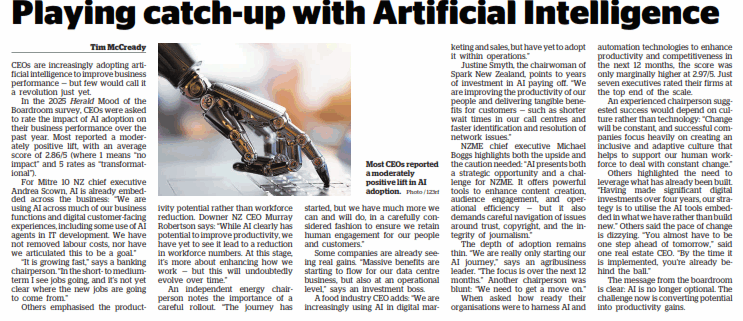
CEOs are increasingly adopting artificial intelligence to improve business performance — but few would call it a revolution just yet.

In the 2025 Herald Mood of the Boardroom survey, CEOs were asked to rate the impact of AI adoption on their business performance over the past year. Most reported a moderately positive lift, with an average score of 2.86/5 (where 1 means “no impact” and 5 rates as “transformational”).

For Mitre 10 NZ chief executive Andrea Scown, AI is already embedded across the business: “We are using AI across much of our business functions and digital customer-facing experiences, including some use of AI agents in IT development. We have not removed labour costs, nor have we articulated this to be a goal.”

“It is growing fast,” says a banking chairperson. “In the short- to medium-term I see jobs going, and it’s not yet clear where the new jobs are going to come from.”

Others emphasised the productivity potential rather than workforce reduction. Downer NZ CEO Murray Robertson says: “While AI clearly has potential to improve productivity, we have yet to see it lead to a reduction in workforce numbers. At this stage, it’s more about enhancing how we work — but this will undoubtedly evolve over time.”

An independent energy chairperson notes the importance of a careful rollout. “The journey has started, but we have much more we can and will do, in a carefully considered fashion to ensure we retain human engagement for our people and customers.”

Some companies are already seeing real gains. “Massive benefits are starting to flow for our data centre business, but also at an operational level,” says an investment boss.

A food industry CEO adds: “We are increasingly using AI in digital marketing and sales, but have yet to adopt it within operations.”

Justine Smyth, the chairwoman of Spark New Zealand, points to years of investment in AI paying off. “We are improving the productivity of our people and delivering tangible benefits for customers — such as shorter wait times in our call centres and faster identification and resolution of network issues.”

NZME chief executive Michael Boggs highlights both the upside and the caution needed: “AI presents both a strategic opportunity and a challenge for NZME. It offers powerful tools to enhance content creation, audience engagement, and operational efficiency — but it also demands careful navigation of issues around trust, copyright, and the integrity of journalism.”

The depth of adoption remains thin. “We are really only starting our AI journey,” says an agribusiness leader. “The focus is over the next 12 months.” Another chairperson was blunt: “We need to get a move on.”

When asked how ready their organisations were to harness AI and automation technologies to enhance productivity and competitiveness in the next 12 months, the score was only marginally higher at 2.97/5. Just seven executives rated their firms at the top end of the scale.

An experienced chairperson suggested success would depend on culture rather than technology: “Change will be constant, and successful companies focus heavily on creating an inclusive and adaptive culture that helps to support our human workforce to deal with constant change.”

Others highlighted the need to leverage what has already been built. “Having made significant digital investments over four years, our strategy is to utilise the AI tools embedded in what we have rather than build new.” Others said the pace of change is dizzying. “You almost have to be one step ahead of tomorrow,” said one real estate CEO. “By the time it is implemented, you’re already behind the ball.”

The message from the boardroom is clear: AI is no longer optional. The challenge now is converting potential into productivity gains.

New NZIBF director outlines exporters’ response to tariffs

New NZIBF director outlines exporters’ response to tariffs

The New Zealand International Business Forum (NZIBF) has entered a new chapter of leadership, with Felicity Roxburgh stepping in as executive director at a time of heightened geopolitical uncertainty.

Roxburgh brings almost 20 years’ experience in trade and foreign policy. She has served in senior roles at the Ministry of Foreign Affairs and Trade, with postings in Hong Kong, New York and in the Pacific. Most recently, she was New Zealand’s Consul-General in New Caledonia, and before that led the business programme at the Asia New Zealand Foundation. She succeeds Stephen Jacobi who helped establish NZIBF in 2007.
Roxburgh had little time to ease into the role. Just weeks after joining the Forum she was fronting 15 media interviews on the United States’ sudden 15% tariff on New Zealand goods.

“There is a large appetite to understand what is happening in clear, simple terms and the impact on our exporters,” she says. “People knew the tariffs were going to impact us, but they didn’t know how or why.”

One of her top priorities is ensuring the fast-moving responses of business are better understood.

“Companies are responding to tariffs, supply chain disruption and investment uncertainty in real time”. Whether through scenario planning, diversifying into new markets or passing on costs to importers and consumers, she says these real-time adjustments are often invisible in high-level policy discussions, yet they are vital for resilience and competitiveness.

She is also focused on the future of New Zealand’s free trade agenda. Roxburgh points out that while New Zealand benefits from a dense “elaborate spaghetti network of free trade agreements”, gaps remain. “India and the US are the big missing pieces,” she says, noting that the government is putting huge investment into growing the India relationship and negotiating an FTA.

“At the same time, behind-the-border barriers — non-tariff costs — hit our exporters up to $10 billion a year. It’s a huge challenge.”

She also sees real opportunity in major trade blocs deepening collaboration. “If the Comprehensive and Progressive Agreement for Trans-Pacific Partnership (CPTPP) and the European Union were to do something together — and with us being a member of the CPTPP — it would be around 30% of the global trade. That’s one to watch.”

For Roxburgh, NZIBF’s role in the current climate is clear: to amplify exporters’ experience and work with the Government to push forward on market access.

“What does a business response look like to geopolitical uncertainty? Scenario planning, diversification, pricing changes, working with partners. These are practical steps companies are taking, and that’s the story we need to tell.”

Mood of the Boardroom: Boardrooms split on staff as AI reshapes workforce (NZ Herald)

Mood of the Boardroom: Boardrooms split on staff as AI reshapes workforce (NZ Herald)

New Zealand’s boardrooms are split on the outlook for projected staff numbers, with the Mood of the Boardroom survey revealing a near three-way divide over whether headcount will increase, remain steady or decrease in the year ahead.

Asked if they expect to make changes to staff numbers over the next 12 months, 30% of respondents say they anticipate increasing staff numbers, while 33% expect to cut back. A further 35% forecast no change, with the remaining 2% unsure.

The mixed sentiment underscores a business environment where leaders are juggling cost pressures, technological disruption, and the demands of growth.

One executive in the tourism industry was blunt: “We have and continue to reduce staff numbers as we take costs out.”

A logistics boss notes, “We are rolling off a period of intense capital project delivery.”

Technology is a recurring theme in workforce projection. Several CEOs pointed to automation and AI reshaping the size and shape of their workforce.

“Technology advancements could well result in fewer jobs in some areas (corporate), whereas as assets and the balance sheet grows, and there is more development and construction going on, the workforce is likely to increase,” says one experienced chairperson.

Others spoke of balancing efficiency with future capability.

“We’ll continue to adjust resources to match demand and ensure the business stays efficient — focusing on keeping essential roles while scaling back where necessary,” says Anne Gaze, of Campus Link Foundation.

Some businesses remain in contraction mode. The CEO of an engineering firm says: “Due to the industry slowdown, our business has had to make difficult decisions around staff right-sizing … Looking forward, it is more about focusing on what skills and capabilities are required in the future.”

There are also generational concerns.

“We have dropped significantly in the last two years but hope to be able to start recruiting graduates again, subject to projects progressing in the economy,” one executive in the construction sector says, warning younger staff have been “hit the hardest” as clients resist paying for inexperienced talent.

For others, their infrastructure pipeline is expected to drive demand: “The significant infrastructure development programme underway will continue to gain momentum in the year ahead and associated staffing growth will reflect that,” says Auckland Airport chief executive Carrie Hurihanganui.

Mixed opinion on access to skilled talent
Business leaders are mixed on whether attracting and retaining skilled talent has become easier or harder in the last year, but the overall sentiment leans toward it being a moderately challenging issue.

On a scale of 1 to 5, where 1 equals very difficult and 5 equals very easy, the average score was 2.95/5.

For some, access to skilled labour has eased in the past year, with a softer economy and higher unemployment increasing the pool of available candidates.

Several note they are receiving record numbers of applications, describing the current climate as an “employer’s market”.

Executive director of the Retirement Villages Association, Michelle Palmer, says: “We’ve seen a huge number of applications for roles in the past six months — unprecedented numbers — a sign of the times in the current unemployment environment.”

An education provider observes that “redundancies have released a lot of competent people into the market”, but says retaining top performers remains difficult.

Yet many stress that the challenge is far from solved, particularly in specialised fields.

Advanced technology, R&D, digital, AI, engineering, and data analytics are all cited as areas where skills are scarce.

The lure of higher wages in Australia and beyond features prominently, with multiple executives highlighting a “flight to Australia” across professions including law, health, and infrastructure.

One leader describes it as “alarming”, while another says young lawyers are now departing earlier in their careers than ever before.

Cordis managing director Craig Bonnor adds that “talent retention of Kiwis in the early to mid-career phase is the most challenging”.

At the same time, pressure is coming from within New Zealand. Downer NZ chief executive Murray Robertson warns that “the entry of international firms into the New Zealand market for major projects is placing additional pressure on local businesses to retain key talent.”
Pipeline certainty in infrastructure also looms large. An engineering leader cautions that “without certainty in the pipeline, we won’t attract the skilled workforce required”.

Regional differences are also apparent. Institute of Directors CEO Kirsten (KP) Patterson says Wellington is increasingly at risk of losing its brightest talent, “as they are losing confidence that they can successfully raise careers and families in a vibrant capital city”.

Immigration settings drew mixed views. Some report improvements under the current government, making it easier to recruit nurses and caregivers, while others say changes had done little to ease shortages in critical, high-demand sectors.

As one technology leader puts it: “For AI skills, things are very, very difficult. But for other roles, it is typically not a concern.”

While New Zealand’s lifestyle and reputation for innovation continue to draw talent, executives stress that retention depends on competitive pay, career development, and building purpose-driven organisations.

As Harcourts managing director Bryan Thomson sums up: “The business world relies on talent acquisition and retention.

“Now as always, this is the number one challenge for every leader.”

ICBC NZ CEO Bin Liu sees exciting opportunities to finance New Zealand’s infrastructure transformation, writes Tim McCready

ICBC NZ CEO Bin Liu sees exciting opportunities to finance New Zealand’s infrastructure transformation, writes Tim McCready

New Zealand is entering a critical new phase of infrastructure development. Decades of underinvestment, rapid urban growth, and the increasing impacts of climate change have converged to create both a challenge and an opportunity.

ICBC New Zealand, a subsidiary of the world’s largest bank by total assets and capital, sees compelling potential for Chinese capital to support this transformation. With more than 11 years of local operations, the bank draws on global experience and deep funding capability to deliver tailored, ESG-aligned financing solutions for New Zealand.

Speaking at the recent China Business Summit in Auckland, Bin Liu, CEO of ICBC New Zealand reflected on the state of the market.

“I have three key takeaways from the past year,” he said. “First, we are finally seeing more infrastructure projects moving — and at a bigger scale than before.