
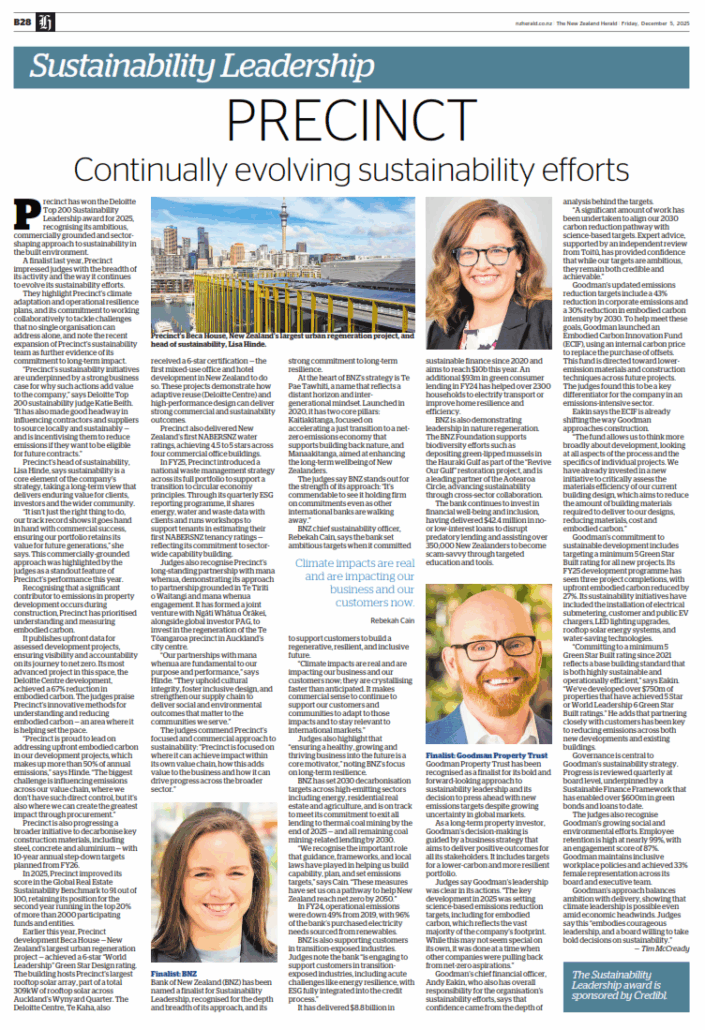
Deloitte Top 200: Sustainability Leadership Award 2025 - Precinct
Precinct has won the Deloitte Top 200 Sustainability Leadership award for 2025, recognising its ambitious, commercially grounded and sector-shaping approach to sustainability in the built environment.
A finalist last year, Precinct impressed judges with the breadth of its activity and the way it continues to evolve its sustainability efforts.
They highlight Precinct’s climate adaptation and operational resilience plans, and its commitment to working collaboratively to tackle challenges that no single organisation can address alone. Judges also note the recent expansion of Precinct’s sustainability team as further evidence of its commitment to long-term impact.
“Precinct’s sustainability initiatives are underpinned by a strong business case for why such actions add value to the company,” says Deloitte Top 200 sustainability judge Katie Beith. “It has also made good headway in influencing contractors and suppliers to source locally and sustainably – and is incentivising them to reduce emissions if they want to be eligible for future contracts.”
Precinct’s head of sustainability, Lisa Hinde, says sustainability is a core element of Precinct’s strategy, taking a long-term view that delivers enduring value for clients, investors and the wider community.
“It isn’t just the right thing to do, our track record shows it goes hand in hand with commercial success, ensuring our portfolio retains its value for future generations,” she says. This commercially grounded approach was highlighted by the judges as a standout feature of Precinct’s performance this year.
Recognising that a significant contributor to emissions in property development occurs during construction, Precinct has prioritised understanding and measuring embodied carbon.
It publishes upfront data for assessed development projects, ensuring visibility and accountability on its journey to net zero. Its most advanced project in this space, the Deloitte Centre development, achieved a 67% reduction in embodied carbon. The judges praise Precinct’s innovative methods for understanding and reducing embodied carbon – an area where it is helping set the pace.
“Precinct is proud to lead on addressing upfront embodied carbon in our development projects, which makes up more than 50% of annual emissions,” says Hinde.
“The biggest challenge is influencing emissions across our value chain, where we don’t have such direct control, but it’s also where we can create the greatest impact through procurement.”
Precinct is also progressing a broader initiative to decarbonise key construction materials, including steel, concrete and aluminium – with 10-year annual step-down targets planned from FY26.
In 2025, Precinct improved its score in the Global Real Estate Sustainability Benchmark to 91 out of 100, retaining its position for the second year running in the top 20% of more than 2000 participating funds and entities.
Earlier this year, Precinct development Beca House – New Zealand’s largest urban regeneration project – achieved a 6-star “World Leadership” Green Star Design rating. The building hosts Precinct’s largest rooftop solar array, part of a total 309kW of rooftop solar across Auckland’s Wynyard Quarter. The Deloitte Centre, Te Kaha, also received a 6-star certification – the first mixed-use office and hotel development in New Zealand to do so. These projects demonstrate how adaptive reuse (Deloitte Centre) and high-performance design can deliver strong commercial and sustainability outcomes.
Precinct also delivered New Zealand’s first NABERSNZ water ratings, achieving 4.5 to 5 stars across four commercial office buildings.
In FY25, Precinct introduced a national waste management strategy across its full portfolio to support a transition to circular economy principles. Through its quarterly ESG reporting programme, it shares energy, water and waste data with clients and runs workshops to support tenants in estimating their first NABERSNZ tenancy ratings – reflecting its commitment to sector-wide capability building.
Judges also recognise Precinct’s long-standing partnership with mana whenua, demonstrating its approach to partnership grounded in Te Tiriti o Waitangi and mana whenua engagement. It has formed a joint venture with Ngāti Whātua Ōrākei, alongside global investor PAG, to invest in the regeneration of the Te Tōangaroa precinct in Auckland’s city centre.
“Our partnerships with mana whenua are fundamental to our purpose and performance,” says Hinde. “They uphold cultural integrity, foster inclusive design, and strengthen our supply chain to deliver social and environmental outcomes that matter to the communities we serve.”
She says it is rewarding to see the mutually beneficial outcomes these relationships bring, from joint venture ownership to cultural advisory roles, service provision, and enduring connections that enrich both the built environment and society.
The judges commend Precinct’s focused and commercial approach to sustainability: “Precinct is focused on where it can achieve impact within its own value chain, how this adds value to the business and how it can drive progress across the broader sector.”
Its work continues to set benchmarks in sustainable property development – by reducing carbon as well as reshaping how commercial buildings are designed, delivered, and operated in New Zealand.
The Sustainability Leadership award is sponsored by Credibl.
Finalist: BNZ
Bank of New Zealand (BNZ) has been named a finalist for Sustainability Leadership, recognised for the depth and breadth of its approach, and its strong commitment to long-term resilience.
At the heart of BNZ’s strategy is Te Pae Tawhiti, a name that reflects a distant horizon and inter-generational mindset. Launched in 2020, it has two core pillars: Kaitiakitanga, focused on accelerating a just transition to a net-zero emissions economy that supports building back nature, and Manaakitanga, aimed at enhancing the long-term well-being of New Zealanders.
The judges note that BNZ is impressive for the comprehensiveness of its approach: “It is commendable to see it holding firm on commitments when other international banks are walking away.”
BNZ chief sustainability officer, Rebekah Cain, says the bank set ambitious targets when it committed to supporting customers to build a regenerative, resilient, and inclusive future.
“Climate impacts are real and are impacting our business and our customers now; they are crystallising faster than anticipated. It makes commercial sense to continue to support our customers and communities to adapt to those impacts and to stay relevant to international markets.”
Judges also highlight that “ensuring a healthy, growing and thriving business into the future is a core motivator,” noting BNZ’s focus on long-term resilience.
BNZ has set 2030 decarbonisation targets across high-emitting sectors including energy, residential real estate and agriculture, and is on track to meet its commitment to exit all lending to thermal coal mining by the end of 2025 – and all remaining coal mining-related lending by 2030.
“We recognise the important role that guidance, frameworks, and local laws have played in helping us build capability, plan, and set emissions targets,” says Cain. “These measures have set us on a pathway to help New Zealand reach net zero by 2050.”
In FY24, operational emissions were down 49% from 2019, with 96% of the bank’s purchased electricity needs sourced from renewables.
BNZ is also supporting customers in transition-exposed industries. Judges note the bank “is engaging to support customers in transition‑exposed industries, including acute challenges like energy resilience, with ESG fully integrated into the credit process.”
It has delivered $8.8 billion in sustainable finance since 2020 and aims to reach $10b this year. An additional $93m in green consumer lending in FY24 has helped over 2300 households to electrify transport or improve home resilience and efficiency.
“We’re confident we’ll surpass our $10b sustainable finance target in 2025,” says Cain. “Over the past five years, this lending has supported our customers, who represent a variety of sectors, to build models of resilience, and invest in things like energy efficiency, sustainable product innovation, water infrastructure and irrigation, preventing pollution, protecting and restoring biodiversity, social housing, and diversification of land.”
BNZ is also demonstrating leadership in nature regeneration. The BNZ Foundation supports biodiversity efforts such as depositing green-lipped mussels in the Hauraki Gulf as part of the “Revive Our Gulf” restoration project, and is a leading partner of the Aotearoa Circle, advancing sustainability through cross-sector collaboration.
The bank continues to invest in financial well-being and inclusion, having delivered $42.4 million in no- or low-interest loans to disrupt predatory lending and assisting over 350,000 New Zealanders to become scam-savvy through targeted education and tools.
BNZ’s integrated strategy positions it as a leader among New Zealand’s financial institutions, focused on creating long-term value for customers, communities and the environment.
Finalist: Goodman Property Trust
Goodman Property Trust (GMT) has been recognised as a finalist for its bold and forward-looking approach to sustainability leadership and its decision to press ahead with new emissions targets despite growing uncertainty in global markets.
As a long-term property investor, GMT’s decision-making is guided by a business strategy that aims to deliver positive outcomes for all its stakeholders. It includes targets for a lower-carbon and more resilient portfolio.
Judges say GMT’s leadership was clear in its actions. “The key development in 2025 was setting science-based emissions reduction targets, including for embodied carbon, which reflects the vast majority of the company’s footprint. While this may not seem special on its own, it was done at a time when other companies were pulling back from net-zero aspirations.”
GMT’s CFO, Andy Eakin, who also has overall responsibility for the organisation’s sustainability efforts, says that confidence came from the depth of analysis behind the targets.
“A significant amount of work has been undertaken to align our 2030 carbon reduction pathway with science-based targets. Expert advice, supported by an independent review from Toitū, has provided confidence that while our targets are ambitious, they remain both credible and achievable.”
GMT’s updated emissions reduction targets include a 43% reduction in corporate emissions and a 30% reduction in embodied carbon intensity by 2030.
To help meet these goals, GMT launched an Embodied Carbon Innovation Fund (ECIF), using an internal carbon price to replace the purchase of offsets. This fund is directed toward lower-emission materials and construction techniques across future projects. The judges found this to be a key differentiator for the company in an emissions-intensive sector.
Eakin says the ECIF is already shifting the way GMT approaches construction.
“The fund allows us to think more broadly about development, looking at all aspects of the process and the specifics of individual projects. We have already invested in a new initiative to critically assess the materials efficiency of our current building design, which aims to reduce the amount of building materials required to deliver to our designs, reducing materials, cost and embodied carbon.”
GMT’s commitment to sustainable development includes targeting a minimum 5 Green Star Built rating for all new projects. Its FY25 development programme has seen three project completions, with a reduction in upfront embodied carbon of 27%. Its sustainability initiatives have included the installation of electrical submetering, customer and public EV chargers, LED lighting upgrades, rooftop solar energy systems, and water-saving technologies.
“Committing to a minimum 5 Green Star Built rating since 2021 reflects a base building standard that is both highly sustainable and operationally efficient,” says Eakin. “We’ve developed over $750 million of properties that have achieved 5 Star or World Leadership 6 Green Star Built ratings.” He adds that partnering closely with customers has been key to reducing emissions across both new developments and existing buildings.
Governance is central to GMT’s sustainability strategy. Progress is reviewed quarterly at board level, underpinned by a Sustainable Finance Framework that has enabled over $600m in green bonds and loans to date.
The judges also recognise GMT’s growing social and environmental efforts.
Employee retention is high at nearly 99%, with an engagement score of 87%. GMT maintains inclusive workplace policies and achieved 33% female representation across its board and executive team.
Biodiversity initiatives include native planting and urban regeneration, and features such as beehives across larger estates to enhance and protect the natural environment.
GMT’s approach balances ambition with delivery, showing that climate leadership is possible even amid economic headwinds. Judges say this “embodies courageous leadership, and a board willing to take bold decisions on sustainability.”

