
Air New Zealand, Fonterra and Auckland Airport rethink resilience after fuel crisis
Air New Zealand, Fonterra and Auckland Airport rethink resilience after fuel crisis
Tim McCready
When conflict in the Middle East threatened to disrupt New Zealand’s fuel supplies, the organisations critical to the country’s trade and international connectivity were forced to confront just how exposed they were.
Fuel tankers continued to arrive, aircraft kept flying and export products remained on the move. But prices surged, shipping routes came under pressure and officials began calculating how long supplies would last, which industries would be prioritised if shortages hit, and how disruption to petrochemicals might spread through the wider economy.
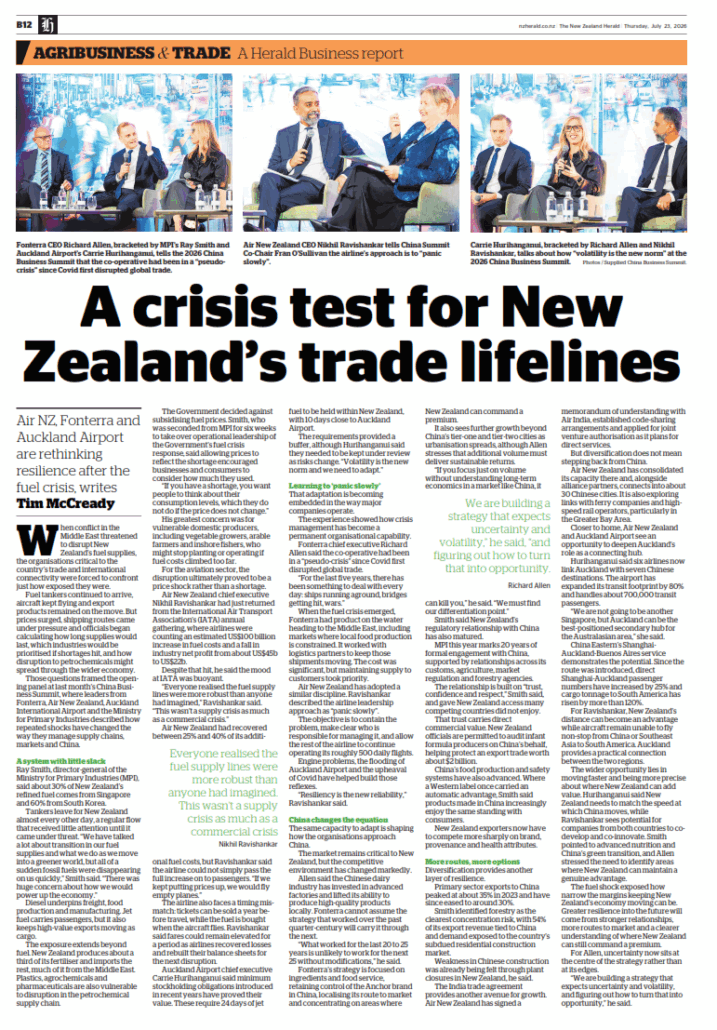
Those questions framed the opening panel at last month’s China Business Summit, where leaders from Fonterra, Air New Zealand, Auckland Airport and the Ministry for Primary Industries described how repeated shocks have changed the way they manage supply chains, markets and China.
A system with little slack
Ray Smith, director-general of the Ministry for Primary Industries (MPI), said about 30% of New Zealand’s refined fuel comes from Singapore and 60% from South Korea.
Tankers leave for New Zealand almost every other day, a regular flow that received little attention until it came under threat. “We have talked a lot about transition in our fuel supplies and what we do as we move into a greener world, but all of a sudden fossil fuels were disappearing on us quickly,” Smith said.
“There was huge concern about how we would power up the economy.”
Diesel underpins freight, food production and manufacturing. Jet fuel carries passengers, but it also keeps high-value exports moving as cargo.
The exposure extends beyond fuel.
New Zealand produces about a third of its fertiliser and imports the rest, much of it from the Middle East. Plastics, agrochemicals and pharmaceuticals are also vulnerable to disruption in the petrochemical supply chain.
The Government decided against subsidising fuel prices. Smith, who was seconded from MPI for six weeks to take over operational leadership of the Government’s fuel crisis response, said allowing prices to reflect the shortage encouraged businesses and consumers to consider how much they used.
“If you have a shortage, you want people to think about their consumption levels, which they do not do if the price does not change.”
His greatest concern was for vulnerable domestic producers, including vegetable growers, arable farmers and inshore fishers, who might stop planting or operating if fuel costs climbed too far.
For the aviation sector, the disruption ultimately proved to be a price shock rather than a shortage.
Air New Zealand chief executive Nikhil Ravishankar had just returned from the International Air Transport Association’s (IATA) annual gathering, where airlines were counting an estimated US$100 billion increase in fuel costs and a fall in industry net profit from about US$45b to US$22b.
Despite that hit, he said the mood at IATA was buoyant.
“Everyone realised the fuel supply lines were more robust than anyone had imagined,” Ravishankar said. “This wasn’t a supply crisis as much as a commercial crisis.”
Air New Zealand had recovered between 25% and 40% of its additional fuel costs, but Ravishankar said the airline could not simply pass the full increase on to passengers. “If we kept putting prices up, we would fly empty planes.”
The airline also faces a timing mismatch: tickets can be sold a year before travel, while the fuel is bought when the aircraft flies. Ravishankar said fares could therefore remain elevated for a period as airlines recovered losses and rebuilt their balance sheets for the next disruption.
Auckland Airport chief executive Carrie Hurihanganui said minimum stockholding obligations introduced in recent years have proved their value. These require 24 days of jet fuel to be held within New Zealand, with 10 days close to Auckland Airport.
The requirements provided a buffer, although Hurihanganui said they needed to be kept under review as risks change.
“Volatility is the new norm and we need to adapt.”
Learning to ‘panic slowly’
That adaptation is becoming embedded in the way major companies operate.
The experience showed how crisis management has become a permanent organisational capability.
Fonterra chief executive Richard Allen said the co-operative had been in a “pseudo-crisis” since Covid first disrupted global trade.
“For the last five years, there has been something to deal with every day: ships running aground, bridges getting hit, wars.”
When the fuel crisis emerged, Fonterra had product on the water heading to the Middle East, including markets where local food production is constrained.
It worked with logistics partners to keep those shipments moving. The cost was significant, but maintaining supply to customers took priority.
Air New Zealand has adopted a similar discipline. Ravishankar described the airline leadership approach as “panic slowly”.
The objective is to contain the problem, make clear who is responsible for managing it, and allow the rest of the airline to continue operating its roughly 500 daily flights.
Engine problems, the flooding of Auckland Airport and the upheaval of Covid have helped build those reflexes.
“Resiliency is the new reliability,” Ravishankar said.
China changes the equation
The same capacity to adapt is shaping how the organisations approach China.
The market remains critical to New Zealand, but the competitive environment has changed markedly.
Allen said the Chinese dairy industry has invested in advanced factories and lifted its ability to produce high-quality products locally. Fonterra cannot assume the strategy that worked over the past quarter-century will carry it through the next.
“What worked for the last 20 to 25 years is unlikely to work for the next 25 without modifications,” he said.
Fonterra’s strategy is focused on ingredients and food service, retaining control of the Anchor brand in China, localising its route to market and concentrating on areas where New Zealand can command a premium.
It also sees further growth beyond China’s tier-one and tier-two cities as urbanisation spreads, although Allen stresses that additional volume must deliver sustainable returns.
“If you focus just on volume without understanding long-term economics in a market like China, it can kill you,” he said. “We must find our differentiation point.”
Smith said New Zealand’s regulatory relationship with China has also matured.
MPI this year marks 20 years of formal engagement with China, supported by relationships across its customs, agriculture, market regulation and forestry agencies.
The relationship is built on “trust, confidence and respect”, Smith said, and gave New Zealand access many competing countries did not enjoy.
That trust carries direct commercial value. New Zealand officials are permitted to audit infant formula producers on China’s behalf, helping protect an export trade worth about $2 billion.
China’s food production and safety systems have also advanced. Where a Western label once carried an automatic advantage, Smith said products made in China increasingly enjoy the same standing with consumers.
New Zealand exporters now have to compete more sharply on brand, provenance and health attributes.
More routes, more options
Diversification provides another layer of resilience.
Primary sector exports to China peaked at about 35% in 2023 and have since eased to around 30%.
Smith identified forestry as the clearest concentration risk, with 54% of its export revenue tied to China and demand exposed to the country’s subdued residential construction market.
Weakness in Chinese construction was already being felt through plant closures in New Zealand, he said.
The India trade agreement provides another avenue for growth. Air New Zealand has signed a memorandum of understanding with Air India, established code-sharing arrangements and applied for joint venture authorisation as it plans for direct services.
But diversification does not mean stepping back from China.
Air New Zealand has consolidated its capacity there and, alongside alliance partners, connects into about 30 Chinese cities. It is also exploring links with ferry companies and high-speed rail operators, particularly in the Greater Bay Area.
Closer to home, Air New Zealand and Auckland Airport see an opportunity to deepen Auckland’s role as a connecting hub.
Hurihanganui said six airlines now link Auckland with seven Chinese destinations. The airport has expanded its transit footprint by 80% and handles about 700,000 transit passengers.
“We are not going to be another Singapore, but Auckland can be the best-positioned secondary hub for the Australasian area,” she said.
China Eastern’s Shanghai-Auckland-Buenos Aires service demonstrates the potential. Since the route was introduced, direct Shanghai-Auckland passenger numbers have increased by 25% and cargo tonnage to South America has risen by more than 120%.
For Ravishankar, New Zealand’s distance can become an advantage while aircraft remain unable to fly non-stop from China or Southeast Asia to South America. Auckland provides a practical connection between the two regions.
The wider opportunity lies in moving faster and being more precise about where New Zealand can add value. Hurihanganui said New Zealand needs to match the speed at which China moves, while Ravishankar sees potential for companies from both countries to co-develop and co-innovate. Smith pointed to advanced nutrition and
China’s green transition, and Allen stressed the need to identify areas where New Zealand can maintain a genuine advantage.
The fuel shock exposed how narrow the margins keeping New Zealand’s economy moving can be. Greater resilience into the future will come from stronger relationships, more routes to market and a clearer understanding of where New Zealand can still command a premium.
For Allen, uncertainty now sits at the centre of the strategy rather than at its edges.
“We are building a strategy that expects uncertainty and volatility,” he said, “and figuring out how to turn that into opportunity.”

