
Eden Park boss urges Auckland to think bigger (NZ Herald)
Eden Park boss urges Auckland to think bigger
Tim McCready
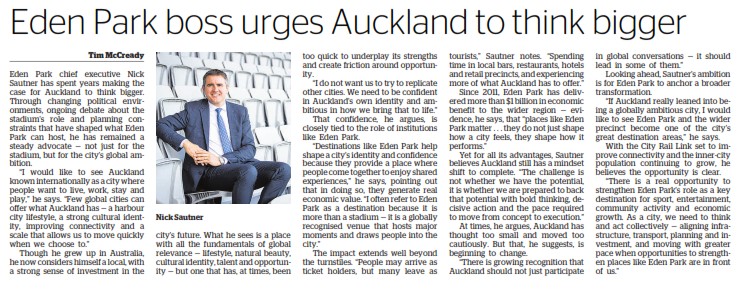
Eden Park chief executive Nick Sautner has spent years making the case for Auckland to think bigger. Through changing political environments, ongoing debate about the stadium’s role and planning constraints that have shaped what Eden Park can host, he has remained a steady advocate — not just for the stadium, but for the city’s global ambition.
“I would like to see Auckland known internationally as a city where people want to live, work, stay and play,” he says. “Few global cities can offer what Auckland has — a harbour city lifestyle, a strong cultural identity, improving connectivity and a scale that allows us to move quickly when we choose to.”
Though he grew up in Australia, he now considers himself a local, with a strong sense of investment in the city’s future. What he sees is a place with all the fundamentals of global relevance — lifestyle, natural beauty, cultural identity, talent and opportunity — but one that has, at times, been too quick to underplay its strengths and create friction around opportunity.
“I do not want us to try to replicate other cities. We need to be confident in Auckland’s own identity and ambitious in how we bring that to life.”
That confidence, he argues, is closely tied to the role of institutions like Eden Park.
“Destinations like Eden Park help shape a city’s identity and confidence because they provide a place where people come together to enjoy shared experiences,” he says, pointing out that in doing so, they generate real economic value. “I often refer to Eden Park as a destination because it is more than a stadium — it is a globally recognised venue that hosts major moments and draws people into the city.”
The impact extends well beyond the turnstiles. “People may arrive as ticket holders, but many leave as
tourists,” Sautner notes. “Spending time in local bars, restaurants, hotels and retail precincts, and experiencing more of what Auckland has to offer.”
Since 2011, Eden Park has delivered more than $1 billion in economic benefit to the wider region — evidence, he says, that “places like Eden Park matter . . . they do not just shape how a city feels, they shape how it performs.”
Yet for all its advantages, Sautner believes Auckland still has a mindset shift to complete. “The challenge is not whether we have the potential, it is whether we are prepared to back that potential with bold thinking, decisive action and the pace required to move from concept to execution.”
At times, he argues, Auckland has thought too small and moved too cautiously. But that, he suggests, is beginning to change.
“There is growing recognition that Auckland should not just participate in global conversations — it should lead in some of them.”
Looking ahead, Sautner’s ambition is for Eden Park to anchor a broader transformation.
“If Auckland really leaned into being a globally ambitious city, I would like to see Eden Park and the wider precinct become one of the city’s great destination areas,” he says.
With the City Rail Link set to improve connectivity and the inner-city population continuing to grow, he believes the opportunity is clear.
“There is a real opportunity to strengthen Eden Park’s role as a key destination for sport, entertainment, community activity and economic growth. As a city, we need to think and act collectively — aligning infrastructure, transport, planning and investment, and moving with greater pace when opportunities to strengthen places like Eden Park are in front of us.”

