
Fuel crisis tops NZ business leaders’ global concerns (NZ Herald)
Fuel crisis tops NZ business leaders’ global concerns (NZ Herald)
A year ago, tariffs and great-power rivalry dominated boardroom concerns. This year, the fuel crisis and oil prices have taken over.
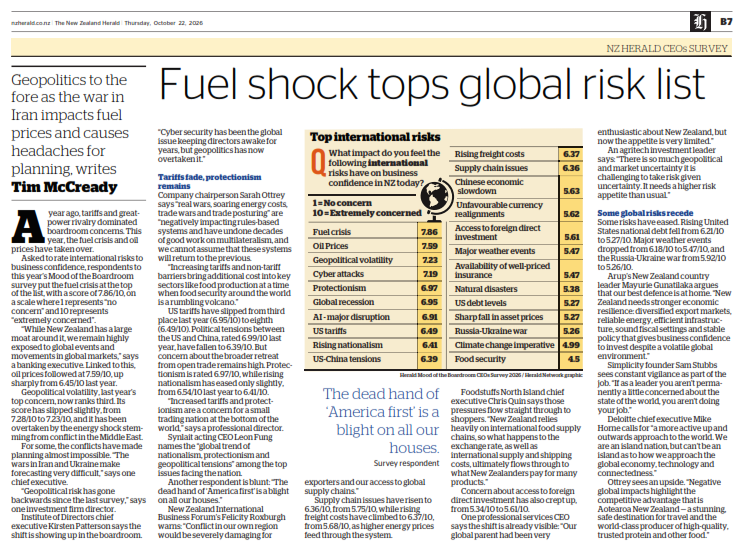
Asked to rate international risks to business confidence, respondents to this year’s Mood of the Boardroom survey put the fuel crisis at the top of the list, with a score of 7.86/10, on a scale where 1 represents “no concern” and 10 represents “extremely concerned”.
“While New Zealand has a large moat around it, we remain highly exposed to global events and movements in global markets,” says a banking executive. Linked to this, oil prices followed at 7.59/10, up sharply from 6.45/10 last year.
Geopolitical volatility, last year’s top concern, now ranks third. Its score has slipped slightly, from 7.28/10 to 7.23/10, and it has been overtaken by the energy shock stemming from conflict in the Middle East.
For some, the conflicts have made planning almost impossible. “The wars in Iran and Ukraine make forecasting very difficult,” says one chief executive.
“Geopolitical risk has gone backwards since the last survey,” says one investment firm director.
Institute of Directors chief executive Kirsten Patterson says the shift is showing up in the boardroom. “Cyber security has been the global issue keeping directors awake for years, but geopolitics has now overtaken it.”
Tariffs fade, protectionism remains
Company chair Sarah Ottrey says “real wars, soaring energy costs, trade wars and trade posturing” are “negatively impacting rules-based systems and have undone decades of good work on multilateralism, and we cannot assume that these systems will return to the previous.
“Increasing tariffs and non-tariff barriers bring additional cost into key sectors like food production at a time when food security around the world is a rumbling volcano.”
US tariffs have slipped from third place last year (6.95/10) to eighth (6.49/10). Political tensions between the US and China, rated 6.99/10 last year, have fallen to 6.39/10. But concern about the broader retreat from open trade remains high. Protectionism is rated 6.97/10, while rising nationalism has eased only slightly, from 6.54/10 last year to 6.41/10.
“Increased tariffs and protectionism are a concern for a small trading nation at the bottom of the world,” says a professional director.
Synlait acting CEO Leon Fung names the “global trend of nationalism, protectionism and geopolitical tensions” among the top issues facing the nation.
Another respondent is blunt: “The dead hand of ‘America first’ is a blight on all our houses.”
New Zealand International Business Forum’s Felicity Roxburgh warns: “Conflict in our own region would be severely damaging for exporters and our access to global supply chains.”
Supply chain issues have risen to 6.36/10, from 5.75/10, while rising freight costs have climbed to 6.37/10, from 5.68/10, as higher energy prices feed through the system.
Foodstuffs North Island chief executive Chris Quin says those pressures flow straight through to shoppers. “New Zealand relies heavily on international food supply chains, so what happens to the exchange rate, as well as international supply and shipping costs, ultimately flows through to what New Zealanders pay for many products.”
Concern about access to foreign direct investment has also crept up, from 5.34/10 to 5.61/10.
One professional services CEO says the shift is already visible: “Our global parent had been very enthusiastic about New Zealand, but now the appetite is very limited.”
An agritech investment leader says: “There is so much geopolitical and market uncertainty it is challenging to take risk given uncertainty. It needs a higher risk appetite than usual.”
Some global risks recede
Some risks have eased. Rising United States national debt fell from 6.21/10 to 5.27/10. Major weather events dropped from 6.18/10 to 5.47/10, and the Russia-Ukraine war from 5.92/10 to 5.26/10.
Arup’s New Zealand country leader Mayurie Gunatilaka argues that our best defence is at home. “New Zealand needs stronger economic resilience: diversified export markets, reliable energy, efficient infrastructure, sound fiscal settings and stable policy that gives business confidence to invest despite a volatile global environment.”
Simplicity founder Sam Stubbs sees constant vigilance as part of the job. “If, as a leader you aren’t permanently a little concerned about the state of the world, you aren’t doing your job.”
Deloitte chief executive Mike Horne calls for “a more active up and outwards approach to the world. We are an island nation, but can’t be an island as to how we approach the global economy, technology and connectedness.”
Ottrey sees an upside. “Negative global impacts highlight the competitive advantage that is Aotearoa New Zealand — a stunning, safe destination for travel and the world-class producer of high-quality, trusted protein and other food.”

