
Ministry of Awesome triples Christchurch footprint with new start-up hub
Ministry of Awesome triples Christchurch footprint with new start-up hub
Ministry of Awesome has tripled its Christchurch footprint. Chief executive Graham Scown tells Tim McCready he sees it as economic infrastructure needed by New Zealand’s start-ups.
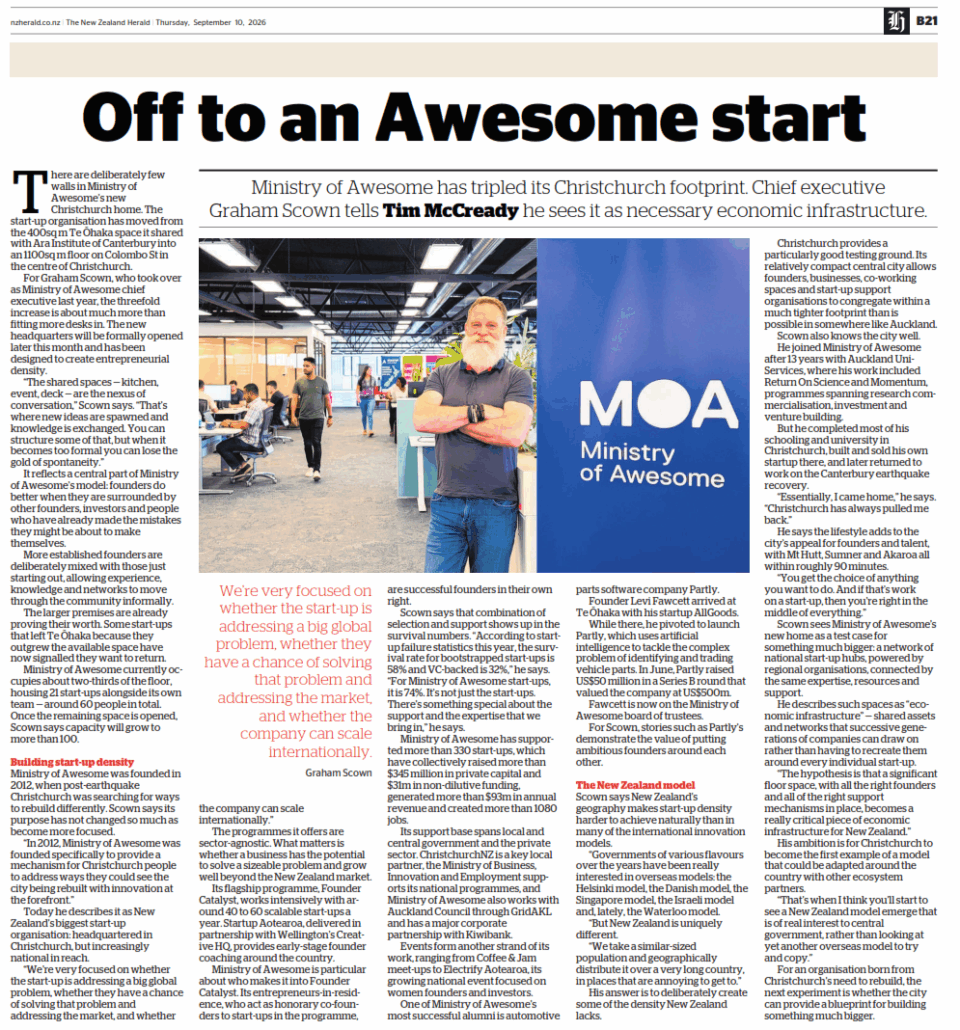
There are deliberately few walls in Ministry of Awesome’s new Christchurch home.
The start-up organisation has moved from the 400sq m Te Ōhaka space it shared with Ara Institute of Canterbury into an 1100sq m floor on Colombo St in the centre of Christchurch.
For Graham Scown, who took over as Ministry of Awesome chief executive last year, the threefold increase is about much more than fitting in more desks. The new headquarters will be formally opened later this month and has been designed to create entrepreneurial density.
“The shared spaces – kitchen, event, deck – are the nexus of conversation,” Scown says. “That’s where new ideas are spawned and knowledge is exchanged. You can structure some of that, but when it becomes too formal you can lose the gold of spontaneity.”
It reflects a central part of Ministry of Awesome’s model: founders do better when they are surrounded by other founders, investors and people who have already made the mistakes they might be about to make themselves.
More established founders are deliberately mixed with those just starting out, allowing experience, knowledge and networks to move through the community informally.
The larger premises are already proving their worth. Some start-ups that left Te Ōhaka because they outgrew the available space have now signalled they want to return.
Ministry of Awesome currently occupies about two-thirds of the floor, housing 21 start-ups alongside its own team – around 60 people in total. Once the remaining space is opened, Scown says capacity will grow to more than 100.
Building start-up density
Ministry of Awesome was founded in 2012, when post-earthquake Christchurch was searching for ways to rebuild differently. Scown says its purpose has not changed so much as become more focused.
“In 2012, Ministry of Awesome was founded specifically to provide a mechanism for Christchurch people to address ways they could see the city being rebuilt with innovation at the forefront.”
Today he describes it as New Zealand’s biggest start-up organisation: headquartered in Christchurch, but increasingly national in reach.
“We’re very focused on whether the start-up is addressing a big global problem, whether they have a chance of solving that problem and addressing the market, and whether the company can scale internationally.”
The programmes it offers are sector-agnostic. What matters is whether a business has the potential to solve a sizeable problem and grow well beyond the New Zealand market.
Its flagship programme, Founder Catalyst, works intensively with around 40 to 60 scalable start-ups a year. Startup Aotearoa, delivered in partnership with Wellington’s Creative HQ, provides early-stage founder coaching around the country.
Ministry of Awesome is particular about who makes it into Founder Catalyst. Its entrepreneurs-in-residence, who act as honorary co-founders to start-ups in the programme, are successful founders in their own right.
Scown says that combination of selection and support shows up in the survival numbers. “According to start-up failure statistics this year, the survival rate for bootstrapped start-ups is 58% and VC-backed is 32%,” he says. “For Ministry of Awesome start-ups, it is 74%.”
“It’s not just the start-ups. There’s something special about the support and the expertise that we bring in,” he says.
Ministry of Awesome has supported more than 330 start-ups, which have collectively raised more than $345 million in private capital and $31m in non-dilutive funding, generated more than $93m in annual revenue and created more than 1080 jobs.
Its support base spans local and central government and the private sector. ChristchurchNZ is a key local partner, the Ministry of Business, Innovation and Employment supports its national programmes, and Ministry of Awesome also works with Auckland Council through GridAKL and has a major corporate partnership with Kiwibank.
Events form another strand of its work, ranging from Coffee & Jam meet-ups to Electrify Aotearoa, its growing national event focused on women founders and investors.
One of Ministry of Awesome’s most successful alumni is automotive parts software company Partly.
Founder Levi Fawcett arrived at Te Ōhaka with his startup AllGoods. While there, he pivoted to launch Partly, which uses artificial intelligence to tackle the complex problem of identifying and trading vehicle parts. In June, Partly raised US$50 million in a Series B round that valued the company at US$500m.
Fawcett is now on the Ministry of Awesome board of trustees. For Scown, stories such as Partly’s demonstrate the value of putting ambitious founders around each other.
The New Zealand model
Scown says New Zealand’s geography makes start-up density harder to achieve naturally than in many of the international innovation models.
“Governments of various flavours over the years have been really interested in overseas models: the Helsinki model, the Danish model, the Singapore model, the Israeli model and, lately, the Waterloo model.
“But New Zealand is uniquely different. We take a similar-sized population and geographically distribute it over a very long country, in places that are annoying to get to.”
His answer is to deliberately create some of the density New Zealand lacks.
Christchurch provides a particularly good testing ground. Its relatively compact central city allows founders, businesses, co-working spaces and start-up support organisations to congregate within a much tighter footprint than is possible in somewhere like Auckland.
Scown also knows the city well. He joined Ministry of Awesome after 13 years with Auckland UniServices, where his work included Return On Science and Momentum, programmes spanning research commercialisation, investment and venture building.
But he completed most of his schooling and university in Christchurch, built and sold his own startup there, and later returned to work on the Canterbury earthquake recovery.
“Essentially, I came home,” he says. “Christchurch has always pulled me back.”
He says the lifestyle adds to the city’s appeal for founders and talent, with Mt Hutt, Sumner and Akaroa all within roughly 90 minutes.
“You get the choice of anything you want to do. And if that’s work on a start-up, then you’re right in the middle of everything.”
Scown sees Ministry of Awesome’s new home as a test case for something much bigger: a network of national start-up hubs, powered by regional organisations, connected by the same expertise, resources and support.
He describes such spaces as “economic infrastructure” – shared assets and networks that successive generations of companies can draw on rather than having to recreate them around every individual start-up.
“The hypothesis is that a significant floor space, with all the right founders and all of the right support mechanisms in place, becomes a really critical piece of economic infrastructure for New Zealand.”
His ambition is for Christchurch to become the first example of a model that could be adapted around the country with other ecosystem partners.
“That’s when I think you’ll start to see a New Zealand model emerge that is of real interest to central government, rather than looking at yet another overseas model to try and copy.”
For an organisation born from Christchurch’s need to rebuild, the next experiment is whether the city can provide a blueprint for building something much bigger.

