
Election policy uncertainty tops NZ CEOs’ concerns
Each year the Mood of the Boardroom asks CEOs to assess their level of concern about a range of domestic issues. This year, boardroom anxieties have shifted away from electricity and towards politics and the price of fuel.
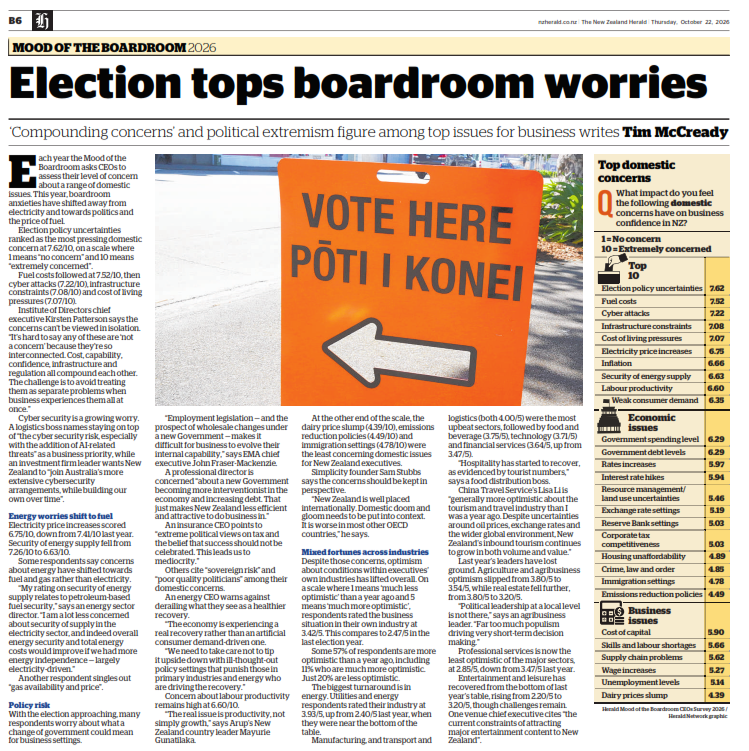
Election policy uncertainties ranked as the most pressing domestic concern at 7.62/10, on a scale where 1 means “no concern” and 10 means “extremely concerned”.
Fuel costs followed at 7.52/10, then cyber attacks (7.22/10), infrastructure constraints (7.08/10) and cost of living pressures (7.07/10).
Institute of Directors chief executive Kirsten Patterson says the concerns can’t be viewed in isolation.
“It’s hard to say any of these are ‘not a concern’ because they’re so interconnected. Cost, capability, confidence, infrastructure and regulation all compound each other. The challenge is to avoid treating them as separate problems when business experiences them all at once.”
Cyber security is a growing worry. A logistics boss names staying on top of “the cyber security risk, especially with the addition of AI-related threats” as a business priority, while an investment firm leader wants New Zealand to “join Australia’s more extensive cybersecurity arrangements, while building our own over time”.
Energy worries shift to fuel
Electricity price increases scored 6.75/10, down from 7.41/10 last year. Security of energy supply fell from 7.26/10 to 6.63/10.
Some respondents say concerns about energy have shifted towards fuel and gas rather than electricity.
“My rating on security of energy supply relates to petroleum-based fuel security,” says an energy sector director. “I am a lot less concerned about security of supply in the electricity sector, and indeed overall energy security and total energy costs would improve if we had more energy independence — largely electricity-driven.”
Another respondent singles out “gas availability and price”.
Policy risk
With the election approaching, many respondents worry about what a change of government could mean for business settings.
“Employment legislation — and the prospect of wholesale changes under a new Government — makes it difficult for business to evolve their internal capability,” says EMA chief executive John Fraser-Mackenzie.
A professional director is concerned “about a new Government becoming more interventionist in the economy and increasing debt. That just makes New Zealand less efficient and attractive to do business in.”
An insurance CEO points to “extreme political views on tax and the belief that success should not be celebrated. This leads us to mediocrity.”
Others cite “sovereign risk” and “poor quality politicians” among their domestic concerns.
An energy CEO warns against derailing what they see as a healthier recovery.
“The economy is experiencing a real recovery rather than an artificial consumer demand-driven one.
“We need to take care not to tip it upside down with ill-thought-out policy settings that punish those in primary industries and energy who are driving the recovery.”
Concern about labour productivity remains high at 6.60/10.
“The real issue is productivity, not simply growth,” says Arup’s New Zealand country leader Mayurie Gunatilaka.
At the other end of the scale, the dairy price slump (4.39/10), emissions reduction policies (4.49/10) and immigration settings (4.78/10) were the least concerning domestic issues for New Zealand executives.
Simplicity founder Sam Stubbs says the concerns should be kept in perspective.
“New Zealand is well placed internationally. Domestic doom and gloom needs to be put into context. It is worse in most other OECD countries,” he says.
Mixed fortunes across industries
Despite those concerns, optimism about conditions within executives’ own industries has lifted overall. On a scale where 1 means ‘much less optimistic’ than a year ago and 5 means ‘much more optimistic’, respondents rated the business situation in their own industry at 3.42/5. This compares to 2.47/5 in the last election year.
Some 57% of respondents are more optimistic than a year ago, including 11% who are much more optimistic. Just 20% are less optimistic.
The biggest turnaround is in energy. Utilities and energy respondents rated their industry at 3.93/5, up from 2.40/5 last year, when they were near the bottom of the table.
Manufacturing, and transport and logistics (both 4.00/5) were the most upbeat sectors, followed by food and beverage (3.75/5), technology (3.71/5) and financial services (3.64/5, up from 3.47/5).
“Hospitality has started to recover, as evidenced by tourist numbers,” says a food distribution boss.
China Travel Service’s Lisa Li is “generally more optimistic about the tourism and travel industry than I was a year ago. Despite uncertainties around oil prices, exchange rates and the wider global environment, New Zealand’s inbound tourism continues to grow in both volume and value.”
Last year’s leaders have lost ground. Agriculture and agribusiness optimism slipped from 3.80/5 to 3.54/5, while real estate fell further, from 3.80/5 to 3.20/5.
“Political leadership at a local level is not there,” says an agribusiness leader. “Far too much populism driving very short-term decision making.”
Professional services is now the least optimistic of the major sectors, at 2.85/5, down from 3.47/5 last year.
Entertainment and leisure has recovered from the bottom of last year’s table, rising from 2.20/5 to 3.20/5, though challenges remain. One venue chief executive cites “the current constraints of attracting major entertainment content to New Zealand”.

