
Business confidence hits nine-year high
Business confidence hits nine-year high
New Zealand’s top business leaders have rediscovered their optimism about the domestic economy. Confidence has climbed past the nine-year high recorded in 2024.
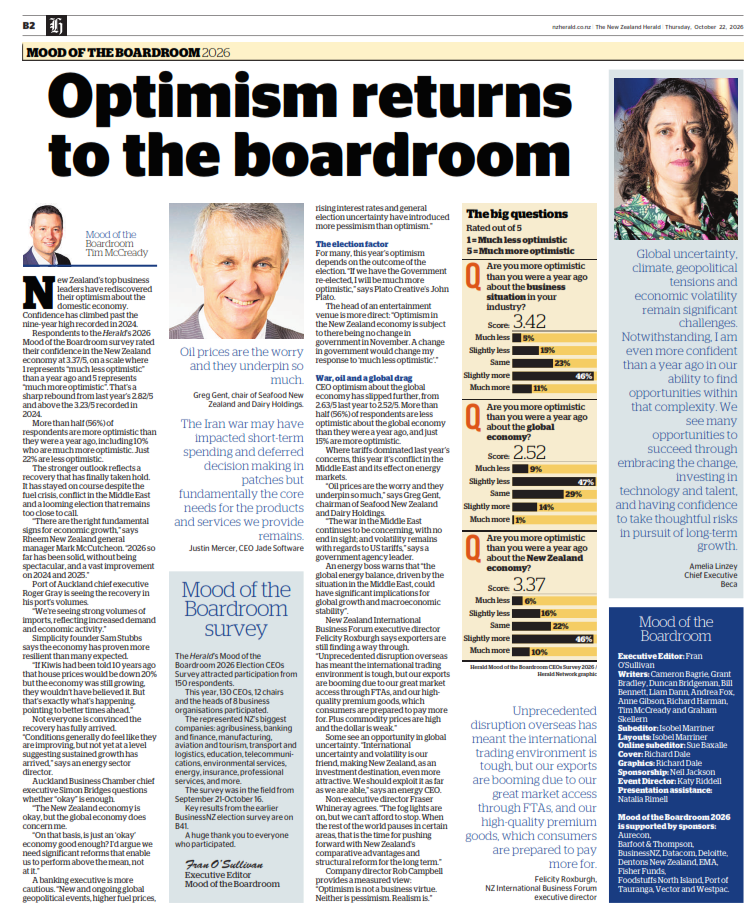
Respondents to the Herald’s 2026 Mood of the Boardroom survey rated their confidence in the New Zealand economy at 3.37/5, on a scale where 1 represents “much less optimistic” than a year ago and 5 represents “much more optimistic”. That’s a sharp rebound from last year’s 2.82/5 and above the 3.23/5 recorded in 2024.
More than half (56%) of respondents are more optimistic than they were a year ago, including 10% who are much more optimistic. Just 22% are less optimistic.
The stronger outlook reflects a recovery that has finally taken hold. It has stayed on course despite the fuel crisis, conflict in the Middle East and a looming election that remains too close to call.
“There are the right fundamental signs for economic growth,” says Rheem New Zealand general manager Mark McCutcheon. “2026 so far has been solid, without being spectacular, and a vast improvement on 2024 and 2025.”
Port of Auckland chief executive Roger Gray is seeing the recovery in his port’s volumes.
“We’re seeing strong volumes of imports, reflecting increased demand and economic activity.”
Simplicity founder Sam Stubbs says the economy has proven more resilient than many expected.
“If Kiwis had been told 10 years ago that house prices would be down 20% but the economy was still growing, they wouldn’t have believed it. But that’s exactly what’s happening, pointing to better times ahead.”
Not everyone is convinced the recovery has fully arrived. “Conditions generally do feel like they are improving, but not yet at a level suggesting sustained growth has arrived,” says an energy sector director.
Auckland Business Chamber chief executive Simon Bridges questions whether “okay” is enough.
“The New Zealand economy is okay, but the global economy does concern me …
“On that basis, is just an ‘okay’ economy good enough? I’d argue we need significant reforms that enable us to perform above the mean, not at it.”
A banking executive is more cautious. “New and ongoing global geopolitical events, higher fuel prices, rising interest rates and general election uncertainty have introduced more pessimism than optimism.”
The election factor
For many, this year’s optimism depends on the outcome of the election. “If we have the Government re-elected, I will be much more optimistic,” says Plato Creative’s John Plato.
The head of an entertainment venue is more direct: “Optimism in the New Zealand economy is subject to there being no change in government in November. A change in government would change my response to ‘much less optimistic’.”
War, oil and a global drag
CEO optimism about the global economy has slipped further, from 2.63/5 last year to 2.52/5. More than half (56%) of respondents are less optimistic about the global economy than they were a year ago, and just 15% are more optimistic.
Where tariffs dominated last year’s concerns, this year it’s conflict in the Middle East and its effect on energy markets.
“Oil prices are the worry and they underpin so much,” says Greg Gent, chairman of Seafood New Zealand and Dairy Holdings.
“The war in the Middle East continues to be concerning, with no end in sight; and volatility remains with regards to US tariffs,” says a government agency leader.
An energy boss warns that “the global energy balance, driven by the situation in the Middle East, could have significant implications for global growth and macroeconomic stability”.
New Zealand International Business Forum executive director Felicity Roxburgh says exporters are still finding a way through.
“Unprecedented disruption overseas has meant the international trading environment is tough, but our exports are booming due to our great market access through FTAs, and our high-quality premium goods, which consumers are prepared to pay more for. Plus commodity prices are high and the dollar is weak.”
Some see an opportunity in global uncertainty. “International uncertainty and volatility is our friend, making New Zealand, as an investment destination, even more attractive. We should exploit it as far as we are able,” says an energy CEO.
Non-executive director Fraser Whineray agrees. “The fog lights are on, but we can’t afford to stop. When the rest of the world pauses in certain areas, that is the time for pushing forward with New Zealand’s comparative advantages and structural reform for the long term.”
Company director Rob Campbell provides a measured view: “Optimism is not a business virtue. Neither is pessimism. Realism is.”

